
The Landscape of Data Center Projects
Data center project management is the discipline of applying knowledge, skills, and tools to infrastructure projects to meet requirements on time and on budget. It covers everything from planning new builds and migrations to executing power upgrades and decommissioning assets.
With the exponential growth in data demand, every new facility is a complex, high-value undertaking. Delays can mean millions in lost revenue, and budget overruns can cripple profitability. The stakes are high, as most project defects stem from early planning decisions or deployment flaws. Without a standardized approach, projects face higher costs, wasted time, and reduced quality.
I’m Dave Brocious, and with over 30 years in complex infrastructure projects, I’ve seen how critical proper data center project management is. At Sky Point Crane, we support data center builds across Western Pennsylvania by providing the specialized lifting, rigging, and logistics that keep these mission-critical projects on schedule.
Know your Data center project management terms:
Behind every seamless cloud service lies a labyrinth of complex infrastructure projects. For modern businesses, effective data center project management is a strategic imperative to ensure our digital backbone is robust, scalable, and delivered efficiently.

Common Types of Data Center Projects
The dynamic world of data centers involves a wide variety of projects, including:
- New Site Builds: Establishing entirely new facilities from groundwork to full operation.
- Migrations: Moving existing IT infrastructure and data to a new location with minimal downtime.
- Consolidations: Merging multiple IT rooms into fewer, more efficient facilities.
- Network Installations: Deploying or upgrading network connectivity, including fiber and switches.
- Power Upgrades: Enhancing electrical capacity with new UPS systems, generators, and switchgear.
- Component Upgrades: Replacing hardware like servers, storage, or cooling units for better performance.
- Decommissioning: Systematically dismantling and removing obsolete assets and infrastructure.
- Server Installations: Deploying and integrating new server racks.
- Edge Computing Sites: Building smaller, distributed data centers to reduce latency.
The High Cost of Inefficiency: Common Project Challenges
The lack of a standardized approach leads to common, costly problems:
- Manual Processes and Disparate Tools: Juggling spreadsheets, forms, and ticketing systems leads to fragmented data and what’s known as “swivel chair” management.
- Error-Prone Data: Manual entry increases mistakes, affecting everything from inventory to capacity planning.
- Budget Overruns and Schedule Delays: Without real-time oversight, projects often exceed budgets and timelines.
- Reduced Quality and Poor Documentation: Inconsistent processes result in poor quality and difficult future maintenance.
- Inadequate Testing: Rushed projects may skip critical testing, leading to service degradation or outages.
These issues underscore why efficient project management is the cornerstone of success in data center construction.
The Data Center Project Lifecycle: A Standardized Approach
A standardized, process-driven methodology for data center project management is an insurance policy against budget overruns, schedule delays, and costly defects. Following a tested approach allows projects to be delivered faster and more affordably, changing chaos into a predictable and manageable process.

A well-defined project lifecycle allows teams to plan carefully, execute with confidence, and catch potential problems before they become expensive disasters.
The Four Key Phases of a Data Center Project
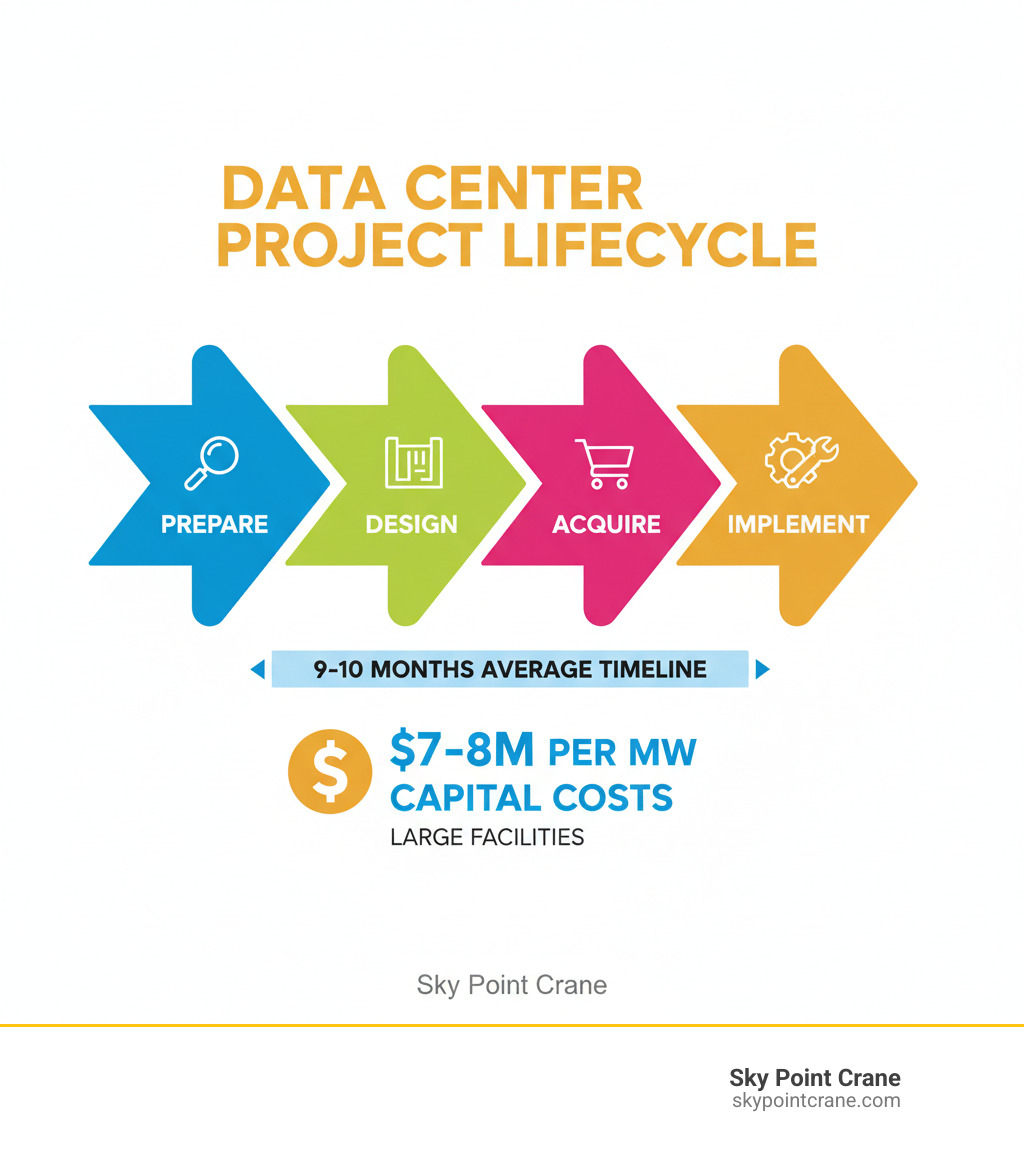
Every successful data center project moves through four distinct phases, each building on the last.
- The Prepare Phase: This is where the “what” and “why” are established. It involves assessing business needs, defining success, and finalizing the project scope, budget, location, and regulatory requirements. Clear answers here prevent confusion and rework later.
- The Design Phase: Requirements are turned into detailed blueprints. This includes planning power and cooling capacities, selecting hardware, and designing the network infrastructure. Since most downstream problems start with design flaws, this stage is critical.
- The Acquire Phase: With the design locked in, the team procures all necessary equipment, materials, and services. This involves engaging contractors, managing supply chains, and ensuring timely delivery of components like generators, UPS systems, and racks.
- The Implement Phase: Plans become reality through physical construction and installation. This phase includes groundwork, building construction, and installing electrical, mechanical, and IT systems. It concludes with rigorous testing, commissioning, and the final handover of the operational data center.
For a deeper look at how these stages work, see this guide to standardized processes.
Why a Standardized Methodology is Crucial for Success
In an industry where an hour of downtime can cost hundreds of thousands of dollars, a standardized methodology is non-negotiable. It delivers:
- Faster Delivery: Avoids reinventing the wheel for each project.
- Reduced Expenses: Optimizes resource allocation and minimizes rework.
- Fewer Defects: Bakes quality checks into every stage.
This approach creates predictability, enabling better decision-making and scalable success. It also eliminates responsibility gaps by clearly defining ownership for every step, preventing dropped balls and finger-pointing. Without standardization, you invite reduced quality, higher costs, wasted time, and poor documentation. This disciplined approach is central to our construction project management services and how we support data center builds.
Assembling Your Elite Data Center Project Team
A data center project requires an elite crew of experts working in sync to handle the unique pressures of data center project management. Assembling the right team is critical, as these projects demand a rare combination of technical depth and practical experience with infrastructure that cannot fail.

Essential Roles and Specialized Skills
A successful data center project needs a core team of professionals with both technical and real-world experience:
- Project Manager: The conductor of the orchestra, responsible for planning, execution, budget, and schedule. This role requires specific experience in data center construction. Learn more about the project manager for construction company.
- Construction Manager: Owns the day-to-day site reality, coordinating subcontractors and ensuring work matches blueprints.
- Electrical & Mechanical Engineers: Design the lifeblood systems—power distribution, backup generators, UPS systems, and sophisticated cooling solutions.
- Network Engineers: Build the communication backbone of high-speed cabling, switches, and routers.
- Commissioning Agent: An independent expert who validates that all systems perform as designed before completion.
- Specialized Contractors: Handle physical construction, including fire suppression, security, and heavy lifting. Teams like ours at Sky Point Crane provide the critical rigging and lifting for multi-ton generators and cooling towers across Pennsylvania, Ohio, West Virginia, and Maryland.
Beyond technical skills, the best teams communicate openly, adapt to challenges, and stay current with evolving technology.
The Importance of Certified and Skilled Labor
Excellent plans are useless without properly trained and certified people to execute them, especially for the heavy lifting and precision installation required in data center construction.
At Sky Point Crane, we insist that our crane operators are NCCCO certified, having passed rigorous national safety and operational standards. When lifting expensive equipment over sensitive infrastructure, proven expertise is non-negotiable. Similarly, our certified riggers understand the physics of moving heavy loads safely. They plan every movement to the inch, as a single mistake can lead to damaged equipment or catastrophic delays. Understanding the importance of certified riggers is crucial.
Comprehensive crane safety protocols are requirements we live by, as a safe site is a productive site. Our teams also engage in continuous learning to stay current with the latest industry methodologies. Investing in certified, skilled labor ensures faster delivery, reduced risk, and higher quality outcomes. It means building your critical infrastructure with professionals who know there’s no room for “close enough” in data center project management.
The Modern Toolkit for Effective Data Center Project Management
Managing a multi-million dollar data center project with spreadsheets is no longer viable. Modern data center project management relies on sophisticated software to turn complexity into clarity, creating visibility and improving accuracy for the entire team.

Leveraging DCIM and Project Management Platforms
Data Center Infrastructure Management (DCIM) software was designed to eliminate the “swivel chair” problem of jumping between disparate tools. It consolidates workflows into a unified platform, creating a single source of truth for tracking space, power, cooling, assets, and costs.
This real-time data access improves collaboration, as all team members work from the same plan. DCIM platforms also excel at SLA tracking and KPI reporting, changing reactive management into proactive problem-solving. The data-driven insights lead to smarter decisions throughout the project lifecycle. For more on this, see the whitepaper on project controls for data center success.
The Role of BIM and 3D Lift Planning in Data Center Construction
While DCIM manages operations, Building Information Modeling (BIM) and 3D Lift Planning tackle physical construction challenges.
BIM software creates a complete digital twin of the data center before construction begins. It integrates architectural, structural, mechanical, and electrical plans into one model, allowing teams to identify and resolve conflicts—like a duct running into a power conduit—while they are still pixels on a screen. This improved data visibility makes coordination exponentially easier.
For our team at Sky Point Crane, 3D Lift Planning software is a game-changer for heavy equipment installation. Lifting a 40-ton generator requires zero improvisation. Our advanced 3D Lift Planning software allows us to simulate the entire operation beforehand. We can visualize the lift, identify obstructions, and determine the exact crane and rigging configuration needed, which is critical for tight job sites in Western Pennsylvania, Ohio, and West Virginia.
This detailed planning ensures safety and efficiency. Our 3D Lift Plan Ultimate Guide details this process, and you can learn more about crane use for building data centers on our site. Combining these technologies creates an ecosystem that helps deliver projects safely, on time, and on budget.
Advanced Methodologies in Data Center Project Management
As data centers grow in scale, data center project management requires sophisticated approaches that view the entire lifecycle holistically and apply specialized techniques for critical infrastructure.

Understanding Complete Asset Lifecycle Management
Complete asset lifecycle management connects all project phases—from site origination and construction to operations and decommissioning—into one continuous journey. This holistic approach breaks down silos between teams and ensures that decisions made during construction, for example, consider long-term operational and maintenance impacts.
By managing the entire lifecycle, from site origination and permitting through construction and commissioning to operations and maintenance, teams can make smarter, data-driven decisions. Modern platforms create a single source of truth that integrates developers, operators, and contractors, reducing risk and improving efficiency.
Core Methodologies for Certified Data Center Project Management
Specialized training, such as the Certified Data Center Project Management (CDCPM®) program, is essential for managing mission-critical facilities. These advanced methodologies include:
- Work Breakdown Structure (WBS): Breaks a complex project into smaller, manageable components to improve planning, cost estimation, and progress tracking.
- Critical Path Analysis (CPA): Identifies the sequence of tasks that determine the project duration, allowing teams to focus resources on activities that cannot be delayed.
- Earned Value Management (EVM): Integrates scope, cost, and schedule to provide an objective measure of project performance and forecast outcomes.
- Risk Management: Systematically identifies potential risks (e.g., power failures, supply chain issues) and develops proactive contingency plans.
- Scope Development and Control: Prevents “scope creep” by establishing clear boundaries and a disciplined change management process.
Understanding these methodologies helps our construction and rigging teams better coordinate with project managers, ensuring our specialized lifting services are delivered precisely when needed.
Frequently Asked Questions about Data Center Project Management
Here are answers to the most common questions we hear about managing complex data center projects.
What is data center project management?
Data center project management is the specialized practice of applying knowledge, skills, and tools to infrastructure projects to ensure they meet requirements on schedule and within budget. It involves orchestrating everything needed to build, upgrade, or maintain the physical and IT backbone of our digital world, from new site builds and migrations to power upgrades and server installations. Because downtime in these facilities can cost millions, specialized management expertise is essential.
What are the biggest challenges in data center projects?
The biggest challenges stem from complexity, coordination, and the high-stakes environment. Key issues include:
- Managing Complex Dependencies: Data centers are intricate ecosystems where a delay in one area (e.g., electrical) can cause a domino effect across the entire project.
- Coordinating Diverse Teams: Aligning electrical, mechanical, network, and construction specialists requires constant, clear communication.
- Controlling Budgets and Schedules: With capital costs averaging $7-8 million per megawatt, there is immense pressure to prevent overruns and delays.
- Mitigating Risk in Live Environments: Many projects involve working around operational infrastructure, where any misstep could cause a costly outage.
- Rapid Technological Change: Projects must align with current best practices while often integrating with legacy systems.
What is the first step in planning a data center project?
The first and most critical step is a thorough assessment of business needs to define project requirements. Rushing this phase is a common cause of project failure. This assessment should clarify:
- The “Why”: What business goals does the project support (e.g., capacity growth, improved efficiency, regulatory compliance)?
- Technical Requirements: What level of criticality, redundancy, and resilience is needed to maintain uptime?
- Constraints: What is the budget? What are the location’s limitations regarding power, fiber, and labor? What regulations must be met?
- Growth Plan: How will the facility scale over the next five to ten years?
The Planning and Design Considerations for Data Centers report confirms that most defects stem from decisions made in this early planning phase. Getting it right from the start is the foundation for success.
Conclusion
Effective data center project management is the foundation that supports our digital world. Success hinges on three key elements: embracing standardized processes, assembling skilled teams, and leveraging modern technology like DCIM and BIM. When these components align, complex projects become well-orchestrated operations.
Data consumption continues to drive demand for new and upgraded data centers across Western and Central Pennsylvania, Ohio, West Virginia, and Maryland. Each project is a chance to build the future, but it must be done efficiently to avoid costly delays and budget overruns.
At Sky Point Crane, we specialize in supporting these critical infrastructure builds. Our NCCCO certified operators and certified riggers provide the precision and safety needed for heavy lifting and equipment installation, ensuring your data center project management efforts stay on track. With our commitment to safety and advanced tools like 3D Lift Planning, we handle the heavy lifting so you can focus on the bigger picture.
Ready to discuss how we can support your next data center project? Contact us for expert crane services and let’s build the future together.