
All Terrain Crane Hire: For When Life Throws You a Curveball
When Only One Crane Can Do It All: A Guide to All-Terrain Crane Hire
All terrain crane hire is the go-to solution when your job site demands both highway mobility and serious off-road lifting power — without the cost of running two separate machines.
Here’s what you need to know at a glance:
| Question | Quick Answer |
|---|---|
| What is it? | Renting a multi-axle crane that travels on public roads and handles rugged terrain |
| Typical capacity | 50 to 500 tons |
| Best for | Construction, wind energy, oil & gas, infrastructure, tight urban sites |
| What’s included | Usually operator, lift planning, rigging, and transport logistics |
| Cost factors | Crane size, job duration, location, and operator inclusion |
| Setup time | Fast — no major site construction required |
Most crane types force a trade-off. Rough terrain cranes handle the mud but can’t travel highways. Truck cranes cruise the roads but struggle on uneven ground. All-terrain cranes are built to do both — and that’s exactly what makes them so valuable on complex, real-world job sites.
Whether you’re installing a wind turbine, placing a rooftop HVAC unit, or lifting heavy precast concrete in a tight spot, the right all-terrain crane can save you time, reduce transport costs, and keep your project moving.
I’m Dave Brocious, and with over 30 years of experience in business development and operations — including leading the Sky Point Crane team through countless complex all terrain crane hire projects across Western Pennsylvania and beyond — I’ve seen what separates a smooth lift from a costly delay. Let’s break down everything you need to know to make the right call for your next project.
Understanding All-Terrain Cranes: The Hybrid Powerhouse
When we talk about an “all-terrain” (AT) crane, we are talking about the Swiss Army knife of the lifting world. These machines are engineered to bridge the gap between high-speed highway travel and rugged, off-road performance. At Sky Point Crane, we often recommend all terrain crane hire because these units offer a hybrid mobility that is hard to beat.
Unlike specialized machines that need to be hauled on a trailer to every site, an AT crane can drive itself to the job at highway speeds. Once it arrives, its all-wheel drive and multi-axle suspension allow it to navigate through the mud, loose gravel, and uneven surfaces common in West Virginia oilfields or Pennsylvania construction zones.

If your project is located entirely off-road and involves staying in one spot for months, you might consider rough terrain crane options. However, if you need a machine that can jump from a paved road onto a rocky job site and start lifting within the hour, the AT crane is your powerhouse.
How They Differ from Mobile Cranes
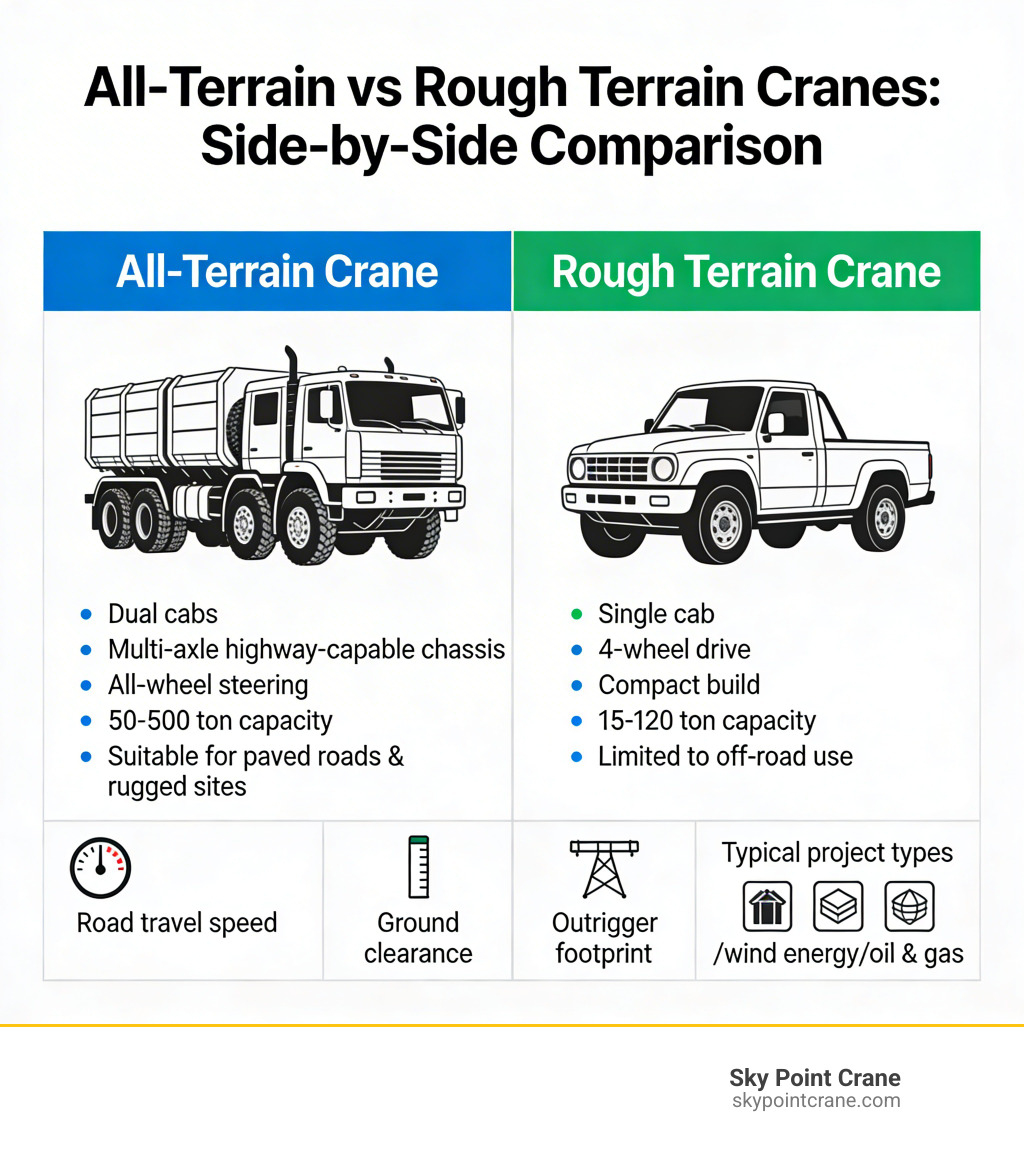
The term “mobile crane” is a broad umbrella, but all-terrain cranes are a very specific, high-tech subset. The biggest difference lies in the chassis technology and the dual-cab design.
A standard truck crane is essentially a crane mounted on a commercial truck chassis. It’s great for the road but can’t handle a pothole, let alone a muddy construction site. All-terrain cranes, however, feature a custom-built, multi-axle chassis with sophisticated suspension systems. They also utilize two cabs: one for driving (the carrier cab) and one for operating the crane (the superstructure cab). This allows for better ergonomics and specialized control during the lift. For projects requiring massive reach but less off-road capability, you might look into our Lattice Boom Truck Crane Guide.
All Terrain Crane Hire vs. Rough Terrain
A common question we get in Pittsburgh and Maryland is: “Why not just use a rough terrain (RT) crane?”
RT cranes are fantastic for “pick-and-carry” operations—meaning they can move while holding a load. They have a compact footprint and high ground clearance. However, RT cranes are not road-legal. You have to pay for a separate truck and trailer to move them. All terrain crane hire eliminates that extra transport cost because the crane is its own transport. Additionally, AT cranes typically offer much higher lifting capacities (up to 500 tons or more) compared to the smaller RT units. If you are working in an even tighter space, such as a warehouse interior, you might want to compare with a carry deck crane for those specific indoor needs.
Key Benefits of All Terrain Crane Hire for Complex Projects
The beauty of the all-terrain crane is its versatility. In our service areas across Ohio and West Virginia, we see projects that change conditions daily. One day you’re on a paved lot; the next, you’re in a trench.
One of the primary benefits is rapid deployment. Because these cranes travel at highway speeds, we can get them to your site quickly—sometimes even for 24-hour emergency services. Once there, the setup efficiency is remarkable. Modern AT cranes feature automated outrigger leveling and quick-assembly counterweight systems. To see these machines in action, explore Sky Point Crane’s all-terrain services.
Versatility Across Diverse Environments
We’ve deployed AT cranes for a wide variety of industries:
- Infrastructure: Setting bridge girders on highway projects.
- Energy Sector: Maintaining wind farms or installing components in oilfields.
- Urban Centers: Navigating the tight streets of downtown Pittsburgh to lift HVAC units.
- Industrial: Moving heavy machinery into industrial storage solutions.
Superior Maneuverability in Tight Quarters
Don’t let the size of a 300-ton crane fool you. These machines are incredibly nimble. Thanks to all-wheel steering (including “crab steering”), they can move sideways or diagonally into position.
Modern units often feature VarioBase® technology, which allows each outrigger to be extended to a different length. This is a game-changer when you’re working between two buildings or on a narrow road where you can’t fully extend every support. For even smaller jobs where space is at an absolute premium, check out our Mini Crane Rental Guide.
Technical Specifications: Lifting Capacity and Reach
When you are planning a lift, the “specs” are everything. You need to know if the crane can reach the height and hold the weight.
| Crane Class | Max Capacity | Max Boom Length | Common Use Case |
|---|---|---|---|
| Light AT | 40 – 60 Tons | 100 – 130 ft | Residential, small HVAC, light steel |
| Medium AT | 90 – 130 Tons | 150 – 200 ft | Cell towers, bridge work, industrial |
| Heavy AT | 250 – 500 Tons | 250+ ft | Wind turbines, heavy infrastructure |
At Sky Point Crane, we maintain a diverse fleet to ensure we have the right tool for the job. You can view our full equipment fleet to see the specific models we have available for your region.
Boom Length and Reach Capabilities
Most all-terrain cranes utilize a telescopic boom system. This allows for a compact profile during travel but massive reach once deployed. Many of our units, like the Liebherr LTM series, feature hydro-mechanical telescoping that can extend under load. If you need even more height, we can add jib extensions to reach heights of over 300 feet. For smaller, more localized lifts, a boom truck crane might be a lighter alternative.
Heavy Lifting Performance
For the really big stuff—like 500-ton Tadano or Liebherr units—the performance is staggering. These cranes use heavy ballast (counterweights) that are transported separately but quickly attached on-site. With high-torque engines and sophisticated LICCON3 or similar control systems, these cranes offer the precision needed for “critical lifts” where there is zero margin for error. Learn more about our heavy lift capabilities and how we handle these massive loads.
Planning Your Lift: Selection Factors and Safety
We don’t just “drop off” a crane. At Sky Point Crane, we believe the lift begins long before the crane arrives on site. Choosing the right all terrain crane hire involves looking at ground conditions, site access, and the lift radius.
One of our signature services is Engineered 3D Lift Planning. This allows us to simulate the entire lift in a virtual environment. We can see exactly how the crane will sit, where the outriggers will land, and if there are any overhead obstructions like power lines or trees.
Safety Measures and Certifications
Safety isn’t just a buzzword for us; it’s our culture. Every operator we employ is NCCCO certified. This means they have undergone rigorous testing and practical exams to ensure they can handle these complex machines safely. We also ensure all our equipment is OSHA compliant and undergoes regular, documented maintenance. You can read more about our commitment to Safety and Health Standards on our dedicated safety page.
Professional Rigging and Support
A crane is only as good as the team supporting it. Our all terrain crane hire services often include more than just the machine. We provide:
- Certified Riggers: To ensure the load is balanced and secured.
- Signal Persons: To communicate clearly with the operator.
- Field Technicians: To handle on-site logistics.
- Transport Logistics: Managing the move of counterweights and jibs.
For a full breakdown of these essential roles, visit our Rigging and Signal Person Services page.
Frequently Asked Questions about All Terrain Crane Hire
How much does all terrain crane hire cost?
The cost of all terrain crane hire depends on several variables. The primary factors include the capacity of the crane (a 500-ton crane costs more than a 50-ton crane), the duration of the rental (daily, weekly, or monthly), and the distance of the job site from our depots in Pittsburgh or West Virginia. Other costs include “mobilization fees” for transporting counterweights and whether you require a “wet hire” (including an operator) or a “dry hire” (machine only, though most high-capacity AT cranes require a certified operator from the rental company).
How quickly can a crane be mobilized to my site?
Because AT cranes can travel at highway speeds (up to 50-55 mph), we can mobilize them very quickly. We offer 24/7 availability for emergency situations. For a standard planned lift, we typically like a few days’ notice to perform site assessments and 3D lift planning, but in a pinch, we can move remarkably fast.
What is included in a serviced all terrain crane hire?
When you choose a “serviced” or “wet” hire from Sky Point Crane, you get a comprehensive package. This includes the NCCCO-certified operator, the fuel, the insurance coverage, and the initial lift planning. We can also provide the rigging equipment (slings, shackles, spreader bars) and the personnel to manage the ground-level operations.
Conclusion
Life—and construction projects—will always throw you curveballs. Whether it’s a sudden change in terrain, a tight deadline, or a massive load that needs to be placed with surgical precision, all terrain crane hire provides the flexibility you need to stay on track.
At Sky Point Crane, we are proud to serve Western and Central Pennsylvania, Ohio, West Virginia, and Maryland with top-tier lifting solutions. Our blend of modern equipment, NCCCO-certified expertise, and 24/7 service makes us the trusted partner for the region’s most challenging projects.
Ready to get your project off the ground? We’re here to help you plan every detail. Request a Quote for Sky Point Crane Services today and let’s get to work.