
Why Smart Project Managers Explore Their Crane Rental Options
Crane rental options give you access to specialized heavy lifting equipment without the massive capital investment of ownership. When you need to hoist materials, install rooftop equipment, or tackle a major construction project, renting provides flexibility to match the right crane to your specific job requirements—whether that’s a compact mini crawler for tight indoor spaces or a 200-ton rough terrain crane for major infrastructure work.
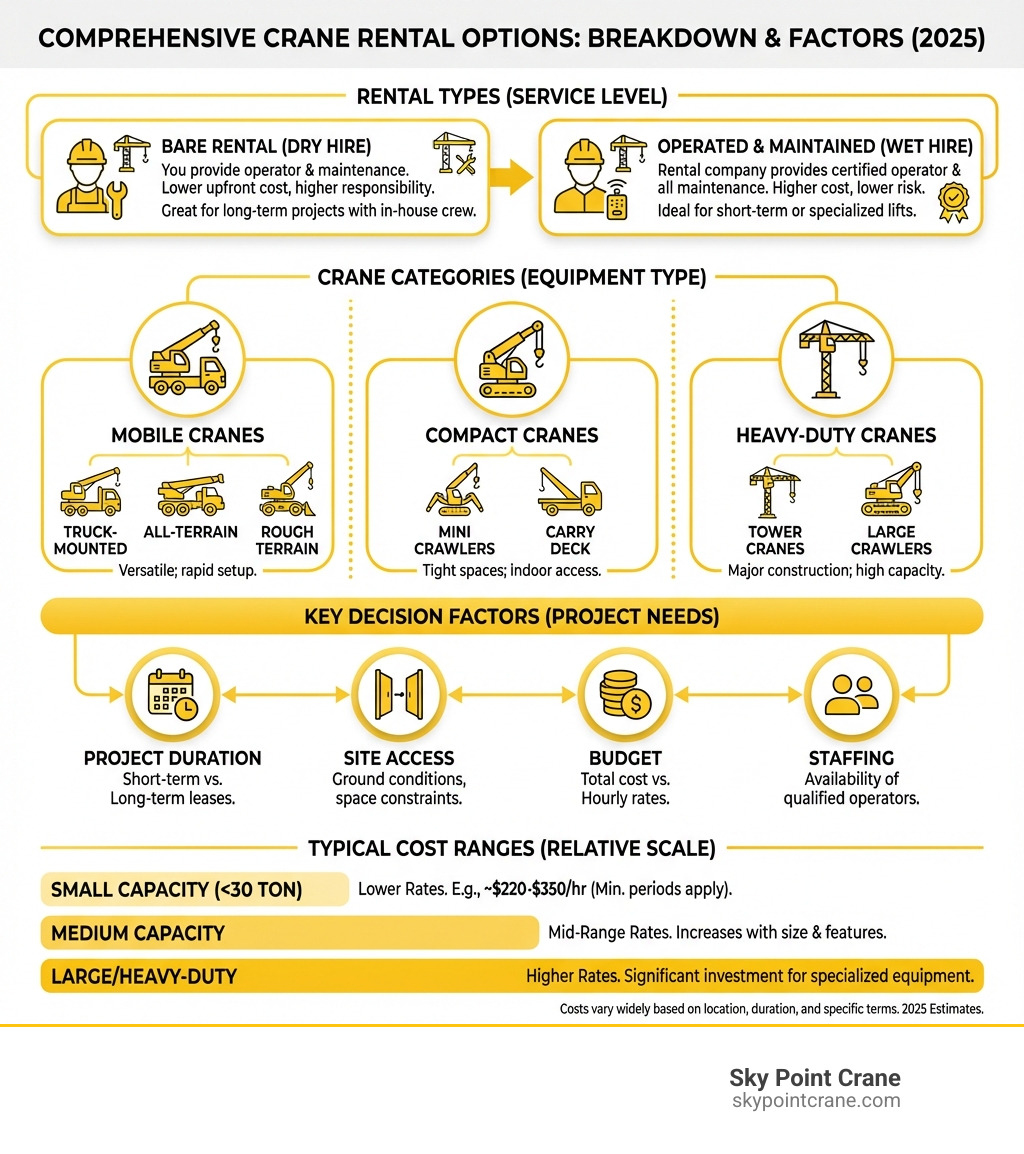
Your main crane rental choices include:
- Bare Rental (Dry Hire) – You provide the operator and handle maintenance
- Operated & Maintained (Wet Hire) – Rental company provides certified operators and all maintenance
- Mobile Cranes – Truck-mounted, all-terrain, and rough terrain models for versatile applications
- Compact Cranes – Mini crawlers and carry deck cranes for tight spaces and indoor work
- Heavy-Duty Cranes – Tower cranes and large crawlers for major construction projects
The decision isn’t just about picking a crane size. You’re choosing between different levels of service, weighing financial considerations against convenience, and matching equipment capabilities to your site conditions and project timeline.
Cost factors vary widely based on crane capacity, rental duration, location, and whether you need just the equipment or a full-service package. A 30-ton crane might run $220-$350 per hour with minimum rental periods, while larger units can reach much higher rates. Transportation, insurance, operators, and rigging services all add to your total investment.
Renting makes financial sense for most projects. You avoid the upfront purchase cost of equipment that can run into millions of dollars. You skip ongoing maintenance expenses and storage costs. Most importantly, you gain access to the exact crane your project needs—not just whatever equipment you happen to own.
The rental market offers remarkable variety. Large national and global rental companies maintain extensive fleets, with some offering everything from 5-ton mobile cranes to massive 1,600-ton crawlers. You can find everything from 1.25-ton mini crawlers for indoor work to 80-ton rough terrain units for major infrastructure projects. The scale is immense, with some providers operating thousands of individual rental units across North America.
I’m Dave Brocious, and after 30+ years in the lifting industry, I’ve helped countless project managers steer crane rental options to find solutions that balance safety, efficiency, and budget. At Sky Point Crane, we’ve built our reputation on solving customer problems with the right equipment and responsive service—because understanding your options is the first step toward a successful lift.
Crane rental options terms to learn:
The Two Main Paths: Bare Rental vs. Operated & Maintained
When considering crane rental options, one of the most fundamental decisions you’ll face is whether to opt for a bare crane rental or an operated and maintained crane rental. This choice significantly impacts your project’s budget, liability, control, and the expertise required from your team. It’s a bit like deciding whether to rent a car and drive it yourself, or hire a chauffeured service – both get you to your destination, but with very different levels of responsibility and convenience.
| Feature | Bare Crane Rental (Dry Hire) | Operated & Maintained (Wet Hire) |
|---|---|---|
| Cost | Lower upfront rental rate; additional costs for operator, fuel, maintenance, insurance. | Higher upfront rental rate; often includes operator, fuel, maintenance, insurance. |
| Liability | Higher for renter (operations, maintenance, safety). | Primarily with the rental company (equipment, operator). |
| Expertise | Requires in-house certified operators and maintenance staff. | Provided by rental company (certified operators, technicians). |
| Maintenance | Renter’s responsibility (scheduled, emergency repairs). | Rental company’s responsibility. |
| Control | Maximum control over scheduling, operations. | Less direct control, but operations are streamlined. |
| Convenience | Less convenient; requires significant internal resources. | Highly convenient; turnkey solution. |
The core difference boils down to control versus convenience. With a bare rental, you gain maximum control over the equipment’s schedule and usage, but assume full responsibility for its operation, maintenance, and any associated liabilities. With an operated and maintained rental, you delegate these responsibilities to us, receiving a comprehensive, turnkey solution.
What is Bare Crane Rental?
Bare crane rental, also known as dry hire, means we provide you with the crane, and you handle everything else. This includes supplying your own certified operators, fuel, regular maintenance, and any necessary repairs. It’s an attractive option for businesses that have robust internal capabilities – a skilled team of NCCCO certified crane operators and experienced maintenance personnel.
The primary benefit of bare crane rental is the potential for cost savings on the direct rental rate. If your internal teams are already familiar with heavy equipment and can efficiently manage the day-to-day usage and upkeep, you can concentrate your spending on the equipment itself. This can lead to greater autonomy and schedule control, as you’re not reliant on our operators’ availability. Bare rental is often ideal for longer-term projects or recurring tasks where your in-house staff can truly maximize the equipment’s utilization. However, it also means you bear the full responsibility for maintenance and repair, potential scheduling overlaps due to unexpected downtime, and ensuring all safety protocols are carefully followed.
What is Operated & Maintained Rental?
Operated & maintained crane rental, or wet hire, is a comprehensive, turnkey solution. When you choose this option, we don’t just provide the crane; we also supply the NCCCO Certified Crane Operators and handle all aspects of maintenance, fuel, and often, insurance. This takes a significant burden off your shoulders, allowing your team to focus on the core project rather than crane logistics.
The key advantages of this model are its full-service support and significantly reduced liability for you. Our operators are not only certified but also highly experienced and familiar with our fleet, ensuring efficient and safe operations. We take care of all day-to-day upkeep, scheduled maintenance, and emergency repairs, minimizing your administrative load and avoiding unanticipated expenses. This makes operated and maintained rental particularly valuable for complex, specialized, or shorter-duration projects where consistent oversight and expert handling are critical. For many projects, the resource savings and peace of mind from opting for a full-service rental outweigh any loss of direct operational control, especially when efficiency and safety are paramount.
A Spectrum of Cranes: Matching the Machine to the Mission
Choosing the right crane for your project is like choosing the right tool for a specific job – a hammer won’t do if you need to turn a screw. We offer a diverse range of crane rental options, each designed with unique capabilities to match various lift capacities, job site access challenges, and project applications. Understanding these differences is key to optimizing efficiency and safety.
Mobile Cranes (Truck, All-Terrain, Rough-Terrain)
Mobile cranes are the workhorses of the lifting industry, prized for their versatility and mobility. Our Mobile Crane fleet includes several types:
-
Truck Cranes: These are mounted on a truck chassis, making them highway-legal and capable of quick setup. They’re perfect for projects that require rapid deployment and movement between multiple sites, or for shorter jobs in urban environments. We offer a range of truck cranes, with capacities up to 55 tons, suitable for tasks from installing signs to lifting rooftop HVAC units.
-
All-Terrain Cranes: As their name suggests, these cranes combine the road-traveling capabilities of a truck crane with the off-road prowess of a rough terrain crane. They can steer both paved roads and challenging job site conditions, making them incredibly versatile for various projects.
-
Rough Terrain Crane: When your project takes you off the beaten path, a rough terrain crane is your best friend. Designed for uneven, unpaved, and challenging ground conditions, these cranes feature robust chassis and large tires for superior traction and stability. They are ideal for construction sites, industrial facilities, and energy projects in Western and Central Pennsylvania, Ohio, West Virginia, and Maryland where the terrain can be unpredictable. We offer rough terrain cranes with capacities ranging from 15 tons up to 80 tons, with boom lengths reaching over 200 feet, ready for the toughest jobs.
These mobile cranes are perfect for projects with difficult site access, tight spaces, and short-term timeframes, offering quick setup and breakdown.
Compact and Specialty Cranes
Sometimes, bigger isn’t better. For projects with confined spaces, indoor requirements, or specific material handling needs, our compact and specialty crane rental options shine.
-
Mini Spider Crane Rental: These innovative cranes are incredibly compact and lightweight, yet surprisingly powerful. Their unique “spider” outriggers allow them to stabilize in tight corners and uneven ground. Mini spider cranes can steer through standard doorways and even be transported via freight elevators, making them ideal for indoor lifting, rooftop installations, and projects in congested urban areas across our service regions. We offer mini crawler cranes with lift capacities up to 4 tons, and vertical reaches up to 42 feet, proving that great things come in small packages.
-
Carry Deck Crane: These highly maneuverable cranes are designed for “pick-and-carry” operations. They can lift a load and then transport it across the job site on their integrated deck, all with a low, compact profile. This makes them perfect for moving materials within a warehouse, industrial facility, or construction site where space is limited and overhead obstacles need to be cleared. If you’re wondering how to choose the right one, our guide on How to Choose the Right Carry Deck Crane Rental can help. Our carry deck cranes range from 2.5 tons to 18 tons in capacity, offering versatility for many on-site material handling needs.
Heavy-Duty and Long-Term Cranes
For the biggest and most demanding projects, our crane rental options extend to heavy-duty and long-term solutions, providing the power and reach required for major construction and infrastructure development.
-
Heavy Duty Crane Rental: These are the giants of our fleet, designed for lifts exceeding the capabilities of standard mobile cranes. When you need to hoist massive components for power plants, large-scale industrial installations, or significant infrastructure projects, our heavy-duty cranes are ready.
-
Tower Cranes: These towering structures are a common sight on urban skylines and major construction sites. They offer immense lifting capacity and height, making them indispensable for constructing high-rise buildings and large-scale industrial facilities. We provide Self Erecting Tower Crane Rental options that are ideal for projects demanding quick and efficient setups, with various hook heights, jib radii, and tip capacities.
-
Crawler Cranes: Mounted on tracks, crawler cranes offer exceptional stability and lifting power, especially for very heavy loads. While they are not highway-legal and require transport, their ability to travel on challenging terrain and perform lifts without outriggers makes them perfect for long-term, large-scale construction projects, wind energy installations, and major infrastructure development where they can remain on-site for extended periods. Some of the largest crawler cranes in the world can lift up to 1,600 tons, highlighting their immense capabilities.
Key Factors Influencing Your Crane Rental Options
Choosing the right crane isn’t a simple decision; it requires careful consideration of several key factors that influence both the efficiency and cost-effectiveness of your project. We believe a thorough project assessment is the foundation of a successful lift, ensuring you select the optimal crane rental options for your specific needs. This involves evaluating lift requirements, site conditions, and, of course, your budget. For a deeper dive into the financial aspects, you can explore The Economics of Crane Rentals.

Financial considerations for your crane rental options
Understanding the financial implications of your crane rental options is crucial for effective project budgeting. The overall cost isn’t just a single number; it’s a combination of several factors. Our Crane Rental Costs Complete Guide provides a detailed breakdown, but here are the main components:
- Hourly vs. Daily/Weekly/Monthly Rates: Shorter rentals typically incur hourly rates (e.g., a 30-ton mobile crane might be $220-$350/hour with minimums), while longer projects benefit from daily, weekly, or monthly rates that offer better value.
- Transportation Costs: This covers the mobilization and demobilization of the crane to and from your job site. The larger the crane, the more complex and costly the transport can be.
- Insurance: Protecting your project and equipment is paramount. We can discuss various insurance options, and you can learn more about specific coverage in our guide to Crane Rental Insurance.
- Operator Costs: If you opt for an operated and maintained rental, the cost of our NCCCO certified operators will be included. For bare rentals, you’ll need to factor in your own operator’s wages.
- Fuel Surcharges: Fuel costs can fluctuate and are often passed on as a surcharge.
- Ancillary Equipment: Don’t forget costs for specialized rigging gear, matting, or other accessories your lift might require.
Evaluating your staffing for different crane rental options
Your in-house staffing and expertise play a significant role in determining the most suitable crane rental options.
- In-house Expertise: Do you have a team of experienced, certified crane operators and riggers? If so, a bare rental might be a viable and cost-effective choice. Your team can maintain control over scheduling and operations.
- Operator Certification: It’s non-negotiable. All crane operators must be properly certified. Our operators are NCCCO certified, adhering to the highest industry standards. Understanding Understanding NCCCO Certification: What It Means for the Construction Industry is vital for safety and compliance.
- Rigger Qualifications: Beyond the operator, a qualified rigging team is essential for safe and efficient lifts. They are responsible for selecting and inspecting rigging gear, attaching loads, and signaling the operator.
- Staffing Impact on Rental Choice: If your team lacks the necessary certifications, experience, or simply isn’t available, an operated and maintained rental becomes the clear choice. This ensures that your lift is handled by professionals, minimizing risk and maximizing efficiency.
Safety and Project Complexity
Safety is, and always will be, our number one priority. The complexity of your project and the specific site conditions will heavily influence your crane rental options and the safety protocols required.
- Crane and Rigging Safety: Every lift, regardless of size, demands meticulous planning and adherence to strict safety standards. We emphasize comprehensive safety protocols for every project.
- Crane Operation Safety Standards: These standards are developed by organizations like OSHA and ASME and are critical for preventing accidents. We adhere to all relevant OSHA crane safety standards and continuously train our teams on best practices.
- Complex Lifts: Projects involving heavy, oversized, or unusually shaped loads, or those in challenging environments, require specialized planning and execution. This is where services like 3D lift planning become indispensable.
- Site Access: The physical characteristics of your job site – ground conditions, overhead obstructions, power lines, and available space – dictate the type and size of crane that can be safely used. For instance, rough terrain cranes are excellent for uneven ground, while mini spider cranes are perfect for tight indoor spaces.
Beyond the Crane: Specialized Services That Ensure Success
Providing the right crane rental options is just one part of the equation. To truly ensure a project’s success, especially in Western and Central Pennsylvania, Ohio, West Virginia, and Maryland, where diverse terrain and project types are common, we offer a suite of specialized services. These value-added solutions are designed to provide comprehensive support, improve efficiency, and mitigate risks from the planning stages through execution.
3D Lift Planning and Engineering
In today’s complex construction environment, guesswork is not an option. Our 3D Lift Planning Services are a game-changer for optimizing safety and efficiency.
- Virtual Simulation: We use advanced software to create a virtual model of your lift, simulating every aspect of the operation. This allows us to visualize the crane’s position, boom angles, load path, and potential obstructions in a detailed, dynamic environment.
- Obstacle Identification: Before the crane even arrives on site, we can identify and address potential clashes with structures, power lines, or other equipment, preventing costly delays and safety hazards.
- Safety Optimization: 3D lift planning allows us to optimize crane placement, determine the safest rigging configurations, and ensure that all clearances are met. It’s a proactive approach to risk mitigation.
- Crane Engineering Solutions: For highly complex or critical lifts, our engineering team provides detailed calculations, custom rigging designs, and comprehensive lift plans that ensure structural integrity and compliance with all regulations.
Project Management and Rigging Expertise
Successful crane operations are a symphony of coordination, precision, and expertise. Our project management and rigging services ensure every note is played perfectly.
- Crane Project Management: From the initial consultation to the final lift, we offer end-to-end project management. This includes site assessment, equipment selection, scheduling, logistics, and communication, ensuring your lift stays on track and within budget.
- Certified Riggers: Our team includes highly trained and certified riggers, who are crucial for safely attaching and detaching loads. They understand load dynamics, proper rigging techniques, and safety protocols, making them an indispensable part of any lifting operation. You can learn more about our Rigging Services Pennsylvania.
- Equipment Transport: We handle all specialized transport and hauling of cranes and ancillary equipment to and from your job site. With our own transport fleet, we ensure timely and safe delivery, getting your equipment where it needs to be, when it needs to be there.
- Full-Service Support: Beyond just the crane, we provide comprehensive support including specialized lifting equipment, industrial storage solutions, and 24/7 service to address any needs that arise during your project.
Frequently Asked Questions about Crane Rentals
We know you have questions, and we’re here to provide clear, straightforward answers about your crane rental options.
How do I find a reliable crane rental company near me?
Finding a reliable crane rental company is paramount for your project’s success and safety. Here’s what we recommend:
- Local Search: Start with a search for “crane rental near me” or “crane rental Pittsburgh PA” (or your specific location within Western and Central Pennsylvania, Ohio, West Virginia, or Maryland). This will help you identify companies that can provide prompt service to your area. For example, if you’re in the Steel City, you might look for Crane Rental Pittsburgh.
- Vetting Companies: Look for companies with a strong reputation, extensive fleet, and a clear commitment to safety. Check their websites for information on their services, equipment, and safety policies.
- Checking Certifications: Ensure the company’s operators are NCCCO certified and that their equipment is regularly inspected and maintained. This is a non-negotiable safety requirement.
- Reviewing Safety Records: Inquire about their safety record and protocols. A reliable company will be transparent about their safety culture and training programs.
- Customer Reviews and References: Look for online reviews and ask for references from past clients to gauge their reliability and customer service.
At Sky Point Crane, we pride ourselves on being a trusted partner for crane rental and rigging services across our regions, offering 24/7 service with NCCCO certified operators.
What is the typical cost structure for crane rentals?
The cost structure for crane rental options can vary significantly based on the type of crane, its capacity, rental duration, and the level of service required. Here’s a breakdown of typical costs:
- Hourly Rates: Many smaller mobile cranes, like a 30-ton unit, are often rented by the hour, with minimum rental periods (e.g., 4-8 hours). Rates can range from $220 to $350 per hour, including an operator.
- Daily/Weekly/Monthly Rates: For longer projects, daily, weekly, or monthly rates offer better value. These rates are typically negotiated based on the specific crane, project duration, and anticipated usage.
- Mobilization/Demobilization Fees: This covers the cost of transporting the crane to and from your job site. These fees can vary widely based on the crane’s size and the distance to the site. Larger cranes require specialized transport and can incur higher mobilization costs.
- Operator Costs: If you opt for an operated and maintained rental, the operator’s wages are included in the rental rate. For bare rentals, you’ll need to factor in the cost of your own NCCCO certified operator.
- Fuel Surcharges: Cranes consume a significant amount of fuel, and fuel surcharges are often added to cover fluctuating fuel prices.
- Ancillary Equipment: Specialized rigging gear, spreader bars, man baskets, and ground protection mats are often rented separately.
- Insurance: While we carry comprehensive insurance, project-specific insurance may be required, and its cost should be factored in.
It’s always best to get a detailed quote custom to your specific project needs to understand the full financial commitment.
What types of projects are best for mini or carry deck cranes?
Mini cranes and carry deck cranes are specialized crane rental options designed for unique project challenges where larger cranes simply can’t operate efficiently or safely.
- Indoor Work: Mini Crane Rental options, particularly mini spider cranes, are perfect for indoor projects. Their compact size and ability to steer through standard doorways and freight elevators make them ideal for lifting materials within existing buildings, warehouses, or factories. They’re often used for installing glass panels, HVAC units, or machinery in tight indoor spaces.
- Tight Access: When job sites have limited space, narrow alleys, or restricted overhead clearances, these compact cranes excel. They can access areas that larger mobile cranes cannot, making them invaluable for urban construction or industrial maintenance.
- Rooftop Installations: Mini cranes are frequently used for lifting and placing equipment onto rooftops, such as air conditioning units, solar panels, or communication equipment, especially when space for a larger crane is limited at ground level.
- Material Transport On-Site: Carry Deck Crane models are specialists in “pick-and-carry” operations. They can lift materials from one point and transport them to another within the job site, eliminating the need for multiple pieces of equipment. This is highly efficient for moving components around a busy construction area or within a manufacturing plant.
- Specialized Applications: We’ve seen mini and carry deck cranes used for everything from delicate machinery placement to assisting in Crane Rental for Tree Removal in residential areas where precision and minimal impact are critical. Their versatility makes them a go-to for a wide range of niche applications.
Conclusion: Making the Right Choice for Your Project
Navigating crane rental options can seem daunting, but by understanding the different types of cranes and rental services available, you can make an informed decision that optimizes your project’s safety, efficiency, and budget. Whether you choose the hands-on approach of a bare rental or the turnkey convenience of an operated and maintained service, the key lies in a thorough assessment of your project’s specific needs.
We’ve explored the diverse range of cranes, from versatile mobile cranes that tackle various terrains to compact mini spider and carry deck cranes for tight spaces, and powerful heavy-duty options for the largest construction feats. We’ve also highlighted the critical factors influencing your choice, including financial considerations, staffing expertise, and the paramount importance of safety.
At Sky Point Crane, we believe in partnering with our clients to provide comprehensive lifting solutions. Our commitment to safety, our fleet of modern equipment, and our team of NCCCO certified operators and rigging experts ensure that your project, whether in Western and Central Pennsylvania, Ohio, West Virginia, or Maryland, is in capable hands. Don’t leave your critical lifts to chance.
Ready to find the perfect crane rental solution for your next project? We’re here to help. Contact Us today to discuss your requirements, or explore our full range of crane rental services to learn more about how we can lift your operations.