
Lattice Boom Crawler Crane Rental Guide for High-Capacity Lifts
What Is a Lattice Crane Boom — and Is It Right for Your Next Lift?
A lattice crane boom is the go-to solution for high-capacity, long-reach lifts on demanding job sites. Here’s a quick look at what you need to know before renting one:
| Factor | Quick Answer |
|---|---|
| What it is | A boom made of pinned, lattice-shaped steel sections — lighter than solid steel, yet extremely strong |
| Best for | Long-term, heavy lifts: wind turbines, bridges, industrial equipment, infrastructure |
| Lifting capacity | Ranges from ~73 tons up to 2,300+ tons depending on crane model |
| Main types | Crawler, truck-mounted, pedestal, and ring cranes |
| vs. Telescopic | Greater reach and capacity, but requires on-site assembly |
| Key advantage | Exceptional strength-to-weight ratio for extended vertical and horizontal reach |
When you’re managing a complex construction project in Western Pennsylvania — whether it’s a power plant expansion, a bridge installation, or an industrial lift — having the right crane can make or break your schedule. The wrong equipment means delays, safety risks, and cost overruns.
Lattice boom crawler cranes are built for exactly these situations. Their modular, pinned-section design allows them to reach heights and handle loads that no telescopic boom can match. They’re the workhorses of heavy construction, energy projects, and infrastructure builds across the region.
I’m Dave Brocious, and with over 30 years of experience in industrial equipment and operations — including guiding clients through complex lattice crane boom rental decisions — I’ve seen what separates a smooth lift from a costly mistake. In the sections below, I’ll walk you through everything you need to know to choose and rent the right lattice boom crawler crane for your project.
Understanding the Lattice Crane Boom Design and Advantages
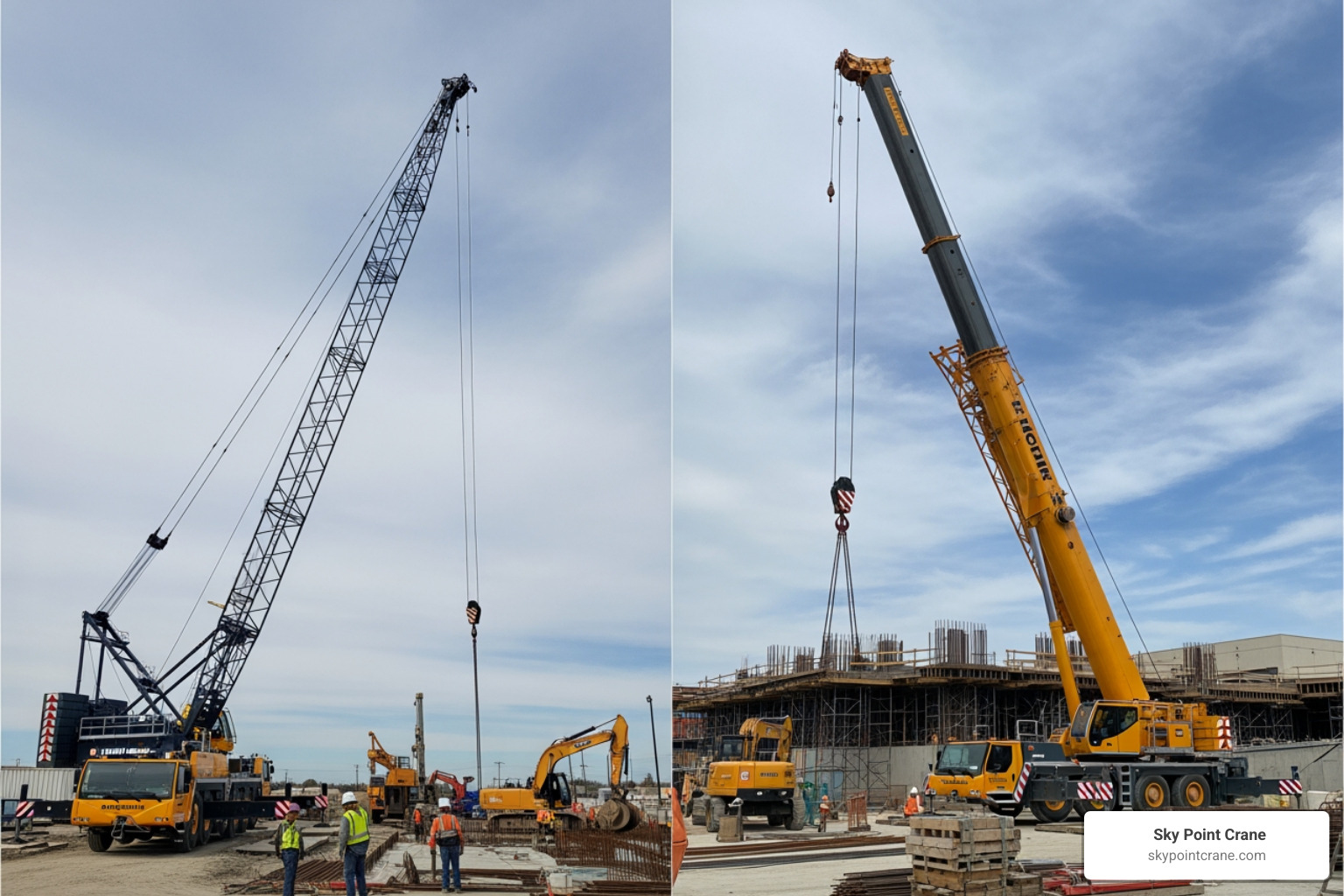
To understand why a lattice crane boom is the titan of the construction site, you have to look at its geometry. Unlike a telescopic boom, which consists of solid steel boxes that slide inside one another, a lattice boom is a skeleton of high-strength steel.
This “open-web” design is based on the principle of triangles. By using a series of interconnected steel tubes or angles, the boom can withstand massive compression loads while remaining remarkably light. In the crane world, weight is the enemy of reach. Because a lattice crane boom weighs significantly less than a telescopic boom of the same length, the crane can use more of its structural capacity to lift the actual load rather than just supporting its own “dead weight.”
This strength-to-weight ratio is why you see these cranes on long-term job sites. While a telescopic crane is great for “taxi” service—driving in, doing a quick lift, and leaving—a lattice crane is a permanent fixture. It provides superior stability and a much larger “lifting envelope,” meaning it can reach further out and higher up without tipping or buckling.
Comparing Lattice vs. Telescopic Booms
| Feature | Lattice Boom Crane | Telescopic Boom Crane |
|---|---|---|
| Reach | Exceptional (up to 600+ feet with jibs) | Moderate (typically maxes out lower) |
| Lifting Capacity | Ultra-Heavy (up to 2,300+ tons) | Heavy (typically up to 1,200 tons) |
| Transportability | Requires multiple trucks; assembled on-site | Driven as a single unit or with a dolly |
| Setup Time | Days (requires rigging and assembly) | Minutes to Hours |
| Best Use | Long-term infrastructure, wind, energy | Daily rentals, tight urban spots, quick lifts |
Key Components of a Lattice Crane Boom
A lattice crane boom isn’t just one long piece of steel; it’s a precision-engineered assembly of several critical parts. Understanding these helps when discussing specs with our team at Sky Point Crane.
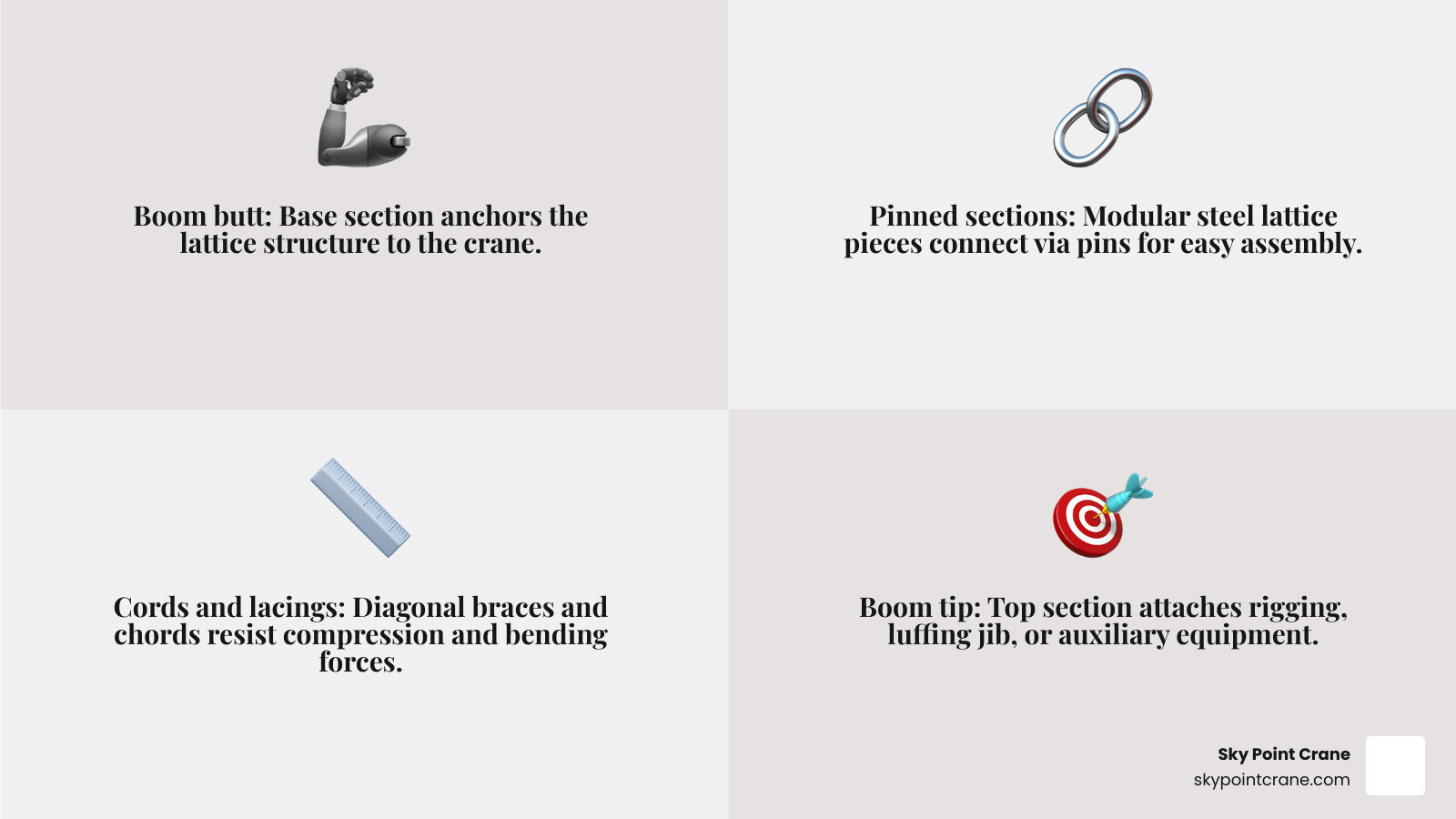
- Boom Butt: This is the “root” of the boom. It’s the widest section and is pinned directly to the crane’s revolving superstructure. It handles the brunt of the leverage during a lift.
- Boom Tip: The business end of the crane. It contains the sheaves (pulleys) through which the wire rope passes to the hook block.
- Pinned Sections (Inserts): These are the modular “middle” pieces. By adding more pinned sections, we can extend the boom to the exact length required for your project.
- Cords and Lacings: The “cords” are the four main longitudinal tubes that run the length of the boom. The “lacings” are the diagonal braces that connect them, creating that signature lattice look.
- High-Strength Steel: Modern booms often utilize performance steels like Strenx®. This material allows manufacturers to build thinner, lighter walls without sacrificing yield strength. In fact, some of the world’s largest 4,000-ton crawler cranes use Strenx® 1100 E for tension bars to ensure they don’t snap under extreme loads.
For a deeper dive into the mechanical physics of these structures, you can explore this resource on Lattice Boom Crane design.
Performance Specs of a Modern Lattice Crane Boom
When we talk about “modern” lattice cranes, we’re talking about machines that defy belief. Take the Liebherr LG 1800-1.0, for example. It has a maximum load capacity of 800 tons and can reach a hoist height of 204 meters (about 670 feet). That is taller than many skyscrapers in downtown Pittsburgh!
Lifting capacity is usually measured at a minimum radius with the shortest possible boom. As you add inserts or reach further out, that capacity drops. This is where luffing jibs come in. A luffing jib is essentially a second lattice boom attached to the tip of the first. It can move independently, allowing the crane to reach “up and over” obstacles like stadium walls or refinery piping.
Typical specs for the fleet we see in the Pennsylvania and Ohio markets include:
- Max Capacity: Ranging from 80 USt (like the Terex HC 80) to 2535 USt (the massive Manitowoc 31000).
- Main Boom Lengths: Often reaching up to 479 feet.
- Reach: Horizontal radii can exceed 150 meters on larger models.
If you’re wondering how these specs translate to truck-mounted versions, check out our lattice-boom-truck-crane-guide for a specialized look at mobile lattice options.
Primary Variations of Lattice Boom Cranes
Not every lattice crane boom is mounted on the same “feet.” Depending on your job site in Maryland or West Virginia, you might need a different carrier.
Lattice Boom Crawler Cranes
These are the most common. Mounted on a pair of massive steel tracks (crawlers), these cranes have an incredibly low ground-bearing pressure. This allows them to travel with a load (“pick and carry”) across soft or uneven terrain. They don’t need outriggers because the weight of the tracks and the wide footprint provide all the stability required.
Lattice Boom Truck Cranes
For projects that require moving between different sites frequently, a truck-mounted lattice crane is ideal. It combines the high-reach lattice crane boom with a chassis that can travel on public roads (often with the boom removed and transported separately). This is a favorite for bridge work where the crane needs to move along the span as construction progresses.
Pedestal and Ring Cranes
In specialized industrial or marine environments, you’ll find pedestal cranes. These are fixed in one spot—like an offshore rig or a barge—and offer massive lifting power with a small footprint. Even more extreme are ring cranes. These sit on a giant circular track, allowing them to swing 360 degrees while supporting thousands of tons. For instance, some pedestal cranes can haul up to 2,000 tons with very short setup times and lower operational costs compared to moving a crawler of the same size.
Operational Logistics: Assembly, Transport, and Maintenance
Renting a lattice crane boom involves more than just a handshake. Because these machines are so large, they cannot be driven to the site in one piece.
On-Site Assembly
A 300-ton crawler crane might require 10 to 15 tractor-trailer loads just to get all the boom sections, counterweights, and the carbody to the site. Once there, an “assist crane” (usually a smaller telescopic crane) is used to pin the sections together. This process can take anywhere from a day to a week depending on the complexity of the configuration.
Modular Transport
The beauty of the modular design is that it’s designed to fit on standard trailers. Manufacturers like SANY and Liebherr design their sections to meet international road regulations. For example, outriggers can often be removed to meet axle load requirements for road licenses in Pennsylvania or Maryland.
Maintenance and the “Zero-Tolerance” Policy
Safety is our absolute priority at Sky Point Crane. Lattice booms are designed to handle compression, not side-loading or impact. Because the steel lacings are thin-walled to save weight, even a small dent or a patch of rust can compromise the entire structure.
We adhere to a strict zero-tolerance policy for damage:
- No Bent Lacings: If a diagonal brace is bent, the boom is out of service.
- No Cracked Welds: We perform regular inspections to ensure the structural integrity of every pin connection.
- Rust Prevention: High-strength alloy steel must be kept clean and protected to prevent structural thinning.
If a boom sustains damage to its main “cords” (the four corner tubes), it must be removed from service immediately. This isn’t just a recommendation; it’s a requirement under standards like NAVFAC P-307. To ensure your site is ready for these protocols, you can learn more about rigging and signal person services to help manage the assembly safely.
Frequently Asked Questions about Lattice Booms
How does a lattice crane boom differ from a telescopic boom?
The primary difference is the structure. A lattice crane boom is a fixed-length triangular steel structure made of pinned sections. A telescopic boom uses hydraulic cylinders to extend solid steel boxes. Lattice booms offer superior vertical reach and significantly higher weight reduction, making them better for ultra-heavy lifts. However, they aren’t “plug and play”—they require assembly, whereas telescopic booms are ready to work almost immediately.
What are the typical lifting capacities for these cranes?
For general construction, you’ll see cranes in the 100 to 300-ton range. However, for major infrastructure or energy projects, capacities can skyrocket. The Manitowoc 31000 can lift 2,535 USt. In marine environments, lattice booms are used on heavy-lift barges for deep-sea construction. Interestingly, innovations in modular design now allow for “synchronized dual cranes.” By connecting two cranes in parallel and using a master-slave control system, operators can lift loads that would be impossible for a single machine.
Why is high-strength steel like Strenx® used in construction?
High-strength steel allows us to “lift higher and heavier.” By using steels with higher yield strengths (like Strenx® 960 or 1100), manufacturers can use less material. This reduces the weight of the boom itself, which directly increases the crane’s lifting capacity. It’s the difference between a crane being able to lift a 50-ton wind turbine component at 100 feet versus 200 feet.
Conclusion: Partnering with Sky Point Crane
Choosing a lattice crane boom for your project is a big decision, but you don’t have to make it alone. At Sky Point Crane, we specialize in providing the heavy-lifting muscle needed for the most demanding sites in Pittsburgh, Western and Central Pennsylvania, Ohio, West Virginia, and Maryland.
We don’t just “rent equipment.” We provide a full-service lifting solution. Our team includes NCCCO certified operators who understand the nuances of lattice boom operation. We also offer comprehensive 3D Lift Planning, which allows us to virtually simulate your lift before a single crane arrives on site. This ensures that every radius, every clearance, and every ground-pressure calculation is spot on.
Whether you are erecting wind turbines, installing bridge spans, or managing a long-term industrial expansion, we have the expertise and the fleet to get it done safely and efficiently.
Ready to plan your next big lift?
- Learn more about our 3D lift planning services to see how we visualize success.
- Check out our lattice-boom-truck-crane-guide for more on mobile options.
- Contact Sky Point Crane today for 24/7 service and expert rigging support across the region. Let’s get to work!