
The HVAC Contractor’s Playbook for Smart Crane Rentals
Why HVAC Contractors Need Specialized Crane Solutions
Crane Rental for HVAC Contractors is essential when installing or replacing rooftop units that weigh over 120 pounds, require lifting beyond 20 feet, or are located in tight or difficult-to-access spaces. The right crane service provides certified operators, advanced lift planning, safe rigging, and often additional services like old unit removal and transport.
Quick Decision Guide:
- Commercial HVAC Units: Use mobile all-terrain cranes or boom trucks for rooftop placements on multi-story buildings
- Residential Rooftop Units: Boom trucks or smaller cranes for quick, efficient lifts
- Tight Interior Spaces: Spyder cranes or carry deck cranes that fit through standard doorways
- High-Rise Buildings: Mobile cranes with extended reach and heavy lifting capacity
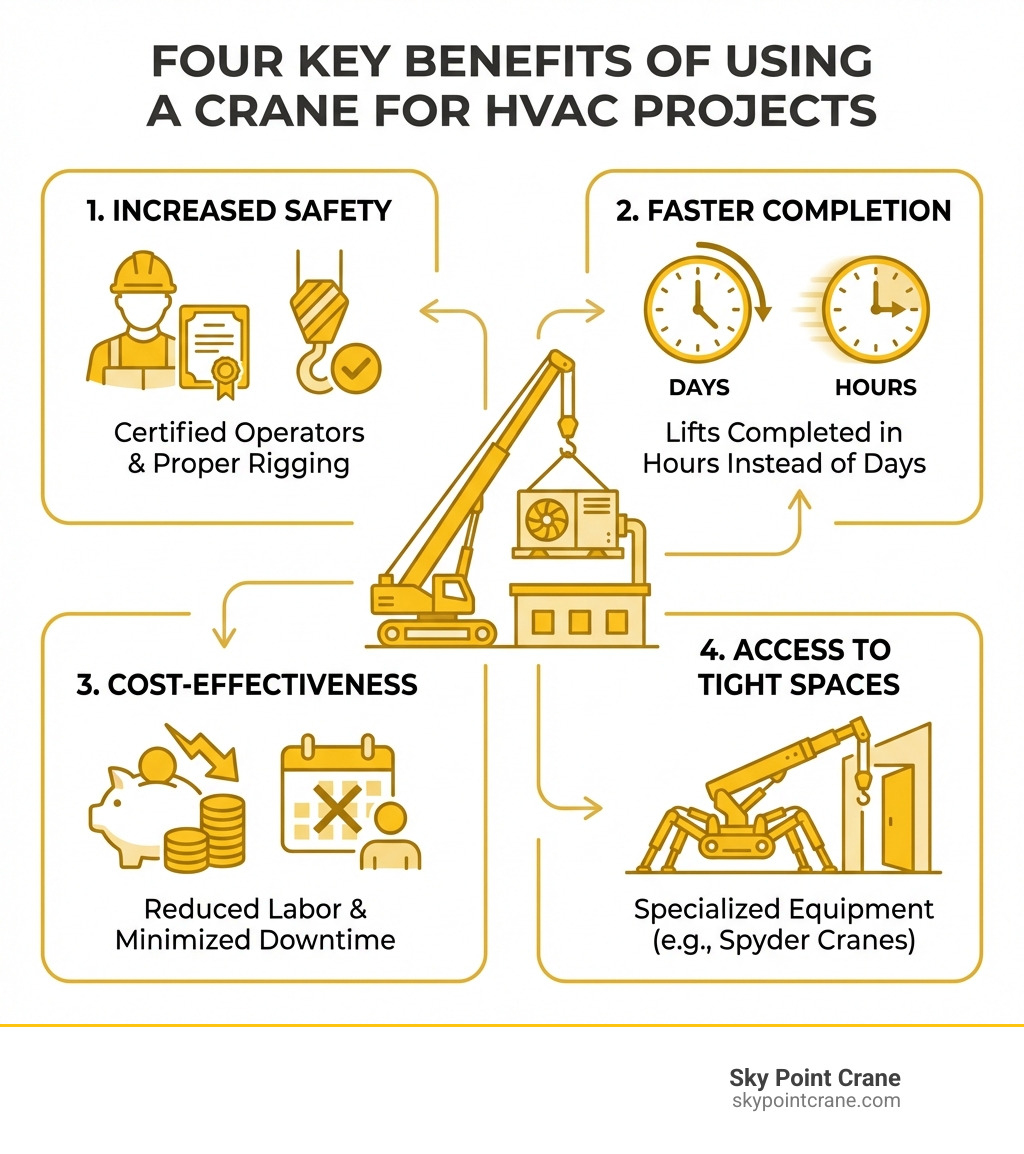
- Benefits: Faster project completion, improved safety, reduced labor costs, access to otherwise unreachable locations
Installing a new HVAC system atop a towering office building is not as simple as it looks. The reality is much harder. HVAC units can weigh thousands of pounds, rooftops are often cluttered with obstacles, and precision placement on equipment curbs is critical. One wrong move can damage expensive equipment or worse, injure workers.
That’s where professional crane rental becomes a game-changer. With the right equipment and certified operators, what might take days using traditional methods can be completed in hours. The HVAC market in the US is expected to grow to $235.5 billion by 2027, and contractors who leverage efficient lifting solutions will have a competitive edge in completing more projects safely and profitably.
The challenges are real. You need to steer existing structures, account for ground bearing pressure, coordinate with building management, and ensure every lift meets OSHA safety standards. The crane operator can’t see the load once it disappears behind a wall or over a roofline, which is why signal persons using hand signals are critical to guide every movement with precision.
Beyond the lift itself, you’re dealing with logistics like transporting heavy equipment to the job site, disposing of old units, and ensuring your team has the certifications required for compliance. A full-service crane rental partner handles all of this, turning a complex multi-day project into a streamlined operation.
I’m Dave Brocious, and I’ve spent over 30 years solving lifting challenges for contractors across Pennsylvania, Ohio, West Virginia, and Maryland, with a focus on making Crane Rental for HVAC Contractors safer, faster, and more cost-effective through advanced planning and certified crews. At Sky Point Crane, we’ve built our reputation on showing up early, answering the phone, and delivering unique solutions that put our customers’ needs first.
Why Cranes are a Game-Changer for HVAC Projects
Let’s face it, HVAC installations and replacements, especially for large commercial or industrial units, are rarely simple. They often involve moving massive, unwieldy equipment to challenging locations, typically rooftops. Trying to tackle these projects with traditional methods like manual labor, winches, or forklifts can be inefficient, costly, and downright dangerous. This is where crane rental truly becomes a game-changer for HVAC contractors.
The global crane rental market size was valued at USD 105.2 billion in 2022 and is projected to reach USD 150.5 billion by 2030, growing at a CAGR of 4.6%. This growth isn’t just for massive construction projects; it reflects a growing reliance on specialized lifting solutions across various industries, including HVAC. We’ve seen how leveraging the right crane can transform an HVAC project from a logistical nightmare into a smooth, efficient operation. It’s about more than just lifting; it’s about smart project management and strategic resource allocation.
Boosting Efficiency and Slashing Project Timelines
When we talk about efficiency in HVAC projects, we’re really talking about saving time and money. Imagine trying to hoist a multi-ton rooftop unit (RTU) onto a five-story building using anything other than a crane. It would require an army of workers, multiple pieces of smaller equipment, and likely days of painstaking effort. With a crane, that same lift can often be completed in a matter of hours.
- Faster Installation and Removal: Cranes allow for the rapid removal of old, defunct HVAC units and the precise placement of new ones. This minimizes the time your client’s building is without proper heating or cooling, which is a huge benefit, especially for critical facilities.
- Reduced Labor Costs: Fewer personnel are needed on-site for the heavy lifting, as the crane does the bulk of the work. This frees up your skilled HVAC technicians to focus on the actual installation, wiring, and piping, rather than wrestling with equipment.
- Minimized Disruption: A quicker lift means less disruption to the building’s occupants, surrounding businesses, or traffic flow. This is particularly important for commercial projects in busy urban areas across Western Pennsylvania, Ohio, West Virginia, or Maryland.
- Streamlined Workflow: By integrating crane services into your project plan, you can create a more predictable and efficient workflow. This allows for better scheduling and coordination with other trades. The economics of crane rentals often show that the initial investment in a crane pays for itself through these significant time and labor savings. It’s a key component of efficient project management.
Overcoming Common Rooftop Placement Challenges
Rooftops are notorious for presenting unique challenges. From existing ductwork and parapet walls to uneven surfaces and limited access, getting an HVAC unit into its exact spot requires precision and power.
- Navigating Obstacles: Cranes, especially those with advanced maneuverability, can lift units directly over existing structures, minimizing the need for complex rigging on the roof itself.
- Lifting Over Existing Structures: We frequently encounter situations where HVAC units need to be placed deep within a rooftop, far from the edge. A crane’s reach can easily span these distances, lifting the unit over obstacles that would otherwise be impossible to bypass.
- Precise Placement on Curbs: HVAC units must be perfectly aligned and set onto their designated equipment curbs to ensure proper sealing and function. Crane operators, guided by experienced signal persons, can achieve this delicate precision.
- Handling Uneven Terrain and Tight Spaces: Whether it’s a sloped roof, a crowded urban environment, or a confined access point, specialized cranes can adapt. Mobile all-terrain cranes, for example, are designed to operate on diverse surfaces, while compact cranes can fit into surprisingly tight spaces. This ability to handle complex scenarios is why we emphasize heavy lift crane planning solutions.
Selecting the Right Crane for Your HVAC Installation
Choosing the right crane is paramount for a successful HVAC project. It’s not a one-size-fits-all decision; the best crane depends on a variety of factors unique to each job site and HVAC unit. When we assess a project, we consider several key elements:
- Weight of the HVAC Unit: This is the most fundamental factor. We need to know the exact weight of the unit to ensure the crane has sufficient lifting capacity.
- Lift Height: How high does the unit need to go? A single-story building will require less reach than a high-rise in downtown Pittsburgh.
- Site Accessibility: Can a large crane easily access the setup location? Are there narrow streets, overhead power lines, or soft ground?
- Ground Conditions: The stability of the ground where the crane will be set up is critical. We assess for factors like soil type, underground utilities, and potential load-bearing issues.
- Load Radius: This refers to the horizontal distance from the crane’s center of rotation to the center of the load. A longer radius generally means less lifting capacity. We use this to determine the crane’s optimal positioning.
Our equipment fleet is diverse to address these varied needs, ensuring we always have the right tool for your HVAC job.
Mobile Cranes vs. Boom Trucks: What’s the Difference?
For most HVAC applications, you’ll primarily be looking at mobile cranes or boom trucks. While both are highly versatile, they each have distinct advantages.
| Feature | Mobile All-Terrain Cranes | Boom Trucks | Mini/Spyder Cranes |
|---|---|---|---|
| Capacity | High (typically 30-825 tons, often 90+ tons for HVAC) | Medium (typically 10-210 tons, common for many RTUs) | Low (typically <10 tons) |
| Reach | Very High (extended boom lengths for tall buildings) | Medium (good reach for most commercial rooftops) | Limited (ideal for confined spaces, lower heights) |
| Mobility | Excellent (can travel on highways and off-road) | Good (street legal, quicker setup than large mobile cranes) | Excellent (compact, can fit through doorways, track-based) |
| Setup Time | Moderate to Long (requires outrigger setup, counterweights) | Short to Moderate (quicker setup) | Very Short (minimal setup) |
| Ideal Use Case | Large commercial/industrial RTUs, high-rise buildings, heavy lifts, complex sites | Standard commercial RTUs, residential rooftop units, quick lifts with good access | Indoor lifts, tight access areas, limited floor load capacity |
Mobile cranes are the workhorses for significant HVAC projects. They offer superior lifting capacity and reach, making them ideal for large commercial or industrial HVAC units that need to be placed on tall buildings or far back on a rooftop. Their all-terrain capabilities mean they can handle varied ground conditions, common in many development sites.
Boom trucks are excellent for smaller to medium-sized HVAC units and projects where speed and maneuverability are key. They combine the transportation capabilities of a truck with a crane, meaning they can get to a site quickly and set up efficiently. For many residential rooftop unit replacements or smaller commercial installations in areas like State College, PA, a boom truck is often the most cost-effective and efficient choice.
Specialized Cranes for Unique HVAC Scenarios
Sometimes, the standard mobile crane or boom truck just won’t cut it. That’s when we turn to specialized equipment designed for unique challenges.
- Carry Deck Cranes: These compact, highly maneuverable cranes are perfect for indoor HVAC work or tight outdoor spaces where a larger crane simply can’t fit. Their ability to “carry” a load while moving makes them incredibly versatile for placing units within a facility or navigating congested areas. Learn more about how to choose the right carry deck crane rental.
- Spyder Cranes: When we talk about fitting through standard doorways for interior lifts, we’re talking about mini crane rental like a Spyder crane. These compact, track-mounted cranes have impressive lifting capabilities for their size and are designed to operate in extremely confined spaces, making them invaluable for replacing HVAC components within existing buildings without major demolition. Need to place an air handler in a tricky spot? A Spyder crane might be your new best friend. You can read more about renting a Spyder crane for these specific needs.
- Rough Terrain Cranes: For HVAC projects on undeveloped sites, construction zones, or areas with challenging ground conditions, a rough terrain crane is essential. These cranes are built for stability and traction on uneven, muddy, or rocky surfaces, ensuring safe and effective lifts even before the pavement is laid.
The Anatomy of a Safe and Successful HVAC Lift
Safety isn’t just a buzzword for us; it’s the bedrock of every operation. When it comes to Crane Rental for HVAC Contractors, a safe lift is a successful lift. We adhere to stringent crane safety protocols and ensure all personnel are certified and highly trained. The construction industry in the US is projected to reach $2.03 trillion by 2027, and with that growth comes an even greater emphasis on safety standards.
The Critical Role of Pre-Planning and 3D Lift Plans
Picture this: A massive HVAC unit, a towering building, and a complex urban environment. Without meticulous pre-planning, you’re essentially flying blind. That’s why we champion the use of 3D lift planning: the future of crane operations.
- Site Assessment: Before any equipment rolls onto your job site, we conduct a thorough assessment. This includes identifying potential obstructions like power lines, trees, or adjacent buildings, and understanding the layout of the site.
- Obstacle Identification: Our pre-planning process carefully maps out all potential obstacles, both overhead and on the ground, ensuring a clear path for the lift.
- Ground Pressure Analysis: We calculate the ground bearing pressure to ensure the crane’s setup location can safely support its weight and the load. This prevents costly ground damage or, worse, crane instability.
- Crane Positioning: 3D lift plans allow us to optimize crane placement for maximum efficiency and safety, considering factors like load radius, boom length, and swing path.
- Simulating the Lift: Using specialized software, we can create a virtual lift plan 3D simulation. This allows us to visualize the entire operation, identify potential clashes, and refine the lift sequence long before the crane arrives on site. It’s like a dress rehearsal for your lift, ensuring everything runs smoothly on the big day.
This level of detailed planning not only improves safety but also significantly improves project outcomes by anticipating challenges and streamlining operations.
Essential Personnel: Certified Operators, Riggers, and Signal Persons
A crane is only as good as the team operating it. That’s why we invest heavily in ensuring our personnel are not just experienced, but also certified to the highest industry standards.
- NCCCO Certified Operators: Our crane operators are all NCCCO certified crane operators. This certification signifies that they have undergone rigorous training and testing, demonstrating a comprehensive understanding of crane operation, safety regulations, and load chart interpretation. Understanding NCCCO Certification: What it Means for the Construction Industry is crucial for any contractor hiring crane services.
- Qualified Riggers: The rigger is responsible for attaching the load to the crane, selecting the appropriate rigging gear, and ensuring the load is balanced and secure for lifting. Our riggers are highly trained and certified, understanding the complexities of various HVAC unit configurations and how to safely prepare them for transport through the air.
- Signal Person Responsibilities: The signal person is the eyes and ears of the crane operator, especially when the load is obscured from view. They provide clear, concise directions using standardized hand signals to guide the operator through every movement. This role is absolutely critical for the safety and precision of the lift. A signal person is a heroic individual, and the crane operator relies on their substantial help. Learn more about rigging signal persons and their vital role.
- OSHA Compliance: All our operations strictly adhere to OSHA (Occupational Safety and Health Administration) regulations. This includes requirements for crane inspections, operator qualifications, rigging practices, and site safety. We maintain high standards for safety, health & environment on every job.
Key Considerations for Crane Rental for HVAC Contractors
Choosing a crane rental company for your HVAC project is a decision that can significantly impact your project’s success. It’s not just about finding the cheapest option; it’s about partnering with a provider who understands the unique demands of HVAC lifts and can deliver safely and efficiently. Our industrial crane rental guide 2025 offers even more insights for various industrial lifting needs.
What to Look for in a Crane Rental for HVAC Contractors
When evaluating potential partners for Crane Rental for HVAC Contractors, consider these crucial factors:
- Experience in HVAC Lifts: Does the company have a proven track record specifically with HVAC unit installations and removals? This specialized experience means they understand the nuances of these lifts, from unit specifications to rooftop challenges.
- Safety Record: A stellar safety record is non-negotiable. Ask about their safety protocols, incident rates, and commitment to ongoing training. We pride ourselves on a strong safety culture and continuous improvement.
- NCCCO Certified Staff: As discussed, certified operators, riggers, and signal persons are essential. Ensure the company employs NCCCO certified crane operators and certified riggers.
- Fleet Size and Condition: A diverse and well-maintained fleet ensures they have the right crane for your specific project, whether it’s a small residential unit or a massive commercial RTU. Our equipment is regularly inspected and maintained to the highest standards.
- 24/7 Availability: HVAC emergencies don’t stick to business hours. A company offering 24 hour crane service can be a lifesaver when unexpected issues arise.
- Local Expertise: For contractors in Western and Central Pennsylvania, Ohio, West Virginia, and Maryland, choosing a local provider means they understand regional regulations, weather patterns, and common site conditions, which can be invaluable.
Understanding the Costs and Value-Added Services
The cost of crane rental can vary widely, but understanding the influencing factors helps you budget effectively and recognize true value. The average cost of renting a crane can range from $250 to $1,500 per day, depending on the type and size of the crane. However, this is a broad estimate, and many variables come into play. Our crane rental costs: complete guide dives deeper into these factors.
Here’s a breakdown of what influences the cost:
- Crane Size and Type: Larger cranes with higher lifting capacities and longer reaches will naturally cost more than smaller boom trucks or specialized mini cranes.
- Duration of Rental: Rentals can be by the hour, day, week, or month. Longer-term rentals may offer a lower daily rate.
- Personnel: Hiring a crane with a certified operator, rigger, and signal person (which we always recommend and provide) will be an additional cost but is crucial for safety and efficiency.
- Location: Travel time and mobilization costs to and from your job site in Pennsylvania, Ohio, West Virginia, or Maryland will impact the overall price.
- Permits: Depending on your project’s location and scope, you might need permits for road closures or oversized loads, which incur additional fees.
Beyond the basic lift, many reputable crane rental companies offer a suite of value-added services that can simplify your HVAC project logistics:
- Transport Services: Moving heavy HVAC units to and from the job site requires specialized transport. We offer full service heavy lift transport solutions, ensuring your equipment arrives safely and on schedule.
- Old Unit Disposal/Scrap Removal: Don’t let that old, defunct HVAC unit sit around cluttering your site. Many companies, including ours, offer scrap removal services, hauling away and properly disposing of the old equipment, often at no additional cost.
- Industrial Storage Options: If your new HVAC unit arrives before the site is ready for installation, or if you need temporary storage for other equipment, some crane companies can provide industrial storage solutions. This can include secure indoor or outdoor facilities.
Frequently Asked Questions about HVAC Crane Rentals
Navigating crane rentals for HVAC projects can bring up a lot of questions. We’ve compiled some of the most common ones we hear from contractors across our service areas.
What information do I need to provide to get an accurate crane rental quote?
To provide you with the most accurate and competitive quote, we’ll need a few key pieces of information about your HVAC project:
- Unit Specifications: The exact weight and dimensions (length, width, height) of the HVAC unit(s) to be lifted. This is critical for selecting the right crane with adequate capacity.
- Building Height: The total height of the building where the unit will be placed.
- Distance from Crane Setup to Placement Spot: This is known as the “load radius.” We need to know how far the crane will need to reach horizontally from its setup location to the final placement of the unit on the rooftop.
- Site Access Details: Describe the access to the job site. Are there narrow streets, tight turns, or gates? What are the ground conditions where the crane will be positioned (paved, gravel, soft soil, uneven terrain)?
- Potential Overhead Obstructions: Are there any power lines, trees, adjacent buildings, or other structures that could interfere with the crane’s boom or the lifted load? Providing photos or a site plan can be incredibly helpful.
- Desired Date and Time: When do you need the crane? This helps us check availability and schedule personnel.
The more detail you can provide, the better we can plan and ensure a smooth, efficient, and safe lift.
Are permits required for placing an HVAC unit with a crane?
Yes, permit requirements are a significant consideration and can vary widely depending on your specific location within Pennsylvania, Ohio, West Virginia, or Maryland, as well as the scope of your project.
- Municipal Regulations: Different cities and counties have their own ordinances regarding crane operations, especially in urban areas.
- Road Closures/Traffic Control: If the crane needs to set up on a public street or if its operations will impede traffic, you will almost certainly need permits for road closures and a detailed traffic control plan.
- Oversized Loads: Transporting large cranes to the site might also require special permits for oversized or overweight vehicles.
Navigating these regulations can be complex and time-consuming. A full-service crane company like Sky Point Crane can often assist with identifying necessary permits, preparing the required documentation, and coordinating with local authorities to ensure full compliance. This takes a significant burden off your shoulders and helps avoid costly delays or fines.
What happens to the old HVAC unit after it’s removed?
This is a common question, and we’re happy to say that many crane rental companies, including Sky Point Crane, offer comprehensive solutions for old HVAC unit removal.
- Hauling and Disposal Services: Once the old unit is safely removed from the rooftop, we can typically haul it away from your job site. This means you don’t have to worry about arranging separate transportation or disposal.
- Coordination for Scrap and Recycling: We often coordinate with local scrap yards and recycling facilities to ensure the old units are disposed of responsibly and environmentally. Many HVAC units contain valuable metals that can be recycled.
- Ensures a Clean and Clear Job Site: Our goal is to leave your job site clean and ready for the next phase of work. By handling the old unit’s removal, we help maintain a tidy and safe environment for your team.
This integrated service streamlines your project, saving you time, effort, and additional logistical headaches.
Conclusion
For HVAC contractors operating in Pennsylvania, Ohio, West Virginia, and Maryland, partnering with an expert crane rental company is not just a convenience—it’s a strategic move. The complexities of modern HVAC installations, from the sheer weight of units to the challenging rooftop environments and stringent safety regulations, demand specialized lifting solutions.
By choosing the right partner, you open up significant benefits: improved safety through certified personnel and meticulous 3D lift planning, increased efficiency that slashes project timelines and labor costs, and the ability to overcome even the most daunting site challenges. This ensures your projects are completed on time, within budget, and without incident.
At Sky Point Crane, we are committed to providing HVAC contractors with comprehensive lifting solutions. With our NCCCO certified operators, advanced 3D lift planning capabilities, and a modern fleet custom for any HVAC project, we’re ready to be your trusted lifting partner.
Don’t let heavy lifting weigh down your next HVAC project. Explore our full range of Crane Rental services and let us help you lift your next project to success.