What Data Centers Mean for Modern Infrastructure
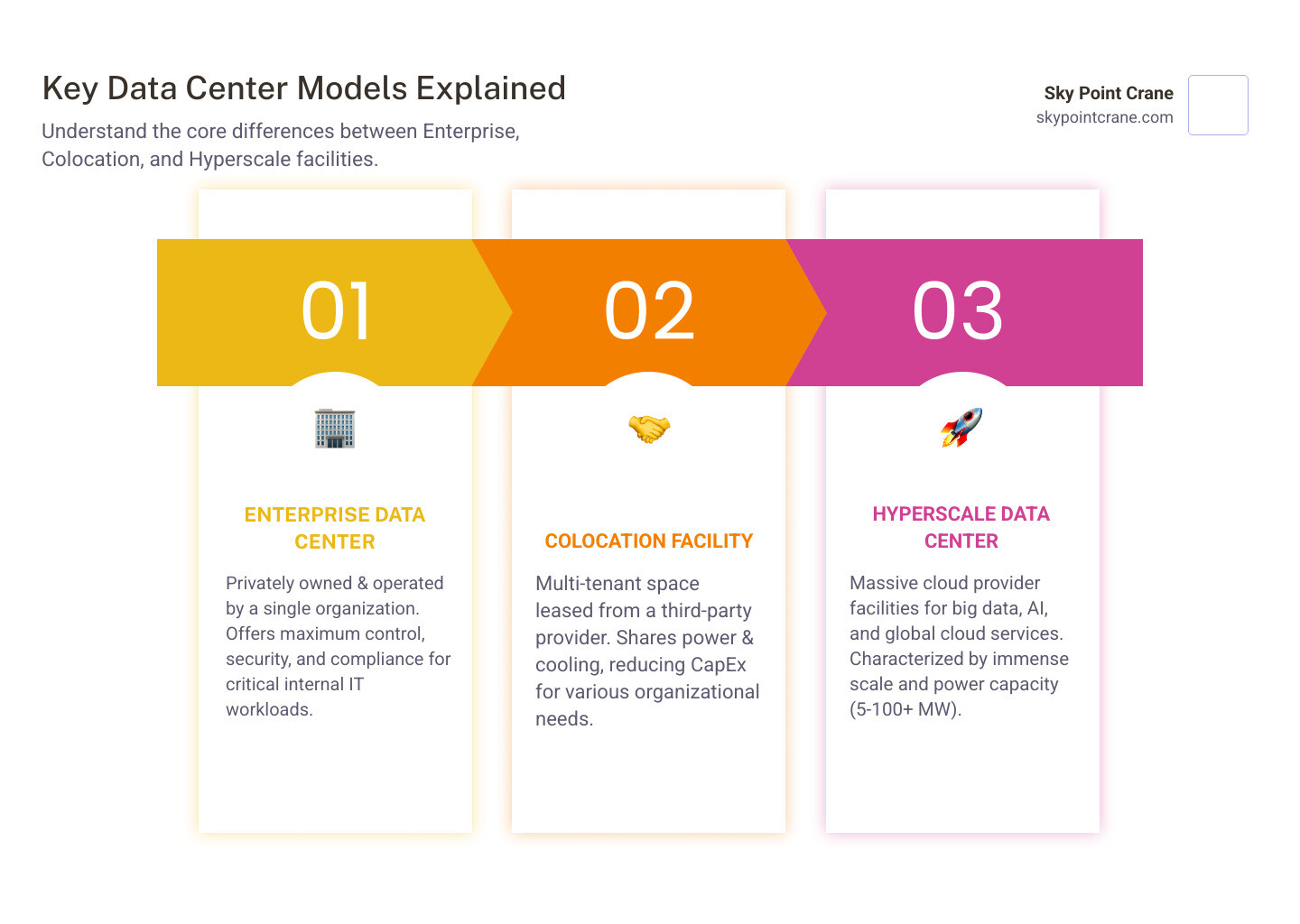
An Enterprise data center is a privately owned and operated facility that houses the IT infrastructure—servers, storage, networking, power, and cooling—for a single organization. These facilities support critical business applications, store sensitive data, and provide complete control over an organization’s digital operations. Unlike colocation or public cloud facilities, enterprise data centers are dedicated to one company’s specific needs, whether located on-premises or at an off-site location chosen for security, connectivity, or environmental advantages.
Quick comparison of major data center types:
| Type | Ownership | Scale | Primary Use |
|---|---|---|---|
| Enterprise | Single organization | 1-10 MW (typically) | Internal IT, compliance-driven workloads |
| Colocation | Third-party provider | Varies | Multi-tenant space, power, and cooling |
| Hyperscale | Cloud service providers | 50,000+ sq ft, 5-100 MW | Cloud services, big data, AI workloads |
| Edge | Varies | 50-500 kW | Low-latency, distributed computing |
These facilities are the physical backbone of the digital economy. Everything from healthcare records to financial transactions to manufacturing systems depends on data centers running 24/7. While cloud computing has grown dramatically—with on-premises workloads falling below 50% of total capacity—enterprise data centers remain essential for organizations requiring maximum security, regulatory compliance, or support for legacy systems that can’t move to the cloud.
The stakes are high. 25% of organizations report that unexpected downtime costs between $301,000 and $400,000 per hour. That’s why the design, construction, and ongoing operation of these facilities demands precision engineering and reliable infrastructure partners.
I’m Dave Brocious, and with over 30 years of leadership experience solving complex industrial challenges, I’ve seen how critical proper planning and execution are when building or expanding an Enterprise data center. At Sky Point Crane, we provide the specialized lifting, rigging, and crane services that data center projects demand—from setting massive generators and UPS systems to positioning prefabricated modules with millimeter precision.
Enterprise data center terms you need:
What Is an Enterprise Data Center?
An Enterprise data center is the private nerve center of a major organization—a facility built specifically to serve one company’s needs by housing its servers, storage, and the massive power and cooling systems required to run them. Unlike multi-tenant data centers, it is dedicated entirely to one company’s operations, whether it’s located on a corporate campus or at a strategic off-site location.
For organizations handling sensitive data, managing complex processes, or facing strict regulatory requirements, these facilities provide complete control. You aren’t sharing resources, and your data remains under your direct management and security protocols. This level of control is essential for applications that cannot afford downtime, such as financial transaction systems, automated production lines, or protected health information databases.
Core Infrastructure Components
An Enterprise data center is a complex ecosystem where every component must work in harmony.
-
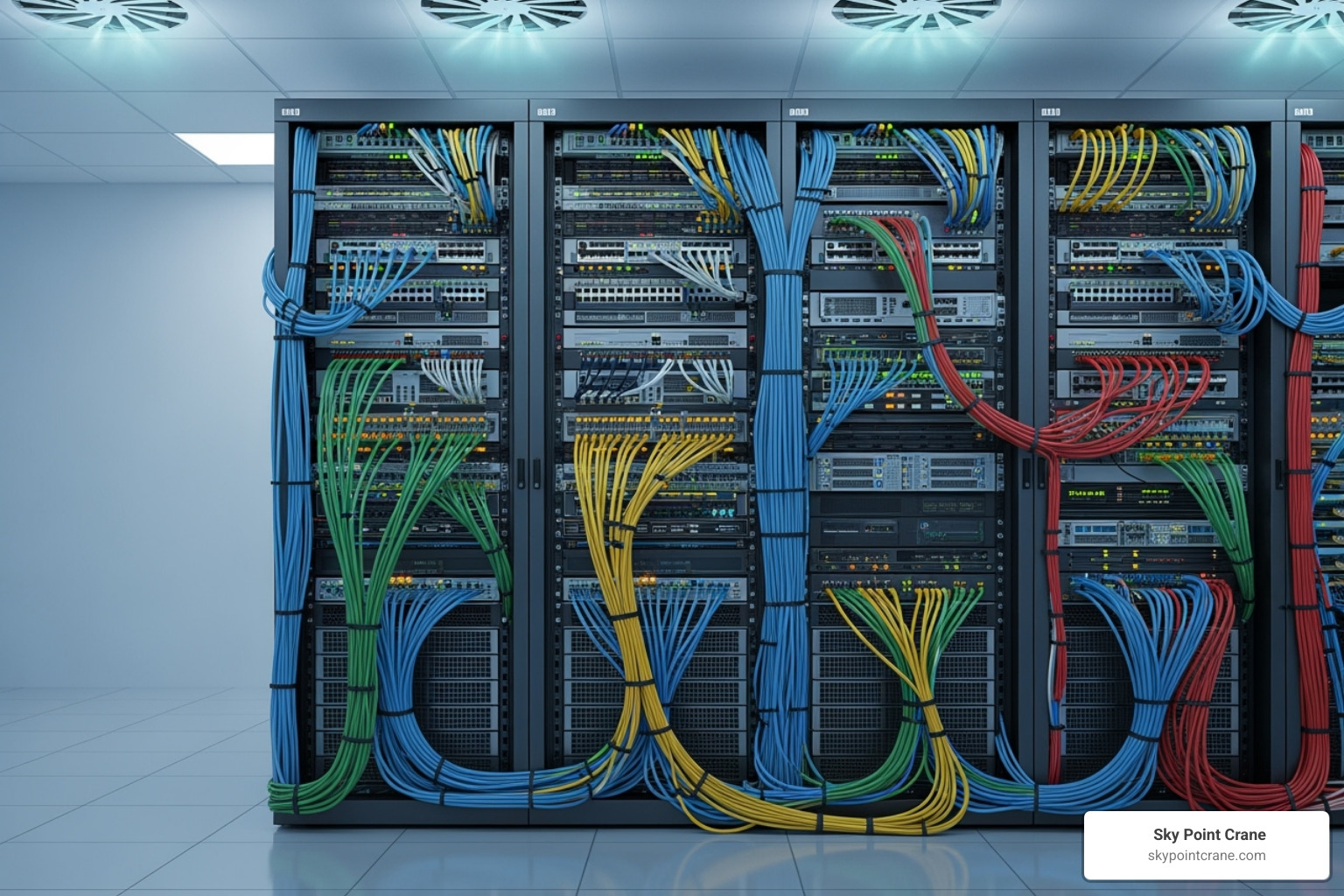
IT Equipment: This is the heart of the facility. Server racks hold compute hardware—from standard x86 servers to specialized systems—that run business applications. Alongside them, storage systems like Storage Area Networks (SAN) and Network Attached Storage (NAS) protect terabytes or petabytes of critical data.
-
Networking Equipment: Switches, routers, and firewalls act as the data highway system, connected by miles of carefully planned copper and fiber optic cables to prevent bottlenecks and ensure smooth data flow.
-
Power Infrastructure: This is a critical, multi-layered system. It often includes dual power feeds from separate utilities, massive uninterruptible power supplies (UPS) to bridge gaps during a switchover, and large backup generators for extended outages.
-
Cooling Systems: Computer Room Air Conditioners (CRAC) and Air Handlers (CRAH) work constantly to manage the enormous heat generated by IT equipment. Modern solutions may include liquid cooling for high-density racks or free cooling systems that use outside air.
-
Physical Security: A multi-layered approach using biometric scanners, keycard access, surveillance cameras, and on-site personnel ensures only authorized individuals can access the equipment.
Inside, the facility is divided into white space, the clean, climate-controlled area for IT equipment, and gray space, which houses the supporting infrastructure like generators and cooling units. At Sky Point Crane, we specialize in positioning heavy gray space equipment with the millimeter precision required during construction.
Understanding Network Sub-Groups
An Enterprise data center manages multiple network layers for different access needs:
-
The intranet is the private, internal network for employees, isolated from the outside world for secure access to proprietary tools and data.
-
The extranet provides controlled, secure access for trusted partners, suppliers, or clients via VPNs to share specific data without exposing the entire internal network.
-
The internet connection supports public-facing services like websites and e-commerce, protected by robust firewalls and security systems.
Enterprise vs. Other Data Center Models
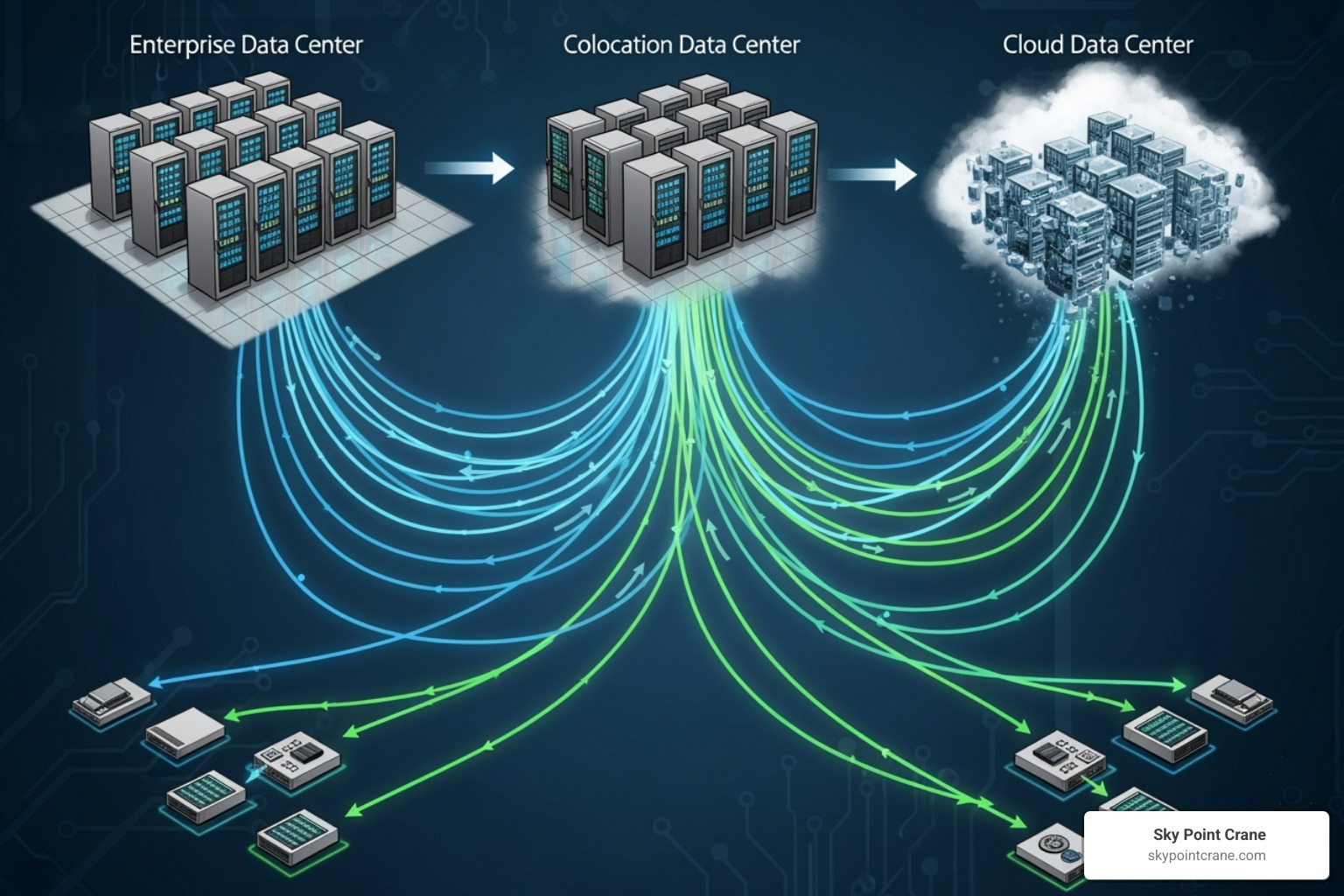
While the Enterprise data center serves a single organization, the broader landscape includes several other models. Today’s IT environment is dominated by Hybrid IT, an approach where organizations mix on-premises infrastructure with public cloud, private cloud, and colocation facilities. This strategy allows companies to play to the strengths of each model. While on-premises workloads have shrunk, Enterprise data centers are not disappearing; they are evolving into a key part of a larger, distributed strategy.
Colocation Facilities
A colocation data center is a multi-tenant facility where businesses can lease space, power, and cooling from a third-party provider. This model reduces capital expenditure by allowing companies to use a provider’s robust, shared infrastructure for their own IT hardware. It’s an ideal solution for organizations that need professional-grade facilities without the cost and complexity of building their own.
Hyperscale Data Centers
Hyperscale data centers are massive facilities operated by cloud giants like Microsoft, Amazon, and Google to power their global services. With only about 700 such facilities worldwide, they are built on a staggering scale to handle big data, AI, and cloud computing. Notably, more than half of all hyperscale facilities are run by just those three companies.
Edge and Hybrid Models
The need for speed, driven by IoT and 5G networks, has led to the rise of edge data centers. These smaller, decentralized facilities process data closer to where it is generated, reducing latency for real-time applications like smart manufacturing and telemedicine. These “edge solutions” are a key part of the hybrid model, which has become the default strategy for many enterprises.
This approach combines the security of an Enterprise data center for critical workloads with the scalability of the public cloud and the speed of edge facilities. It allows organizations to optimize cost, performance, and security by placing workloads where they run most effectively.
Key Advantages and Challenges of Operating an Enterprise Data Center
Choosing to build and operate an Enterprise data center is a major strategic decision that offers significant benefits but also comes with substantial responsibilities. It provides ultimate control but requires a deep commitment of resources.

The Advantages of an Enterprise Data Center
For organizations with specific security, compliance, or performance needs, the benefits are compelling.
- Complete control over infrastructure: Organizations dictate every aspect, from using proprietary hardware to implementing custom security protocols—a level of customization unavailable in shared models.
- Improved security and visibility: This control translates to improved security. You decide who has physical access and can monitor all network activity, which is invaluable for protecting sensitive data.
- Support for legacy software: These facilities can host critical, older applications that are difficult, expensive, or risky to move to the cloud.
- Compliance assurance: For industries governed by regulations like HIPAA or FedRAMP, owning the facility allows for purpose-built infrastructure that meets specific rules, simplifying audits and data sovereignty management.
Significant Disadvantages and Challenges
The decision to operate an Enterprise data center must be weighed against its considerable challenges.
- High capital expenditure (CapEx): The initial cost is a major hurdle, with construction for a typical facility starting at $10 million to $12 million before any IT equipment is purchased.
- Ongoing operational costs (OpEx): Expenses for power, cooling, maintenance, and specialized staff are substantial and can exceed the initial investment over the facility’s lifetime.
- Complexity of management: Data centers require 24/7 monitoring and maintenance, which can strain even well-resourced IT departments.
- Risk of obsolescence: Technology evolves quickly, creating a risk of obsolescence. Continuous investment is needed to keep the facility modern and efficient.
- Talent acquisition: Skilled data center professionals who understand both IT and facilities are in high demand and difficult to recruit and retain.
- Geographic limitations: A physical data center does not easily expand to new regions, requiring either another costly facility or acceptance of higher latency for remote users.
When companies undertake these Building Data Centers projects, the physical construction demands absolute precision. At Sky Point Crane, we serve Pennsylvania, Ohio, West Virginia, and Maryland, providing the expertise to position critical components like 40-ton generators safely and efficiently with our NCCCO certified operators and 3D lift planning.
The Evolution and Management of Enterprise Facilities
The Enterprise data center is constantly evolving to meet new demands. According to the Uptime Institute, while data centers have become highly reliable, energy efficiency gains have stalled. Furthermore, despite redundant systems, 55% of operators still reported an outage in the past three years, highlighting the unending focus on uptime.
The industry’s tiered system classifies data center reliability, with stark differences between levels:
| Data Center Tier | Uptime Standard | Annual Downtime | Redundancy | Typical Use |
|---|---|---|---|---|
| Tier 1 | 99.671% | 28.8 hours | Single path | Small business |
| Tier 2 | 99.741% | 22 hours | Partial (N+1) | Small to mid-size business |
| Tier 3 | 99.982% | 1.6 hours | N+1 fault-tolerant | Large enterprise, colocation |
| Tier 4 | 99.995% | 26.3 minutes | 2N fault-tolerant | Hyperscale, mission-critical operations |
The jump from Tier 1 to Tier 4 represents a massive reduction in potential annual downtime. As the Uptime Institute Global Data Center Survey 2023 highlights, achieving and maintaining this reliability is an ongoing commitment.
Modernization and Evolving Workloads
Several key trends are shaping the modern Enterprise data center:
- Hybrid Cloud Strategy: Most organizations now accept a hybrid approach, using on-premises facilities for sensitive workloads while leveraging the cloud for scalability.
- AI and Machine Learning Adoption: The rise of AI is driving rising server rack densities and increasing power demands. Goldman Sachs Research predicts data center power demand will grow 160% by 2030, largely due to AI.
- Energy Efficiency: Measured by Power Usage Effectiveness (PUE), energy efficiency remains a key focus. While a perfect score is 1.0, most facilities are around 1.5, and improvements require constant optimization.
- Hardware Refresh Cycles: Regular hardware refreshes are essential. About 42% of organizations refresh servers every 2-3 years to improve efficiency, power, and reliability.
The Role of Data Center Infrastructure Management (DCIM)
Data Center Infrastructure Management (DCIM) software is essential for modern operations, providing the visibility and control needed to run a facility efficiently. DCIM acts as a centralized monitoring platform for power, cooling, and assets. It is invaluable for capacity planning, preventing costly emergency expansions. Its automation and efficiency features help optimize energy use and lower operating costs. Crucially, DCIM improves uptime assurance by proactively identifying potential issues before they cause failures.
Want to see how modern DCIM software can transform your Enterprise data center operations? Get your free test drive now! and experience the difference that comprehensive visibility makes.
Frequently Asked Questions about Enterprise Data Centers
Why do companies still use enterprise data centers?
Companies continue to use enterprise data centers for several key reasons: complete control over infrastructure and security protocols; simplified regulatory compliance for industries like finance and healthcare (HIPAA, FedRAMP); and the need to support legacy applications that are not cloud-compatible. Data security remains the top driver for keeping mission-critical workloads on-premises.
How much does it cost to build an enterprise data center?
Building an Enterprise data center is a major investment, with construction costs often ranging from $10 million to $12 million, not including the IT equipment. Ongoing operational costs for power, maintenance, and staff are also substantial. While this high cost leads many to consider colocation or cloud, the investment is often justified for organizations requiring the highest levels of control and security.
What is the difference between a Tier 1 and Tier 4 data center?
Data center “Tiers,” defined by the ANSI/TIA-942 standard, rate a facility’s reliability and redundancy.
A Tier 1 facility is the most basic, with a single path for power and cooling and no redundancy. It offers 99.671% uptime, which allows for up to 28.8 hours of potential downtime per year.
In contrast, a Tier 4 facility is fully fault-tolerant, with multiple, independent power and cooling paths (known as 2N redundancy). This design allows for maintenance without downtime and guarantees 99.995% uptime, or just 26.3 minutes of potential downtime annually. Most large Enterprise data centers are built to Tier 2 or Tier 3 standards, balancing high reliability with cost.
Conclusion
Despite the rise of the cloud, the Enterprise data center is not obsolete. It remains vital for organizations that require complete control, ironclad security, and strict regulatory compliance. The future is hybrid, where companies strategically place workloads in their own facilities while using cloud resources for scalability and flexibility.
While operating an Enterprise data center is expensive and complex—with initial costs often exceeding $10 million and significant ongoing expenses—the investment is a necessary cost for businesses where data sovereignty, compliance, and control are non-negotiable.
What often gets overlooked in these discussions is the physical construction itself. These are precision-engineered facilities where massive components like UPS systems, backup generators, and cooling units must be placed with millimeter-level accuracy. This construction phase demands specialized expertise in heavy lifting and rigging.
That’s where Sky Point Crane comes in. Across Western and Central Pennsylvania, Ohio, West Virginia, and Maryland, our teams bring the specialized equipment and know-how that data center construction demands. We understand that when you’re positioning a multi-ton generator or maneuvering equipment into tight spaces, you need partners who combine technical expertise with an unwavering commitment to safety. Our NCCCO certified operators and comprehensive project management approach, including 3D Lift Planning, ensure that every lift is executed flawlessly.
The digital economy runs on data centers, and data centers are built by people who understand both the technology and the construction challenges. Whether you’re building a new facility or modernizing your infrastructure, the physical foundation matters just as much as the digital one.
Want to learn more about how our crane services can support your next critical infrastructure project? Visit More info about crane services to see how we can help bring your vision to life.