
Your Blueprint for Success: Choosing the Right Construction Crane
Why Construction Crane Hire Is Critical to Project Success
Construction crane hire is the process of renting specialized lifting equipment—along with operators, transport, and support services—to handle heavy loads on construction sites. Here’s what you need to know:
Quick Guide to Construction Crane Hire:
- Mobile cranes (£350-£3500/day): Versatile for short-term jobs, easy setup
- Tower cranes (£800-£1,200/day): Essential for high-rise and long-term projects
- Spider cranes: Compact solutions for tight access and confined spaces
- Wet hire: Includes certified operators and full service
- Dry hire: Equipment only, you provide the operator
- Typical delivery: 24-48 hours for most crane types
- Fleet range: 2 tons to 1,500+ tons lifting capacity
The construction crane rental market is growing rapidly—from $115.5 billion in 2022 to a projected $175.8 billion by 2030, according to industry market reports. That growth reflects one simple truth: most projects can’t justify buying cranes. The equipment costs millions, requires constant maintenance, and sits idle between jobs.
But choosing the wrong crane or hire partner creates serious problems. Projects stall when equipment can’t reach the load or handle the weight. Safety risks multiply when operators lack proper certifications. Costs spiral when you find hidden fees for transport, setup, or overtime.
The right crane hire decision balances three factors:
- Equipment specifications (capacity, reach, terrain capability)
- Service package (operators, planning, logistics, support)
- Total cost (daily rates, mobilization, duration discounts)
I’m Dave Brocious, and I’ve spent 30+ years solving complex lifting challenges for construction teams across Western Pennsylvania and beyond. Through Sky Point Crane, we’ve learned that successful construction crane hire starts with understanding your project’s unique requirements—then matching them to the right equipment and support services.
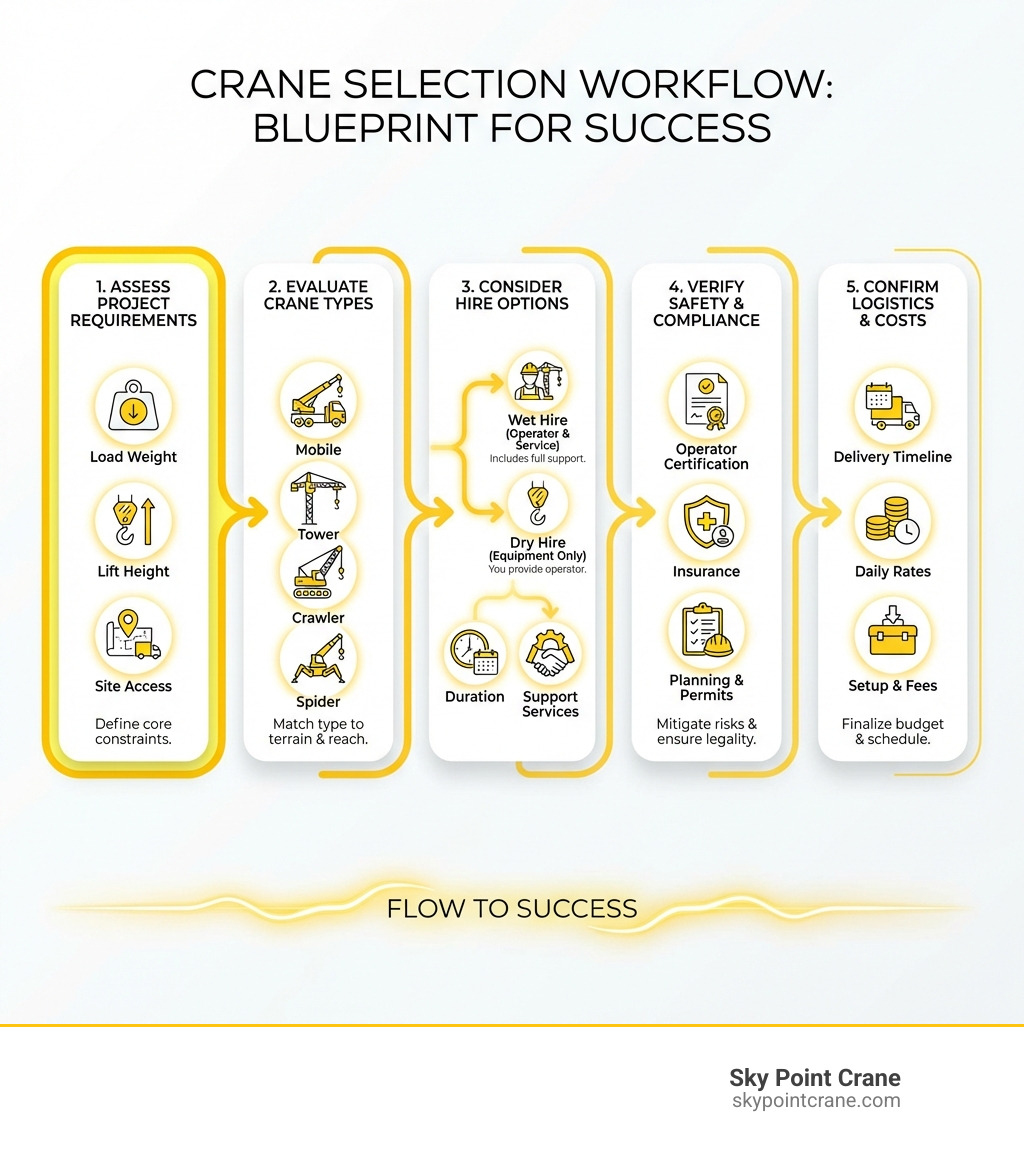
Construction crane hire vocabulary:
Navigating the Market for Construction Crane Hire
When you step onto a job site in Pittsburgh, PA, or Morgantown, WV, you’ll notice that no two lifts are identical. The market for construction crane hire is diverse because the challenges we face are diverse. Choosing the right machine is like picking the right tool from a massive, multi-ton toolbox.
Mobile cranes are the workhorses of the industry. They represent the largest segment of the rental market because they can be driven directly to a site, set up quickly using outriggers, and moved as the project progresses. Whether it’s a truck-mounted crane for a quick HVAC swap or an all-terrain crane capable of navigating the hilly landscapes of Western Pennsylvania, these machines offer the agility that fixed cranes lack.
For projects requiring massive stability and raw power, crawler cranes are the answer. These machines move on tracks (like a tank), allowing them to travel with a load. They are often used for large-scale infrastructure projects, such as bridge beams or heavy industrial installations. While they require more time to transport and assemble, their lifting capacity is best.
Tower Cranes for High-Rise Development
If you look at the skyline of any growing city, you’ll see tower cranes reaching for the clouds. These are the giants of the construction world, essential for high-rise material handling. Unlike mobile units, tower cranes are fixed to a concrete pad or a structural base.
There are several variations to consider:
- Hammerhead Cranes: The classic “L” shape. They feature a horizontal jib with a trolley that moves the load back and forth.
- Luffing Jib Cranes: These have a jib that can be raised or lowered. They are perfect for tight urban spaces where you need to avoid swinging over neighboring buildings.
- Self-Erecting Models: These are the “Swiss Army Knives” of tower cranes. They can fold and unfold themselves on-site, making them ideal for shorter-term projects or sites with limited space. If you’re managing a smaller commercial build, Self Erect Tower Crane Rental can save you significant time and mobilization costs.
Specialized Lifting Equipment
Sometimes, the biggest challenge isn’t the weight—it’s the squeeze. In modern construction, we often have to work inside existing buildings or in narrow alleyways where a standard crane simply won’t fit.
This is where Mini Crane Rental comes into play. Spider cranes, for instance, are compact enough to fit through a standard doorway but strong enough to set glass or steel internal beams. Similarly, carry deck cranes feature a low profile and a flat deck, allowing them to pick up a load and carry it through a warehouse or industrial facility. These specialized tools ensure that “impossible” spaces don’t stop your project in its tracks.
Essential Factors for Equipment Selection
Choosing a crane isn’t just about looking at the maximum weight it can lift. In fact, that’s often the quickest way to end up with the wrong machine. We look at a combination of factors to ensure the lift is safe and efficient.
- Load Capacity: What is the heaviest item? You also have to account for the weight of the rigging hardware.
- Reach Height and Radius: How high does it need to go, and how far away from the crane’s center will the load be placed? As the radius increases, the lifting capacity decreases.
- Site Accessibility: Can the crane get to the setup point? We have to consider overhead power lines, narrow gates, and underground utilities that might not support the crane’s weight.
- Ground Conditions: Is the soil firm enough? In our service areas like Ohio and West Virginia, we often deal with soft earth or uneven terrain that requires specialized Rough Terrain Crane models or extensive matting.
To take the guesswork out of these variables, we use 3D Lift Planning Services. This technology allows us to create a digital twin of your job site, simulating every move before the crane even arrives. It’s the ultimate way to visualize clearances and ensure the equipment you hire is exactly what you need.
Choosing the Right Construction Crane Hire for Your Site
Every site has its “personality.” An urban site in downtown Pittsburgh presents different challenges than a rural natural gas power plant build.
For off-road applications, you need a crane with oversized tires and 4-wheel drive capabilities. If you’re working in a confined urban space, you might need a “city crane” with a compact footprint and a tight turning radius. We always recommend a site survey to identify these constraints early. It’s much cheaper to plan for a tight squeeze than to have a 100-ton crane show up and realize it can’t make the turn into the lot.
Load Charts and Engineering Requirements
The “Bible” of any crane operation is the load chart. Every crane has one, and it dictates exactly what the machine can do at various boom angles and lengths. Reading these charts is a specialized skill—one that our Heavy Lift Crane Planning Solutions team handles for every project.
We also conduct comprehensive lift studies for “critical lifts”—those that exceed a certain percentage of the crane’s capacity or involve multiple cranes. This includes radius calculations and selecting the right rigging hardware (slings, shackles, spreader beams) to ensure the load remains stable during the entire flight.
Logistics, Costs, and Service Packages
When you look into construction crane hire, you’ll generally choose between two primary models: Wet Hire and Dry Hire.
- Wet Hire: This is our specialty. We provide the crane, the fuel, and a highly skilled, NCCCO-certified operator. This is often the preferred choice for construction because it transfers the operational risk and maintenance responsibility to us.
- Dry Hire: You rent the machine only and provide your own qualified operator. This can be cost-effective for long-term projects where you already have staff on the payroll, but it requires you to handle daily maintenance and insurance.
Regardless of the hire type, you need to look for a Reliable Crane Services Guide to understand what’s included in your quote. A “cheap” daily rate can quickly become expensive if transport logistics, fuel surcharges, and setup fees aren’t clearly defined.
Maximizing Efficiency with Construction Crane Hire Services
Managing costs is about more than just finding the lowest number; it’s about maximizing “uptime.”
- Daily Rates: These vary based on the crane’s size. A small boom truck might start around £350, while a heavy-duty tower crane can exceed £1,200 per day.
- Mobilization Fees: This covers the cost of getting the crane to your site. For large cranes that require multiple trucks to haul counterweights, this can be a significant part of the budget.
- Long-term Discounts: If your project lasts weeks or months, most companies (ourselves included) offer discounted weekly or monthly rates.
For a deeper dive into the numbers, check out our Crane Rental Costs Complete Guide. Understanding these financial levers helps you plan your project budget with precision.
Comprehensive Project Management
We believe that construction crane hire shouldn’t just be about dropping off a machine. It should be a partnership. Crane Project Management involves everything from the initial site survey to on-site lift supervision.
Our team provides 24/7 support because construction doesn’t always happen between 9 and 5. Whether you’re working on a cell tower in the middle of the night or responding to an emergency infrastructure repair, having a partner who can manage the logistics, permits, and safety protocols is invaluable.
Safety Standards and Regulatory Compliance
In our industry, safety isn’t just a “priority”—it’s the foundation of everything we do. Operating a crane involves managing immense forces, and there is zero room for error. We strictly adhere to OSHA regulations and maintain a rigorous Crane Safety Protocols program.
Every lift starts with a risk assessment. We look at weather conditions (especially wind speeds), ground stability, and potential “pinch points” on site. By identifying these risks before the hook goes up, we prevent accidents before they happen.
The Importance of Certified Operators
The crane is only as good as the person in the seat. This is why we exclusively employ NCCCO Certified Crane Operators. This certification isn’t just a piece of paper; it’s proof that the operator has the technical knowledge and hands-on skill to handle complex maneuvers safely.
Certified operators are trained in:
- Load weight estimation
- Signal person communication
- Emergency shutdown procedures
- Advanced rigging techniques
Investing in skilled operators is the single best way to ensure accident prevention and keep your project moving smoothly.
Maintenance and Fleet Reliability
When you hire a crane, you’re trusting that the machine has been cared for. A breakdown on-site doesn’t just cost money—it creates safety hazards. We follow strict Crane Operation Safety Standards and OEM (Original Equipment Manufacturer) inspection schedules.
Our fleet undergoes:
- Daily Inspections: Performed by the operator before work begins.
- Monthly Inspections: Detailed checks of hydraulic systems, cables, and structural components.
- Annual Third-Party Inspections: A “deep dive” by independent experts to certify the crane’s integrity.
This commitment to maintenance ensures maximum equipment uptime and reliability for your project.
Frequently Asked Questions about Crane Hire
How much does construction crane hire typically cost?
Costs are highly variable. A small mobile crane or spider crane might range from £350 to £500 per day. Larger all-terrain or tower cranes can range from £800 to £1,200 per day or more. Factors that influence the price include:
- Lifting Capacity: Bigger cranes cost more.
- Reach Height: Longer booms require more specialized equipment.
- Duration: Long-term rentals often come with significant discounts.
- Location: Transport costs depend on how far the crane has to travel.
For a full breakdown of the financial side, read The Economics of Crane Rentals.
How quickly can a crane be delivered to my site?
In most cases, we can have a crane on your site within 24 to 48 hours. However, for smaller mobile units or emergency situations, we offer 24 Hour Crane Service for rapid deployment. That larger cranes requiring assembly or special permits may take slightly longer to coordinate.
What is the difference between wet hire and dry hire?
The main difference is the operator. Wet hire includes a certified operator provided by the rental company, while dry hire is just the equipment. Wet hire is generally safer for complex construction projects because the operator is already familiar with that specific machine’s quirks and maintenance history.
Conclusion

Choosing the right construction crane hire partner is about more than just finding a machine; it’s about securing a blueprint for your project’s success. From the initial 3D lift plan to the final pick, every step requires precision, expertise, and an unwavering commitment to safety.
At Sky Point Crane, we are proud to serve the hardworking teams across Pennsylvania, Ohio, West Virginia, and Maryland. We don’t just provide cranes; we provide operational excellence and peace of mind. Whether you are building a new data center, erecting steel for a local school, or handling a complex industrial lift, we have the fleet and the certified experts to get the job done right.
Ready to lift your next project? Explore our professional crane services and let’s start planning your success today.