
Automated Vertical Warehouses and Beyond: Top Industrial Storage Systems
Why Industrial Vertical Storage is Changing Modern Warehouses
Industrial vertical storage systems are automated solutions that maximize warehouse space by storing inventory upward instead of outward, delivering items directly to operators through advanced technology. Here are the key types and benefits you should know:
Top Industrial Vertical Storage Solutions:
- Vertical Lift Modules (VLMs) – Flexible systems with extractor mechanisms that handle varying item sizes and weights up to 2,200 lbs per tray
- Vertical Carousels – Rotating carrier systems ideal for high-density storage of uniform small parts, similar to a Ferris wheel design
- Automated Storage Systems – Integrated solutions that connect with warehouse management software for real-time inventory control
Primary Benefits:
- Save up to 85% of floor space compared to traditional shelving
- Increase picking accuracy to 99.9% with pick-to-light technology
- Reduce pick time to under 10 seconds with goods-to-person delivery
- Cut labor costs by up to 2/3 through automated retrieval
- Improve safety by eliminating climbing, bending, and manual lifting
If you’re managing a warehouse or production facility, you’ve probably faced these challenges: wasted floor space, endless aisles of static shelving, workers walking miles each day to retrieve parts, and the constant pressure to do more with less. Traditional horizontal storage forces you to expand your building footprint or move to a larger facility—both expensive options.
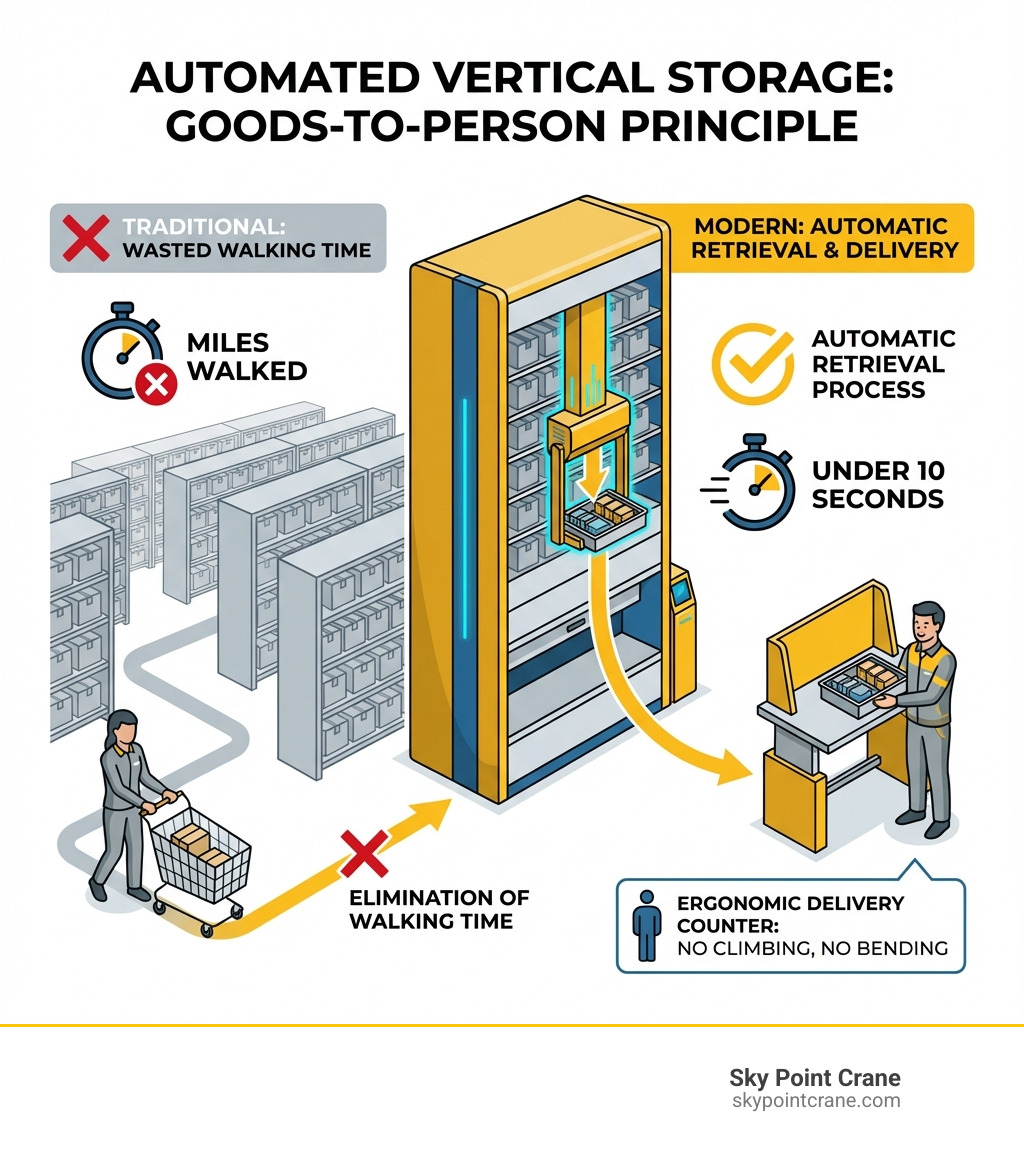
Industrial vertical storage solves these problems by utilizing your building’s height. Instead of spreading inventory across acres of floor space, these systems stack items vertically in compact units. When an operator needs a part, the system automatically retrieves it and delivers it to an ergonomic work counter at waist height. No more searching, climbing, or wasted motion.
The results are measurable. Companies implementing vertical storage report freeing up 60-85% of their floor space, doubling or tripling throughput, and achieving near-perfect inventory accuracy. These aren’t just storage units—they’re strategic tools that transform how warehouses and production facilities operate.
I’m Dave Brocious, and my 30+ years in manufacturing, distribution, and industrial operations have shown me how the right industrial vertical storage solution can dramatically impact efficiency and safety. At Sky Point Crane, we’ve helped countless facilities in Western Pennsylvania not only select the right systems but also handle the complex rigging and installation that these heavy, precision units require.
Know your industrial vertical storage terms:
The Core Benefits of Going Vertical: Space, Savings, and Efficiency
When we talk about industrial vertical storage, we’re not just talking about stacking things high. We’re talking about a fundamental shift in how we approach warehouse and production logistics. The benefits ripple through every aspect of an operation, from the bottom line to employee well-being.
Maximize Your Footprint: Reclaiming Up to 85% of Floor Space
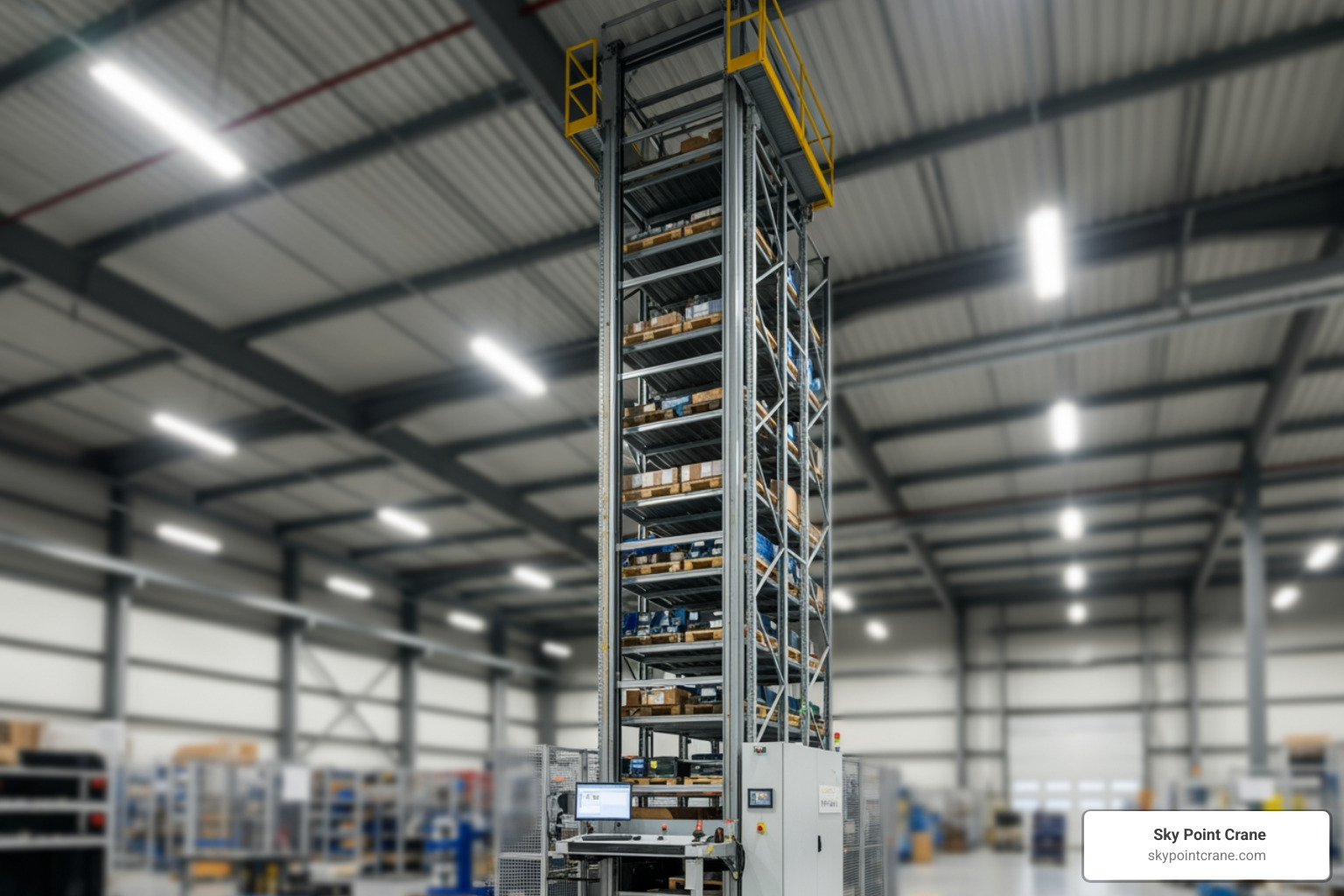
One of the most immediate and impactful advantages of industrial vertical storage is its ability to radically transform your facility’s footprint. Traditional horizontal storage often leaves vast amounts of overhead space — what we like to call “air rights” — completely unused. In today’s competitive landscape, with real estate costs continually rising, expanding your physical building is an expensive, often unnecessary, solution.
Vertical storage systems like Vertical Lift Modules (VLMs) and vertical carousels are designed to capitalize on this untapped vertical space. They can increase your storage capacity by up to 60% within the same footprint, or even better, save up to 85% of your existing floor space. Imagine what you could do with that liberated square footage! More production lines, a larger staging area, or perhaps even a more comfortable breakroom for your hardworking team. This significant reduction in required floor space translates directly into substantial cost savings on real estate, heating, cooling, and even lighting. It’s like finding extra rooms in your house you never knew you had!
For more ways to optimize your indoor industrial space, explore our indoor industrial storage solutions.
Boosting Productivity with the ‘Goods-to-Person’ Principle
At the heart of industrial vertical storage efficiency is the “goods-to-person” principle. Instead of operators walking long distances, searching for items, and climbing ladders or using forklifts, the system brings the required item directly to an ergonomic retrieval counter. This eliminates the “walk and search” time, which can be a massive drain on productivity in traditional warehouses.
The statistics on this are compelling:
- We’ve seen these systems increase pick productivity by up to 400%.
- They can reduce pick time to under 10 seconds, allowing operators to process even complex orders in the shortest possible time.
- This streamlined process often doubles or triples throughput without sacrificing precision, significantly boosting the speed at which orders are fulfilled.
- Furthermore, by automating retrieval and reducing manual labor, companies can cut labor costs by up to 2/3.
The power of vertical storage extends beyond just saving space; it’s about making every minute count, allowing your team to focus on value-added tasks rather than wasted motion. As industry experts emphasize, VLMs capitalize on unused vertical space, freeing up to 85% of previously used floor space and boosting productivity with automated retrieval. You can learn more about this by visiting the MHI Solutions Guide.
Enhancing Ergonomics and Workplace Safety
Beyond space and speed, industrial vertical storage solutions are champions of workplace safety and ergonomics. In traditional warehouses, employees frequently bend, reach, climb ladders, and lift heavy items, leading to fatigue and a higher risk of injuries. Vertical storage systems virtually eliminate these hazards.
Items are delivered to an ergonomically designed waist-high retrieval counter, preventing the need for excessive bending, climbing, or reaching. This reduces strain on the back, shoulders, and knees, contributing to a healthier workforce. Furthermore, these systems are enclosed, protecting employees from falling objects and securing inventory from accidental damage. Many units come equipped with advanced safety features such as safety light barriers, automatic shutter doors, and obstruction sensors that immediately halt operation if an issue is detected. This proactive approach to safety significantly reduces workplace injuries, improving employee morale and reducing costly worker’s compensation claims.
We are committed to creating safer working environments for our clients. Learn more about our dedication to safety and health at our safety, health, and environment page.
Calculating the Return on Investment (ROI)
The decision to invest in industrial vertical storage isn’t just about the immediate benefits; it’s about securing a strong return on investment. While the upfront cost might seem significant, the long-term savings and increased efficiencies typically result in a surprisingly fast ROI, often less than 12 months.
When calculating the ROI, we consider several factors:
- Labor Savings: The reduction in manual labor and increased productivity translates directly into lower operational costs.
- Increased Order Accuracy: With picking accuracy rates up to 99.9%, the costs associated with mispicks, returns, and customer dissatisfaction are dramatically reduced.
- Reduced Inventory Damage and Shrinkage: Enclosed systems protect valuable inventory from dust, damage, and pilfering.
- Space Savings: The value of reclaiming 60-85% of floor space can be quantified by avoiding costly warehouse expansions or by utilizing the freed space for higher-value activities.
- Improved Safety: Fewer workplace injuries mean lower medical costs, reduced absenteeism, and a more engaged workforce.
These combined factors demonstrate that industrial vertical storage isn’t just an expense; it’s a strategic investment that pays dividends for years to come.
A Deep Dive into Industrial Vertical Storage Systems
While the overarching benefits of industrial vertical storage are clear, the specific solution for your facility will depend on your unique needs. Automated Storage and Retrieval Systems (AS/RS) come in various forms, each with distinct advantages. Let’s explore the two most prominent types: Vertical Lift Modules (VLMs) and Vertical Carousels.
Vertical Lift Modules (VLMs): The Flexible Powerhouse
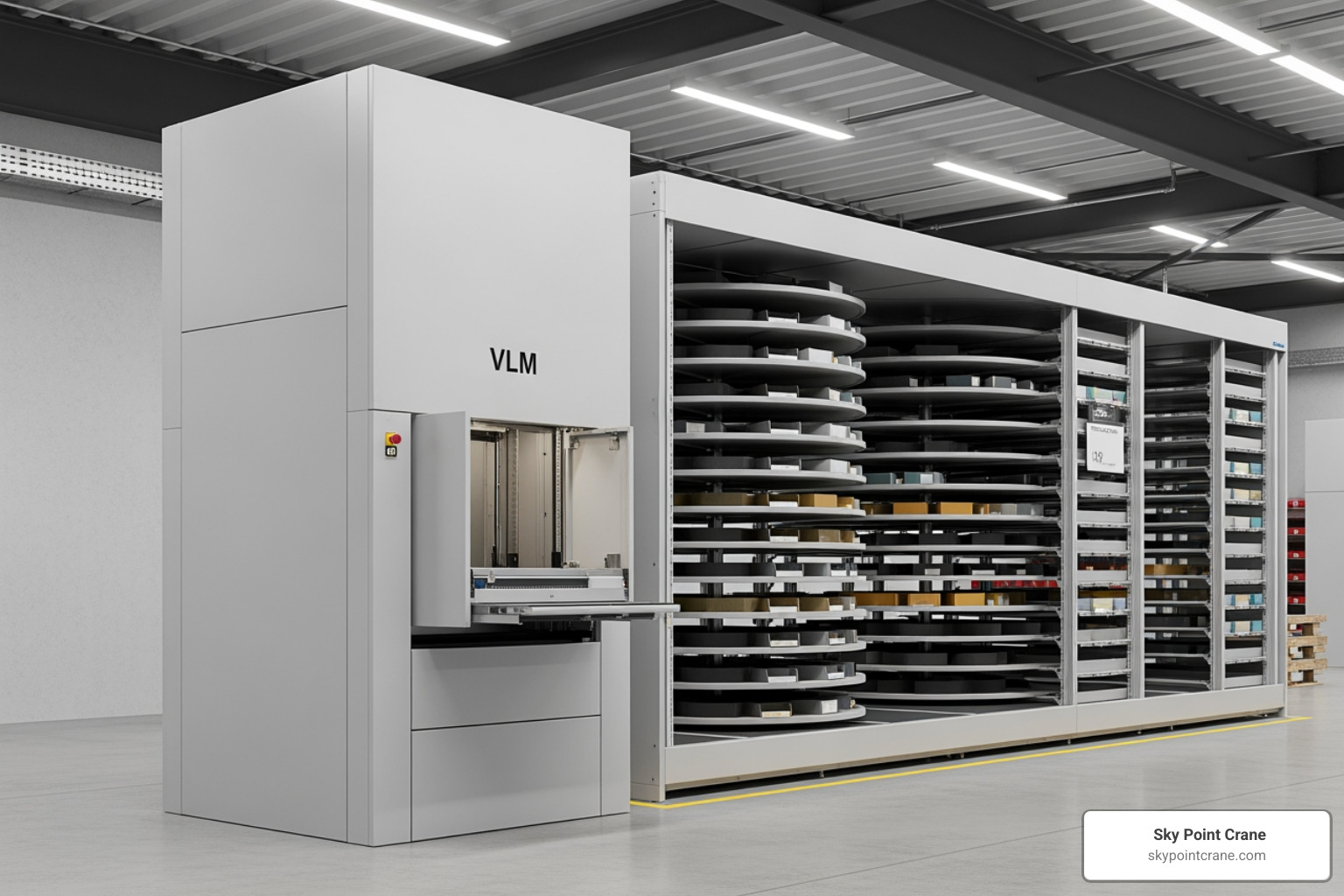
Vertical Lift Modules (VLMs), often called shuttles, are fully automated storage and retrieval systems designed for maximum flexibility and efficiency. Think of them as gigantic, intelligent filing cabinets that reach for the sky.
A VLM consists of two columns of trays with an automated extractor (or inserter/extractor) mechanism moving vertically and horizontally between them. When an item is requested, the extractor retrieves the specific tray and delivers it to an ergonomic access opening at the operator’s level. A key feature is dynamic tray height sensing: as trays are put away, integrated photo-light sensors scan the height of the contents, storing the tray in the most space-efficient location possible. This allows for highly flexible storage of items of varying sizes within the same unit.
VLMs are particularly well-suited for:
- Varied Item Sizes and Weights: They can handle a wide range of inventory, from small parts to heavier, bulkier items. For instance, the PowerColumn 3 VLM can handle loads of up to 2,000 pounds per tray, and some Lean-Lift trays can bear up to 2,208 lbs, with a total unit capacity of up to 132,450 lbs.
- High Ceilings: VLMs can reach impressive heights, from 8.4 to nearly 99 feet, making optimal use of vertical space.
- Integration: VLMs can integrate with overhead cranes and lift-assist equipment for handling very heavy components.
Leading VLM solutions like the SSI LOGIMAT® or Modula systems exemplify this technology, offering robust construction and intelligent inventory management. To learn more about how these systems work, check out this Guide to Understanding Vertical Lift Modules.
Vertical Carousels: The High-Density Specialist
Vertical carousels are another popular form of industrial vertical storage, operating on a principle similar to a Ferris wheel. They consist of a series of carriers or shelves attached to a chain drive that rotates vertically within an enclosed system. When an operator requests an item, the carousel rotates, bringing the correct carrier to an access opening at an ergonomic height.
Vertical carousels excel in applications requiring high-density storage of smaller, more uniform items. They are ideal for:
- Small Parts and Documents: Perfect for managing vast quantities of small components, tools, or even office records.
- Consistent Item Sizes: While some flexibility exists, carousels are generally more efficient when storing items of similar dimensions.
- Lower to Moderate Ceiling Heights: Typically ranging from 7 to 30 feet, they are a great fit for facilities with less extreme vertical space.
- Load Capacity: Vertical carousels can handle loads of up to 1,400 pounds per carrier, making them suitable for many industrial applications.
Manufacturers like Hänel Storage Systems and Vidir Storage Solutions are well-known for their robust vertical carousel offerings. These systems are commonly integrated into manufacturing, distribution, production facilities, and even for managing office records. You can explore more about these solutions at Hänel Storage Systems and Vidir Storage Solutions.
For a comprehensive look at various storage strategies, visit our industrial storage solutions ultimate guide.
VLM vs. Vertical Carousel: A Side-by-Side Comparison
| Feature | Vertical Lift Modules (VLMs) | Vertical Carousels |
|---|---|---|
| Mechanism | Extractor/shuttle retrieves specific trays | Carriers rotate like a Ferris wheel |
| Item Size Flexibility | High (dynamic tray height adjustment) | Moderate (best for uniform sizes) |
| Load Capacity (per tray/carrier) | Up to 2,200 lbs (some models) | Up to 1,400 lbs |
| Ceiling Height Suitability | Very high (up to ~99 ft) | Moderate (up to ~30 ft) |
| Retrieval Speed | Fast (brings specific tray) | Fast (rotates to present carrier) |
| Integration with Cranes | Yes, can integrate with overhead cranes | Less common, generally not designed for heavy crane integration |
Key Features and Customization Options
Choosing the right industrial vertical storage system means considering a range of features and customization possibilities to meet your precise operational needs.
- Load Capacity: This is crucial. As we’ve seen, VLMs can handle trays with contents weighing over 2,000 lbs, while carousels typically manage up to 1,400 lbs per carrier. Your heaviest items will dictate this choice.
- Tray and Carrier Dimensions: Systems offer a variety of tray sizes. For example, the PowerColumn 3 is fully customizable with tray sizes up to 60″ x 240″. This flexibility ensures you can store everything from tiny fasteners to long, awkward pieces of material.
- Unit Height and Footprint: VLMs can reach up to 99 feet, making them ideal for facilities with very high ceilings in Western Pennsylvania, Ohio, West Virginia, or Maryland. Carousels are better suited for moderate heights.
- Access Openings: Many VLMs offer multi-floor access, allowing items to be retrieved from different levels of a building. Some even allow access from both the front and rear.
- Temperature Control and Cleanroom Options: For specialized industries like pharmaceuticals or medical technology, certain VLMs and carousels can be configured with climate control (refrigerated or frozen) or designed for cleanroom environments (ISO Class 6-8), ensuring product integrity and compliance.
- Custom Software: Beyond the physical unit, the software is key. Many systems can be integrated with existing WMS or ERP, and some offer specialized software for inventory management, user access control, and performance tracking.
- New vs. Used Equipment: Both new and used vertical storage equipment are available. New units offer the latest technology, warranties, and full customization. Used equipment can be a more budget-friendly option, and many providers offer refurbishment, warranties, and upgrades for older models, making them a viable choice for many businesses.
For specific requirements, such as heavy-duty storage or specialized cabinet needs, we can help you find solutions. Explore our industrial cabinets for more information.
Integrating Technology for a Smarter Warehouse
The real magic of modern industrial vertical storage lies in its integration with advanced technology. These aren’t just standalone machines; they are intelligent components of a larger, smarter warehouse ecosystem.
Achieving 99.9% Inventory Accuracy and Security
One of the most compelling reasons to adopt industrial vertical storage is the dramatic improvement in inventory accuracy and security. Manual inventory management is prone to human error, leading to miscounts, lost items, and frustrating searches. Automated systems virtually eliminate these issues.
- Automated Inventory Tracking: Every item’s location is precisely tracked by the system’s software. When an item is picked or put away, the system records the transaction, providing real-time inventory data.
- Pick-to-Light Technology: This feature guides operators directly to the correct item with visual cues (e.g., a light illuminating the exact bin). It displays the quantity to pick, significantly reducing errors. This technology helps achieve picking accuracy rates of up to 99.9%.
- Improved Security: The enclosed design of vertical storage systems protects inventory from dust, damage, and unauthorized access. User access controls, requiring employee logins and tracking every transaction, drastically reduce shrinkage and theft. Valuable or sensitive items are kept secure, providing peace of mind.
Seamless Integration with WMS and ERP Systems
For a truly optimized operation, industrial vertical storage systems must communicate seamlessly with your existing Warehouse Management Systems (WMS) and Enterprise Resource Planning (ERP) systems. This integration is critical for open uping the full potential of automation.
- Real-time Data Exchange: Integrated systems provide a single source of truth for inventory data, updating stock levels in real-time across your entire operation.
- Streamlined Order Fulfillment: Orders placed through your ERP or WMS can be automatically sent to the vertical storage system, initiating the goods-to-person retrieval process. This minimizes delays and accelerates order fulfillment.
- Improved Inventory Forecasting: With accurate, real-time data, your WMS/ERP can make more precise inventory forecasts, optimizing purchasing and reducing carrying costs.
- Reduced Manual Data Entry: Automation eliminates the need for manual data input, reducing errors and freeing up staff for more strategic tasks.
- API and Middleware Connectivity: Modern vertical storage systems are designed with Application Programming Interfaces (APIs) and middleware to facilitate easy integration with a wide range of WMS, ERP (including SAP), and e-commerce platforms.
The Role of Industrial Vertical Storage in Warehouse Automation
Industrial vertical storage solutions are not just isolated improvements; they are foundational components of a comprehensive warehouse automation strategy. They represent a significant step towards creating a fully automated and intelligent facility.
By centralizing inventory in vertical systems, you create a dense, accessible core that can feed other automated processes. These systems integrate seamlessly with:
- Conveyors: Automatically delivering retrieved items to packing stations or outbound shipping.
- Robotics: Working in conjunction with robotic arms or autonomous mobile robots (AMRs) for further automation of picking, packing, or transport tasks.
This integration reshapes the warehousing landscape, propelling businesses toward unparalleled efficiency. By embracing vertical storage as part of a broader automation strategy, we help future-proof operations in our service areas of Western Pennsylvania, Ohio, West Virginia, and Maryland, ensuring they remain competitive and adaptable to evolving market demands. You can dig deeper into how VLMs are reshaping warehousing by reading this vertical lift module guide.
Frequently Asked Questions about Industrial Vertical Storage
We often get asked similar questions about industrial vertical storage solutions. Here are some of the most common ones, with our expert answers.
What’s the main difference between a Vertical Lift Module (VLM) and a Vertical Carousel?
The core difference lies in their internal mechanism and flexibility.
- A Vertical Lift Module (VLM) uses an internal extractor or shuttle to retrieve a specific tray from one of two columns of storage. This allows for dynamic height adjustment for each tray, making VLMs highly flexible for storing items of varied sizes and weights.
- A Vertical Carousel operates like a rotating Ferris wheel, where a series of carriers (shelves or bins) are attached to a chain drive. The entire carousel rotates to bring the desired carrier to the access point. This design is best suited for high-density storage of items that are relatively uniform in size and weight.
VLMs offer greater flexibility for diverse inventory and heavier loads, while carousels excel at maximizing space for smaller, consistently sized items.
How much floor space can I realistically save?
Realistically, you can expect to save a significant amount of floor space, often between 60% and 85% compared to traditional static shelving. The exact percentage depends heavily on your current storage methods, the height of your facility’s ceiling, and the type of industrial vertical storage system implemented. By utilizing cubic space that would otherwise go unused, these systems allow you to consolidate inventory into a much smaller footprint, freeing up valuable floor space for other critical operations or even avoiding costly facility expansion.
Can these systems handle very heavy or bulky items?
Absolutely! While many people associate vertical storage with small parts, Vertical Lift Modules (VLMs) are particularly adept at handling heavy and bulky items. VLMs are available in heavy-duty configurations with tray capacities typically ranging from 1,000 lbs to over 2,200 lbs per tray. This makes them ideal for storing tools, dies, molds, engine parts, and other large components found in industrial settings. For extremely heavy or oversized items, these systems can even integrate with overhead cranes or other lift-assist equipment for safe and efficient loading and unloading.
For those needing robust solutions for heavy materials, our industrial racking installation services can complement your vertical storage setup.
Which industries commonly benefit from vertical storage solutions, and what are some real-world examples?
Industrial vertical storage solutions offer transformative benefits across a wide spectrum of industries.
- Manufacturing: For storing tools, dies, spare parts, and work-in-progress components. Case studies show companies like ABB eliminated over 500 storage bin locations, optimizing their production floor.
- Distribution & Logistics: For high-volume order picking and managing diverse inventory. They can double or triple throughput in these environments.
- Healthcare & Pharmaceuticals: For secure, accurate, and often climate-controlled storage of medications, medical supplies, and sensitive equipment. Moses Cone Memorial Hospital reduced their storage footprint by 50% by consolidating refrigerated inventory.
- Automotive: For managing thousands of spare parts in dealerships and manufacturing plants.
- Aerospace: For precise storage of expensive components and tools, often in cleanroom environments.
- E-commerce: For rapid order fulfillment and managing vast product catalogs with high accuracy.
- Office Records Management: Vertical carousels are excellent for secure, high-density storage of important documents and files.
Essentially, any industry dealing with inventory, regardless of size or value, can find a significant advantage in adopting vertical storage.
What are the maintenance and service considerations for vertical storage systems?
Like any advanced machinery, industrial vertical storage systems require proper maintenance to ensure optimal performance and longevity.
- Preventative Maintenance: Regular preventative maintenance (typically two visits per year) is crucial. This includes inspecting mechanical components, sensors, and software, and ensuring all safety features are functioning correctly.
- Warranty and After-Sale Service: Reputable providers offer warranties on new equipment and comprehensive after-sale service, including parts, software upgrades, and modernization of older controllers. Many, like White Systems, provide support from U.S.-based technicians.
- Operator Training: Proper training for your staff on how to operate and troubleshoot the system minimizes errors and maximizes efficiency.
- Sky Point Crane’s Role: Beyond the vertical storage units themselves, the installation of these heavy, precise systems requires expert rigging. At Sky Point Crane, we specialize in providing the necessary crane and rigging services for the safe and efficient installation and occasional heavy maintenance of such equipment in Western Pennsylvania, Ohio, West Virginia, and Maryland. Our NCCCO certified operators and 3D Lift Planning ensure precision and safety during every step.
Conclusion
The landscape of modern industrial operations demands solutions that are not only efficient but also adaptable and safe. Industrial vertical storage systems stand out as a transformative technology, offering unparalleled benefits in space utilization, operational productivity, inventory accuracy, and workplace safety. From reclaiming up to 85% of valuable floor space to boosting picking accuracy to 99.9% and drastically reducing labor costs, the strategic advantages are clear and quantifiable.
Whether you opt for the flexible power of Vertical Lift Modules or the high-density specialization of Vertical Carousels, integrating these systems with your WMS and ERP will create a smarter, more automated, and future-ready warehouse.
At Sky Point Crane, we understand the intricate needs of industrial facilities in Western and Central Pennsylvania, Ohio, West Virginia, and Maryland. Our expertise in rigging and precision installation ensures that your transition to advanced industrial vertical storage is seamless and secure. We’re not just moving things; we’re helping you move forward.
Take your industrial operations to the next level with the right storage solutions.