Everything You Need to Know About Tracked Spider Crane Technology
When Space Is Tight, a Spider Crawler Crane Gets the Job Done
A spider crawler crane is a compact, tracked mini crane with hydraulic outrigger “legs” that spread out like a spider to stabilize the machine — allowing it to lift heavy loads in spaces where no other crane can fit.
Here’s a quick summary of what makes them unique:
| Feature | Spider Crawler Crane |
|---|---|
| Typical lifting capacity | 1 ton to 12+ tons |
| Maximum lift height | Up to 22–25 meters |
| Body width | As narrow as 590mm (fits through a standard door) |
| Terrain | Uneven ground, slopes, indoor floors |
| Power options | Diesel, electric, or battery |
| Best use case | Confined spaces, indoor lifts, rooftops |
If you manage construction projects in Western Pennsylvania or anywhere with tight job sites, you already know the headache of getting a crane into a narrow building, up an elevator shaft, or through a standard doorway. Traditional crawler cranes are powerful — but they’re also massive, heavy, and impossible to squeeze into confined spaces. That’s exactly the problem spider crawler cranes were built to solve.
These machines combine the tracked stability of a crawler crane with a folding, compact body and extendable outrigger legs. The result is a crane that can travel through a single doorway, set up on an uneven rooftop, and lift thousands of pounds — all without the footprint of conventional equipment.
I’m Dave Brocious, and with over 30 years of experience in heavy equipment strategy and operations, I’ve seen how the right spider crawler crane can turn an impossible lift into a routine task. That hands-on perspective is what drives everything we do at Sky Point Crane.
What is a Spider Crawler Crane?
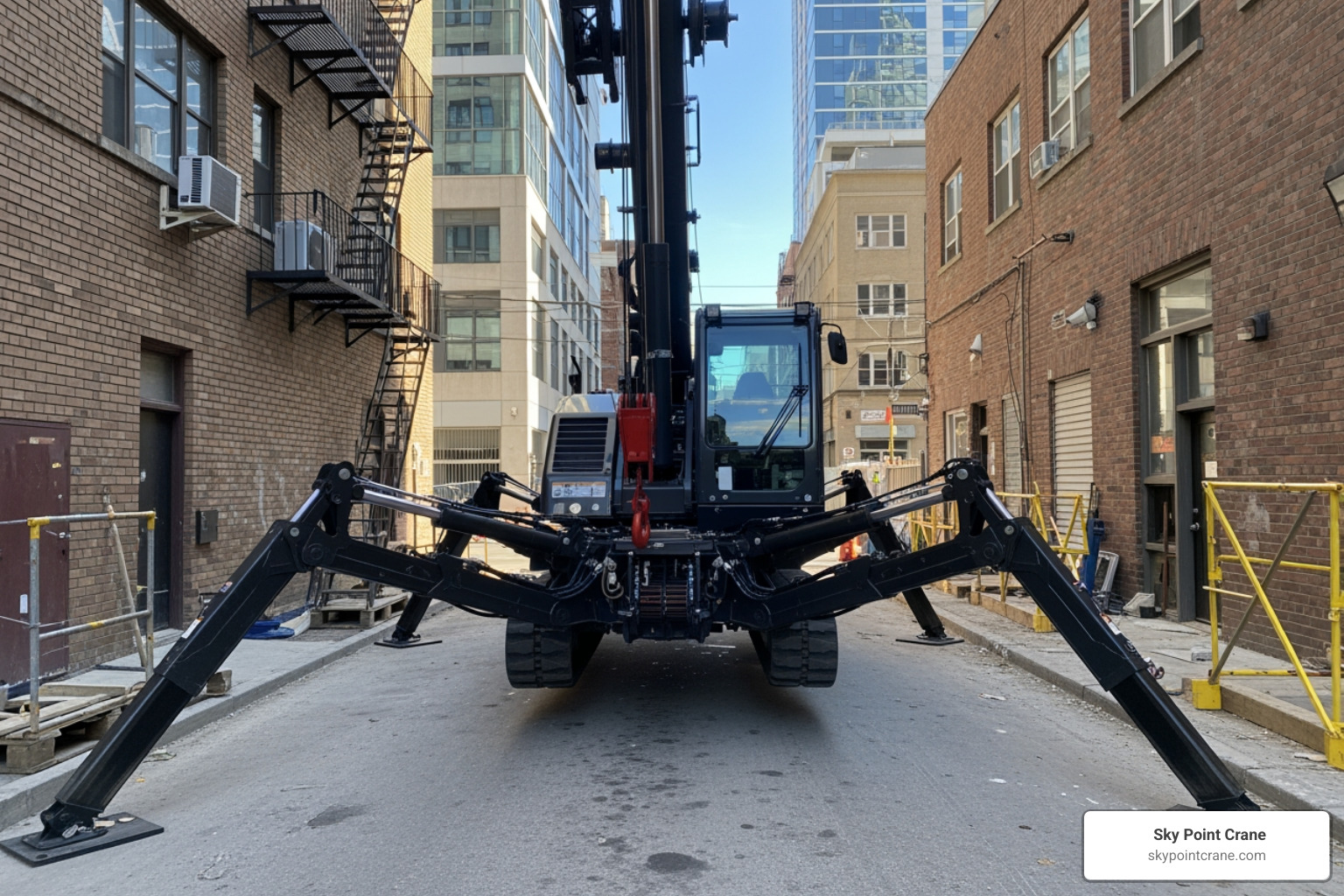
At its core, a spider crawler crane is a lightweight, mini crawler crane designed for maximum maneuverability. While a traditional crane relies on its massive weight (counterweight) to stay upright, a spider crane uses its “legs” to create a wide, stable footprint. This allows the machine itself to stay incredibly light and compact.
We often call them “mini crawlers” because they move on rubber tracks, which are perfect for navigating the finished floors of a new hospital in Pittsburgh or the muddy terrain of a job site in West Virginia. The name “spider” comes from the four hydraulic outriggers that unfold from the chassis. These legs can be positioned at different angles and heights, allowing the crane to “stand” over obstacles, on stairs, or on uneven slopes where a flat-bottomed crane would simply tip over.
If you are looking for a deep dive into these machines, check out our Spider Crane service page or our Mini Spider Crane Ultimate Guide.
Understanding the Components of a Spider Crawler Crane
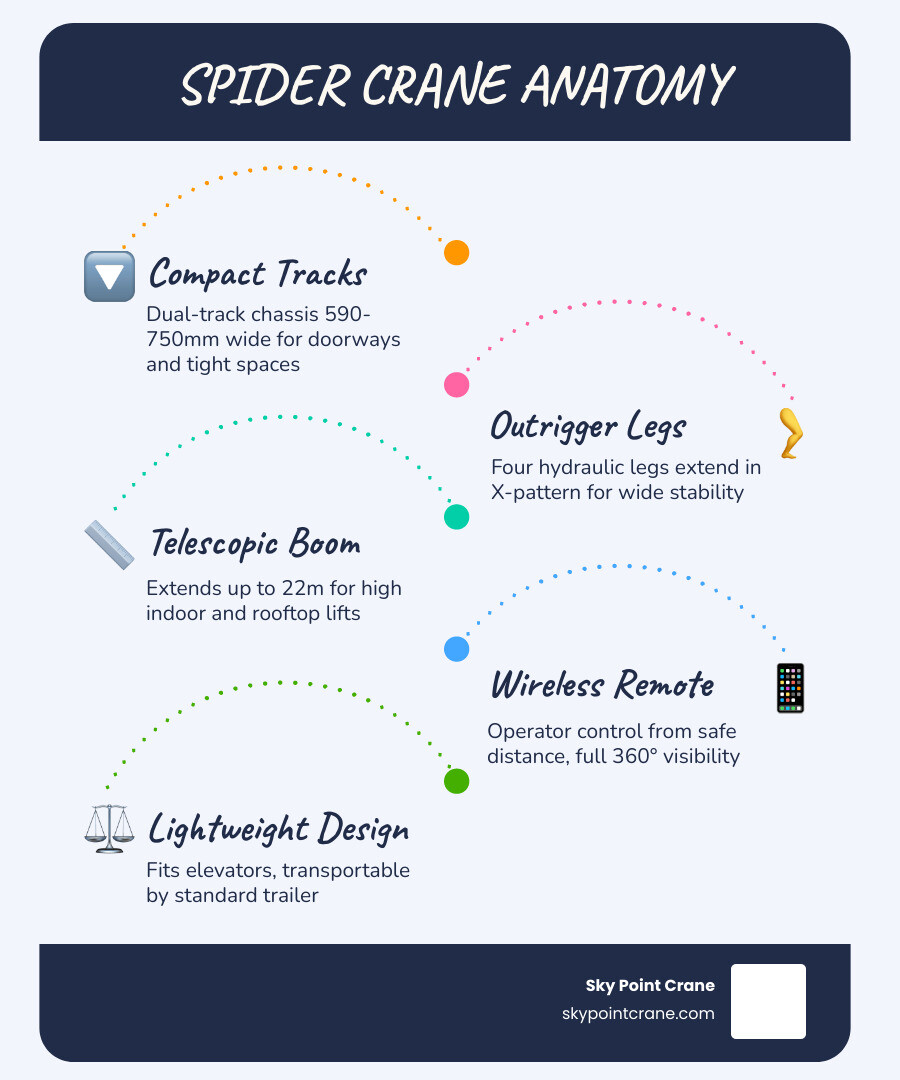
To understand how these machines work, we need to look under the hood (or the legs). A high-quality spider crawler crane is a marvel of engineering, packing several high-tech components into a tiny frame:
- Telescopic U-Shaped Boom: Most models feature a high-strength steel boom that extends and retracts hydraulically. The “U-shape” design helps distribute stress and increases lifting capacity while keeping the weight down.
- Hydraulic Outriggers: These are the “legs.” They feature automatic support systems and hydraulic locks to ensure they don’t move once set.
- Wireless Remote Control: This is a game-changer for safety. Operators can stand away from the load, getting a better view of the lift while controlling the crane with precision.
- Dual Power Systems: Many of the units we work with offer both a diesel engine for outdoor travel and an electric motor or battery for emission-free, quiet indoor work.
- Disk Brake Winch: This provides high durability for continuous use, ensuring the load stays exactly where you put it.
- Load Moment Indicator (LMI): An on-board computer that monitors the load, height, and radius. It will warn the operator at 90% capacity and automatically stop the crane at 100% to prevent tipping.
For example, the Spyder Crane Model URW295 is a classic example of this technology, offering a 2.9-ton capacity in a frame that can fit through a standard doorway.
How Spider Models Differ from Traditional Crawler Cranes
When people hear “crawler crane,” they often think of giants like the XGC88000 crawler crane, which can lift thousands of tons but requires a fleet of trucks just to transport its parts.
A spider crawler crane is the polar opposite. Here are the three main differences:
- Stabilization: Traditional crawlers use their own weight and wide tracks for stability. Spider cranes use outriggers. This means a spider crane can operate on a floor that isn’t perfectly level, whereas a traditional crawler usually requires a flat, prepared surface.
- Ground Pressure: Because they are lightweight and use outriggers to spread the load, spider cranes have very low ground pressure. This is vital when working on rooftops or over underground parking garages in cities like Cleveland or Baltimore.
- Access: A traditional crawler stays outside. A spider crane can literally take the service elevator to the 20th floor, drive through a hallway, and perform a lift inside a finished room.
Key Capabilities and Specifications of a Spider Crawler Crane
Don’t let the small size fool you. These machines are surprisingly “beastly” when it comes to raw numbers. Depending on the model, a spider crawler crane can lift everything from a small HVAC unit to heavy steel beams.
Lifting Capacities and Height Reach
The lifting capacity of a spider crawler crane is highly dependent on the “working radius”—how far away the load is from the center of the crane.
- Small Models (1-3 Tons): These are the “doorway” models. They are perfect for glazing (installing glass) and small plant maintenance.
- Medium Models (4-6 Tons): Models like the URW706 can lift about 13,300 lbs at a short radius. These are the workhorses of urban construction.
- Heavy Duty (8-12 Tons): The largest spider cranes, like the URW-1006, can lift 20,000 lbs. These are used for major industrial installs.
When it comes to height, you might be surprised to learn how high these can reach. Some models have a tip height of over 80 feet when fully extended. If you’re wondering about height limits for your specific project, take a look at our guide: How High Up Can I Use a Spyder Crane?.
Comparing Industry Standard Mini Crane Models
Not all mini cranes are built the same. When choosing a Mini Crane Rental, you’ll encounter different configurations:
- Telescopic Booms: These are the most common. They extend straight out like a telescope and are great for reaching high or far.
- Articulated Booms: These have a “knuckle” that allows them to reach up and over obstacles, much like a finger.
- Pick and Carry Mode: Some mini cranes (often called minipickers) can move while holding a load. Standard spider cranes usually must remain stationary with outriggers deployed to lift their maximum capacity.
- Searcher Hooks and Fly Jibs: These attachments allow the crane to work in even tighter spaces, such as lifting a glass pane right up under a low ceiling.
For more details on specific models, you can browse our Category Crane Rental Mini Spider Crane Rental page.
How to Operate and Set Up a Spider Crawler Crane Safely
Operating a spider crawler crane requires a mix of traditional rigging knowledge and high-tech computer management. Safety is our number one priority at Sky Point Crane, and these machines are packed with features to keep your crew safe.
Transporting Your Spider Crawler Crane to the Job Site
One of the biggest advantages of these cranes is how easy they are to move. Because they are compact, you don’t need a massive multi-axle trailer.
- Standard Trailers: Most small to mid-sized spider cranes can be towed behind a heavy-duty pickup truck.
- Service Elevators: The smallest models (590mm to 750mm wide) can fit into standard freight elevators.
- Quick Disassemble Systems: On larger models like the URW706, you can actually remove the outriggers and boom to reduce the weight for transport or for crane-loading it onto a rooftop.
Even for massive projects, like the record-breaking lifts mentioned in PR News Wire: Crane Capacity Record Breaker, the logistics of smaller support cranes like the spider crane are what keep the site moving efficiently.
Maintenance and Safety Certifications
Like any piece of heavy machinery, a spider crawler crane needs regular love and attention. If you’re looking into Mini Crane Hire, ensure the equipment has been properly maintained.
- Daily Inspections: Check the hydraulic lines, track tension, and outrigger locks every single morning.
- Load Moment Limiter Checks: We always test the computer system to ensure it’s accurately reading the load weight.
- Non-marking Tracks: For indoor work, we use rubber tracks that won’t scuff up those expensive warehouse or lobby floors.
- Certifications: Operators should be NCCCO certified. While these cranes look like “toys” compared to a 500-ton mobile crane, they are powerful machines that require professional handling. You can learn more about this at Certification for Spyder Crane.
Top Applications and Benefits in Modern Construction
We see spider cranes used in some of the most creative ways imaginable across Pennsylvania and Ohio. They are the “Swiss Army Knives” of the lifting world.
Advantages of Compact Tracked Lifting
The benefits of using a spider crawler crane usually boil down to three things: Access, Stability, and Cost.
- Glazing and Curtain Walls: This is the most common use. Using a searcher hook and vacuum lifter, a spider crane can install massive glass panels from the inside of a building, saving you the cost of massive exterior scaffolding.
- Steel Erection in Tight Spots: When you’re adding a mezzanine inside an existing factory, a traditional crane can’t get through the door. A spider crane drives right in.
- Rooftop Work: Because they are lightweight, they can be lifted to a roof by a larger crane. Once there, they can move HVAC units or cellular equipment without needing a massive crane parked on the street for weeks.
- 360-Degree Rotation: Unlike some small lifting devices, a spider crane can slew (rotate) 360 degrees continuously, giving you total flexibility.
Limitations and Environmental Suitability
No machine is perfect. It’s important to know what a spider crawler crane can’t do.
- Payload Restrictions: As the boom extends out, the capacity drops. A crane that lifts 6 tons at 10 feet might only lift a few hundred pounds at 60 feet.
- Setup Time: While they save time overall, you do have to spend time properly deploying and leveling the outriggers.
- Weather Sensitivity: Because they are light, high winds can affect them more than a heavy-duty crawler.
- Regional Scarcity: These are specialized tools. You won’t find them at every local tool rental shop, which is why we specialize in providing them across our service area.
For a real-world look at how specialized equipment handles tough environments, you might find interest in this Stone Construction Case Study regarding coal site operations.
Frequently Asked Questions about Spider Crawler Cranes
Can a spider crane fit through a standard door?
Yes! Many models are specifically designed with a travel width of 24 to 30 inches (590mm – 750mm), allowing them to pass through a standard single doorway or into a freight elevator.
What is the maximum weight a mini spider crane can lift?
The heavy hitters in the spider crane world, like the URW-1006, can lift up to 10 metric tons (22,000 lbs). However, most common rental models handle between 1 and 6 tons.
Do I need a special certification to operate a spider crane?
In most professional construction environments, yes. OSHA requires crane operators to be certified for the type of equipment they are using. At Sky Point Crane, we provide NCCCO certified operators to ensure every lift is handled by a pro.
Conclusion
Whether you are working on a high-rise in downtown Pittsburgh or a factory renovation in Maryland, the spider crawler crane is often the missing piece of the puzzle. It bridges the gap between manual labor and massive, expensive traditional cranes.
At Sky Point Crane, we don’t just “rent equipment.” We provide comprehensive lifting solutions. From 3D Lift Planning to project management, we make sure your lift is safe, efficient, and on budget. If you’re debating between Renting a Spyder Crane or purchasing one, we can help you weigh the Cost of Spyder Crane ownership versus the flexibility of a rental.
Ready to see if a spider crane is right for your next project? Check out our main Spider Crane page or give us a call. We’re ready to help you reach new heights—even in the tightest spaces.