
Ohio’s Emergence as a Data Center Powerhouse

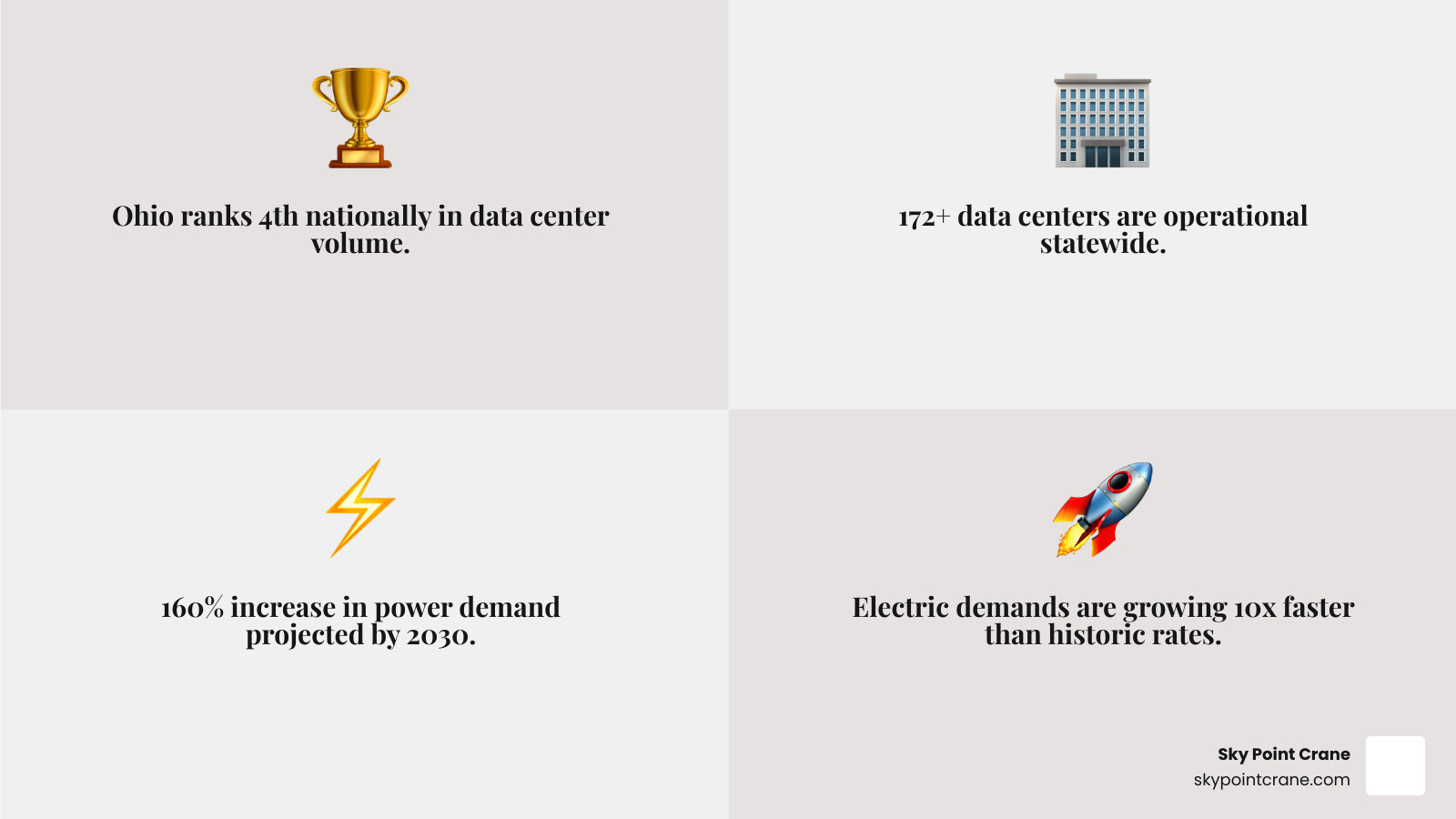
Ohio data center infrastructure has quietly become one of the nation’s most significant digital hubs. The state now ranks fourth nationally for data center volume, trailing only Virginia, Texas, and California. With 172 data centers across the state—more than Pennsylvania, Michigan, and Indiana combined—Ohio has attracted billions in investment from tech giants like Google ($1.7 billion), Amazon ($3.5 billion), and Meta.
Quick Facts About Ohio Data Centers:
- National Ranking: 4th in the United States
- Total Facilities: 172+ data centers statewide
- Central Ohio Leadership: 104 data centers (the state’s primary hub)
- Major Investors: AWS, Google, Meta, QTS Data Centers, Vantage Data Centers
- Power Demand Growth: Projected 160% increase by 2030
- Key Advantage: Central location with low latency to both coasts
Why Ohio is attracting massive data center investment:
- Strategic central U.S. location for content distribution
- Abundant cheap land and power resources
- Data center sales tax exemptions
- Robust electric grid infrastructure
- Historical fiber optic routes along the 41st parallel
This boom hasn’t come without challenges. Electric demands are increasing at 10 times the historic growth rate, with AEP Ohio experiencing unprecedented strain on the grid. Communities are also watching their water resources carefully, as large facilities can consume hundreds of thousands of gallons daily.
I’m Dave Brocious, and through my work at Sky Point Crane, I’ve witnessed the massive construction requirements of the Ohio data center industry, from lifting heavy HVAC units to setting precast concrete panels for these mission-critical facilities. Our team has been on the ground supporting the infrastructure that powers Ohio’s digital change.
Glossary for Ohio data center:
Why Ohio? The Factors Fueling the Data Center Surge
Ohio’s ascension as a leading hub for data centers isn’t accidental; it’s a carefully cultivated outcome driven by a confluence of strategic advantages and proactive policies. For years, the data center industry primarily clustered around traditional tech hubs on the coasts. However, the rise of hyperscale data centers—massive facilities designed to house tens of thousands of servers—shifted the focus towards locations offering abundant, affordable land and power. Ohio emerged as a prime candidate, and we’ve seen the results firsthand.

The Strategic Advantages
One of the most compelling reasons for the Ohio data center boom is the state’s central geographic location. Imagine the internet as a vast highway system. If data has to travel from one coast to the other, a central waypoint significantly reduces the journey time. This central position allows for incredibly efficient content distribution, minimizing latency—that annoying delay you experience when streaming a movie or waiting for a webpage to load. This means quicker data movement to both the East and West Coasts, which is crucial for applications, streaming services, and disaster recovery. For instance, AWS customers in Ohio can experience as low as 12 milliseconds of latency to the US-East (Northern Virginia) region for failover purposes, a critical factor for ensuring business continuity.
Beyond geography, Ohio boasts a historical and infrastructural advantage tied to the 41st parallel. This imaginary line running through the state isn’t just a geographical marker; it’s a superhighway for fiber optic cables. Historically, these routes often followed old railroad rights-of-way, creating a robust, high-bandwidth backbone that crisscrosses the continent. This existing infrastructure provides data centers with unprecedented access to the highest bandwidth, creating a virtuous cycle: more data centers drive more traffic, which drives more fiber optic cables, which, in turn, attracts even more data centers. As Microsoft’s George Moore noted, the historical fiber routes along the 41st parallel are a testament to how 19th-century politics influenced 21st-century digital infrastructure.
Financial and Infrastructural Incentives
Ohio also understands the language of business. The state has implemented favorable tax policies, most notably the Ohio’s data center sales tax exemption. This exemption significantly reduces the operational costs for data center operators, making Ohio an even more attractive prospect compared to other states. When you’re talking about billions of dollars in equipment, a sales tax exemption can translate into massive savings.
Furthermore, Ohio benefits from a robust electric grid and cooperative utilities. A reliable and powerful energy supply is the lifeblood of any data center. These facilities consume immense amounts of electricity, and the ability to access a stable and scalable power infrastructure is non-negotiable. Many communities across Ohio are also eager to diversify their economies, actively welcoming data center projects with open arms. They see the potential for significant investment, temporary construction jobs, and long-term tax revenues, even if the permanent staffing levels are relatively modest. This combination of strategic location, existing fiber, tax incentives, and community support has created a fertile ground for the Ohio data center market to flourish.
The “Silicon Heartland”: Key Regions and Major Investments
When we talk about the Ohio data center landscape, it’s clear that certain regions are pulling more weight than others. While facilities are spread across the state, a few key areas have emerged as undeniable hotbeds of development, attracting the biggest names in tech.
Central Ohio: The Epicenter of Growth
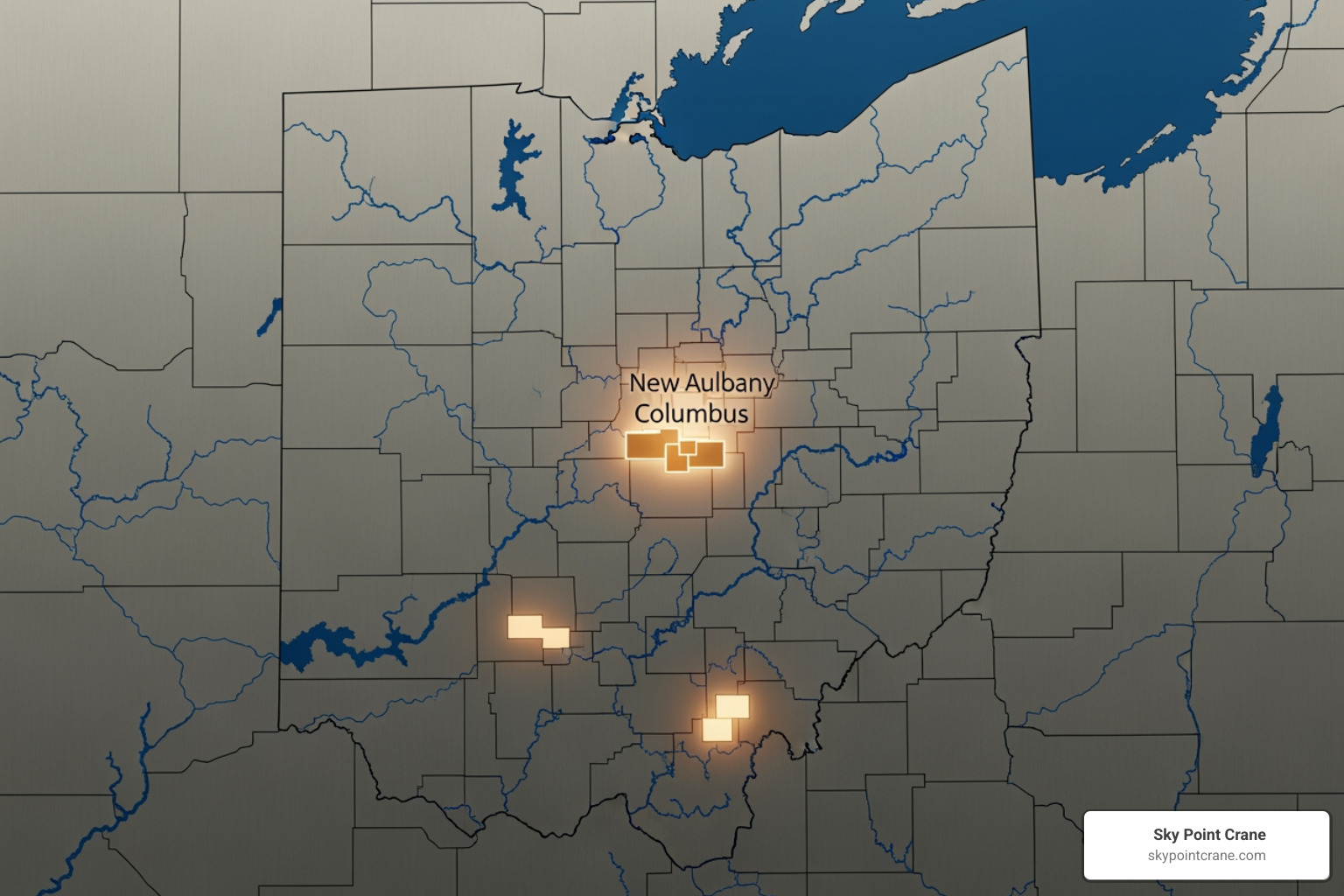
Central Ohio, particularly the New Albany area, has firmly established itself as the “Silicon Heartland” for data centers. With a staggering 104 data centers, it leads the state by a significant margin. This growth began in 2014 with Compass Datacenters, which identified strong interest from data center clients in the region. Since then, it’s been a cascade of investment.
Major players have poured billions into the area:
- Amazon Web Services (AWS) recently reached a deal with New Albany officials for a monumental Amazon’s $3.5 billion expansion. This will add five new data center buildings, totaling 1.25 million square feet of technical space. AWS’s total estimated investment in Ohio is an astounding $7.8 billion.
- Google has also made significant commitments, announcing plans to invest Google’s $1.7 billion investment across three campuses in New Albany, Columbus, and Lancaster. This builds upon their initial $600 million New Albany project started in 2019.
- Meta (formerly Facebook) is another household name with a substantial presence, alongside other hyperscale operations.
- Microsoft has also acquired 200 acres in New Albany for a future data center campus, signaling further expansion.
Beyond these tech titans, multi-tenant providers are also making massive investments:
- QTS Data Centers plans to build four new data centers in New Albany, representing a $1.5 billion investment across two campuses.
- Vantage Data Centers is establishing its OH1 campus in New Albany, Vantage’s first in the Midwest, which will house three two-story hyperscale data centers totaling 192MW across 1.5 million square feet.
- Edged Energy is investing $250 million for a 210,000 square foot facility in New Albany.
- Aligned Datacenters has unveiled plans to build four data centers on a 129-acre campus in Perkins Township, about 100 miles north of Columbus, further expanding Ohio’s digital footprint.
While Central Ohio dominates, other areas are also seeing development. For instance, Iron Mountain’s OHS-1 data center in Miamisburg (Southwest Ohio) is a 44,000 sq. ft. facility with 1.4 MW of power, strategically serving not just Columbus and Cincinnati, but also Indianapolis. In Northeast Ohio, ark’s Cleveland Data Center is a 10,000 sq. ft. facility with 1 MW available, which obtained ENERGY STAR® Certification in 2023. These facilities highlight the distributed, yet concentrated, nature of the Ohio data center market. We’ve even heard whispers that Apple might be eyeing Ohio for future development, which would be another feather in the state’s cap.
Key Players in the Ohio Data Center Market
The list of companies pouring significant capital into Ohio is impressive, reflecting the state’s growing reputation as a premier destination for digital infrastructure. These are the giants and major providers shaping the “Silicon Heartland”:
- Amazon Web Services (AWS): With billions invested in New Albany, AWS is a cornerstone of Ohio’s hyperscale growth.
- Google: Investing $1.7 billion across Central Ohio, Google is expanding its already significant presence.
- Meta (formerly Facebook): A key player in hyperscale data center operations within the state.
- QTS Data Centers: Committing $1.5 billion to develop multiple new data centers in New Albany.
- Vantage Data Centers: Launching its first Midwest campus, OH1, in New Albany, bringing massive hyperscale capacity.
- Aligned Datacenters: Planning a large campus in Perkins Township, expanding the geographical reach of major investments.
- Microsoft: Acquired significant land in New Albany for future data center development.
- Cologix: Another important provider contributing to the region’s data center projects.
- Iron Mountain: With its OHS-1 facility in Miamisburg, Iron Mountain provides crucial colocation services for enterprise clients.
- ark Data Centers: Operating facilities in Cleveland, Akron, and Canton, providing regional connectivity and services.
These companies represent the cutting edge of the digital economy, and their choice to invest heavily in Ohio speaks volumes about the state’s strategic value.
Powering the Digital Age: Infrastructure, Challenges, and the Role of AI
The rapid expansion of the Ohio data center market brings with it immense opportunities, but also significant challenges, particularly concerning infrastructure and resource management. As these digital fortresses proliferate, they demand an ever-increasing supply of power and water, putting a strain on existing systems.
The AI Effect and Power Grid Strain
The advent of Artificial Intelligence (AI) is supercharging the demand for data center capacity, and consequently, for electricity. AI computations are incredibly power-intensive; Goldman Sachs estimates that AI requires ten times the energy of a traditional search engine query. This surge is reflected in projections that forecast a 160% increase in power demand by 2030 for data centers globally.
In Ohio, this isn’t a distant threat; it’s a current reality. AEP Ohio, the state’s primary utility provider, reports that electric demands are increasing at 10 times the historic growth rate. They’ve already signed agreements that will nearly double the load they serve within five years and face a backlog of over 50 customers, mostly data centers, requesting more than 30,000 megawatts of power. This unprecedented demand creates a substantial strain on Central Ohio’s grid, forcing utilities to rapidly upgrade and expand their infrastructure. For us, this means more complex utility projects, often requiring specialized lifting and rigging to install new transformers and power distribution equipment.
The Water Question and Community Concerns
Beyond power, water consumption is another critical aspect of data center operations, especially for cooling servers. While some data centers use air-cooling, many rely on water for efficient temperature regulation. This has led to growing concerns among local communities and environmental advocates.
The challenge is multi-faceted:
- Lack of Transparency: Less than a third of data centers track their water usage, and there’s no mandatory disclosure. This makes it difficult for communities to understand the true impact. The Data Center Coalition argues that this data can reveal proprietary information, while environmental groups like the Alliance for the Great Lakes advocate for greater transparency.
- Significant Usage: The numbers, when available, can be striking. A large Meta data center in Georgia used up to 500,000 gallons a day. In Ohio, the city of Lima inked an agreement to provide millions of gallons daily to an undisclosed data center. In Jerome Township, one Amazon data center is estimated to use around 350,000 gallons on its worst day, contributing to an estimated 10% of Marysville’s daily water capacity from its reservoir.
- Community Reactions: This surge in demand has prompted varied responses. Jerome Township, for example, passed a moratorium on data centers citing safety and utility concerns. The village of Lordstown in northeast Ohio is even considering an outright ban. These communities are actively weighing economic benefits against environmental impact, recognizing that while data centers bring investment, they are also significant resource consumers.
The Mid-Ohio Regional Planning Commission (MORPC) conducted a regional assessment of water needs, concluding that while Central Ohio generally has abundant water, adding industrial capacity like data centers would certainly stretch current infrastructure. This means future planning must include more robust water and wastewater infrastructure, alongside conservation strategies like water reuse. It’s a delicate balance, ensuring that Ohio remains an attractive location for digital growth without compromising its vital natural resources.
Building the Future: The Construction of an Ohio Data Center
The sheer scale of the Ohio data center boom means that construction is happening at an unprecedented pace. These aren’t just ordinary buildings; they are highly specialized, robust structures designed to house mission-critical infrastructure, 24/7, with no downtime. For us at Sky Point Crane, this means being on the front lines, providing the heavy lifting solutions that bring these digital fortresses to life.
The Scale of Hyperscale Construction
Consider the numbers: facilities like Vantage’s OH1 campus in New Albany will encompass 1.5 million square feet. Amazon’s expansion alone adds 1.25 million square feet. These are massive footprints, often sprawling across hundreds of acres, requiring complex logistics and precision engineering from the ground up.
The construction of these facilities involves:
- Heavy Foundations: Laying the groundwork for structures that must withstand the weight and vibration of thousands of servers.
- Precast Concrete Panels: Many data centers use precast concrete for their exterior walls. These massive, heavy panels need to be lifted and precisely placed, often requiring specialized cranes and experienced rigging teams.
- Modular Components: Modern data centers are increasingly built with prefabricated modules for speed and efficiency. These modules, containing everything from power distribution units to cooling systems, are delivered to the site and then carefully hoisted into place.
- Robust Infrastructure: Beyond the building shell, the internal infrastructure is incredibly complex, involving extensive electrical systems, cooling plants, and network cabling.
The entire process of building data centers is a specialized field, demanding expertise in managing large-scale projects with tight deadlines and zero tolerance for error. Every component, from the smallest bolt to the largest cooling tower, plays a role in the ultimate reliability of the facility.
The Critical Role of Cranes and Rigging
This is where our expertise at Sky Point Crane truly shines. We understand that constructing an Ohio data center isn’t just about moving heavy objects; it’s about precision, safety, and efficiency for a mission critical facility. Our NCCCO certified operators and experienced rigging teams are indispensable on these job sites.
We provide the essential crane use for building data centers by:
- Lifting Heavy Components: This includes massive HVAC units that keep servers cool, large electrical transformers that power the entire facility, and modular data center components.
- Setting Structural Elements: From steel beams to those aforementioned precast concrete panels, our cranes are critical for assembling the physical shell of the data center.
- Precision Placement: Many components, especially sensitive electrical gear, require millimeter-perfect placement. Our 3D Lift Planning services ensure that every lift is carefully planned and executed, minimizing risks and maximizing efficiency.
- Specialized Rigging: Often, equipment needs to be moved in tight spaces or over obstacles. Our rigging experts design custom solutions, sometimes even fabricating specialized lifting beams, to steer these complex challenges.
Safety is paramount. Given the sheer size and value of the components involved, and the speed at which these facilities are being built, there’s no room for error. Our rigorous safety protocols and project management ensure that every lift is performed without incident, keeping the project on schedule and budget. Whether it’s a large-scale construction crane rental Ohio project or intricate indoor rigging, we’re proud to be a partner in building Ohio’s digital future.
Economic Impact and Future Outlook for the Ohio Data Center Industry
The change of Ohio into a data center powerhouse has profound economic implications and points toward a dynamic future for the state’s digital infrastructure.
Ohio’s Competitive Edge
Ohio’s journey to becoming a leading data center state is a testament to its unique blend of advantages. While it trails giants like Virginia, Texas, and California, its growth is remarkable, surpassing its neighbors Pennsylvania, Michigan, and Indiana combined in terms of data center volume. This competitive edge stems from:
- Strategic Location: As discussed, its central position reduces latency and offers geographic redundancy for businesses.
- Favorable Business Environment: Tax incentives, particularly the sales tax exemption, significantly lower operational costs for large-scale facilities.
- Infrastructure Readiness: A robust power grid, though currently strained, and extensive fiber optic networks along historical routes provide the necessary backbone.
- Available Land: Compared to densely populated coastal areas, Ohio offers ample, affordable land suitable for the expansive footprints of hyperscale data centers.
These factors combine to make Ohio an attractive alternative to more saturated markets, offering a compelling value proposition for companies seeking to expand their digital presence.
Future Trends and Projections
The outlook for the Ohio data center industry remains overwhelmingly positive, though not without evolving challenges. We anticipate several key trends shaping its future:
- Continued Growth: With AI driving unprecedented demand for processing power, the need for data center capacity will only accelerate. The 10% increase in Ohio’s data center count from the start of the year is likely just the beginning.
- Edge Computing: As applications demand even lower latency (think autonomous vehicles, IoT, and augmented reality), we may see a rise in smaller, more distributed “edge” data centers closer to population centers.
- Sustainable Building Practices: The growing awareness of environmental impact, particularly concerning water and power consumption, will push data center operators towards more sustainable solutions. We expect increased investment in renewable energy sources, more efficient cooling technologies (like those with near-zero Water Utilization Efficiency, or WUE, seen at Vantage’s OH1 campus), and facilities built to LEED Silver standards.
- Power and Water Efficiency: Innovation in cooling and power management will be critical. Data centers will continue to explore methods to reduce their reliance on municipal water and to optimize energy use, not just for environmental reasons but also due to rising costs and utility strain.
- Community Engagement: As communities become more aware of the resource demands, proactive engagement and carefully negotiated agreements will be crucial. This includes strategic approaches like PILOT agreements and TIFs to ensure local benefits, and transparent discussions around resource usage.
- Workforce Development: While data centers are not massive job creators in terms of operational staff (often around 50 jobs for a large facility), they do provide high-paying, specialized roles (often near six figures). There will be a continued need for a skilled workforce to operate and maintain these complex facilities.
The long-term vision for Ohio’s digital infrastructure involves balancing this immense growth with responsible resource management and strong community partnerships. The state is ready to remain a critical player in the digital economy, adapting to new technologies and environmental considerations as it solidifies its role as a true “Silicon Heartland.”
Conclusion
The change of Ohio into a leading Ohio data center hub is a remarkable story of strategic advantage, economic incentive, and relentless technological advancement. From its central location and robust fiber networks to favorable tax policies and ambitious investment from tech giants like Amazon and Google, Ohio has carved out a formidable niche in the nation’s digital landscape.
However, this rapid growth isn’t without its complexities. We’ve explored the immense strain on the power grid, exacerbated by the insatiable demands of AI, and the critical discussions surrounding water usage and environmental impact. These challenges underscore the need for thoughtful planning, innovative solutions, and strong collaboration between industry, utilities, and local communities.
For us at Sky Point Crane, this boom represents the cutting edge of industrial construction. We’ve witnessed the massive scale and precision required to build these digital fortresses, from lifting gargantuan HVAC units to setting the precast concrete panels that form their resilient shells. Our role in providing expert crane use for building data centers and specialized rigging is not just about moving weight; it’s about enabling the infrastructure that powers our increasingly connected world.
As Ohio continues its journey as a digital powerhouse, balancing immense growth with infrastructure and community challenges will be key. The future promises continued innovation, sustainability efforts, and a steadfast commitment to building the robust, reliable foundations upon which our digital future depends.
To learn more about the heavy lifting solutions that make these projects possible, we invite you to explore our comprehensive crane services.