
Why Tree Removal Cranes Are Changing Arboriculture
Tree removal crane services have revolutionized how we safely dismantle hazardous trees in challenging locations. For generations, arboriculture relied on the skill and courage of climbers who scaled trees, using complex rope and pulley systems to lower sections piece by piece. While effective, this method is inherently risky and time-consuming. Now, whether you’re facing a massive oak leaning over your building, a storm-damaged tree tangled in power lines, or a decaying giant in a tight backyard, crane-assisted removal offers a controlled, efficient, and significantly safer alternative.
Key applications for crane-assisted tree removal include:
- Large trees (typically 60+ feet) near structures or in confined spaces where there is no room for error.
- Hazardous situations involving unstable, decaying, or storm-damaged trees that are unsafe for climbers to ascend.
- Tight access areas, such as enclosed courtyards or backyards where traditional felling would inevitably damage property.
- Trees near power lines that require the utmost precision to avoid catastrophic accidents and power outages.
- Emergency removals that demand a rapid response to mitigate immediate threats to people and property.
- Commercial projects where efficiency, predictable timelines, and minimal disruption are paramount.
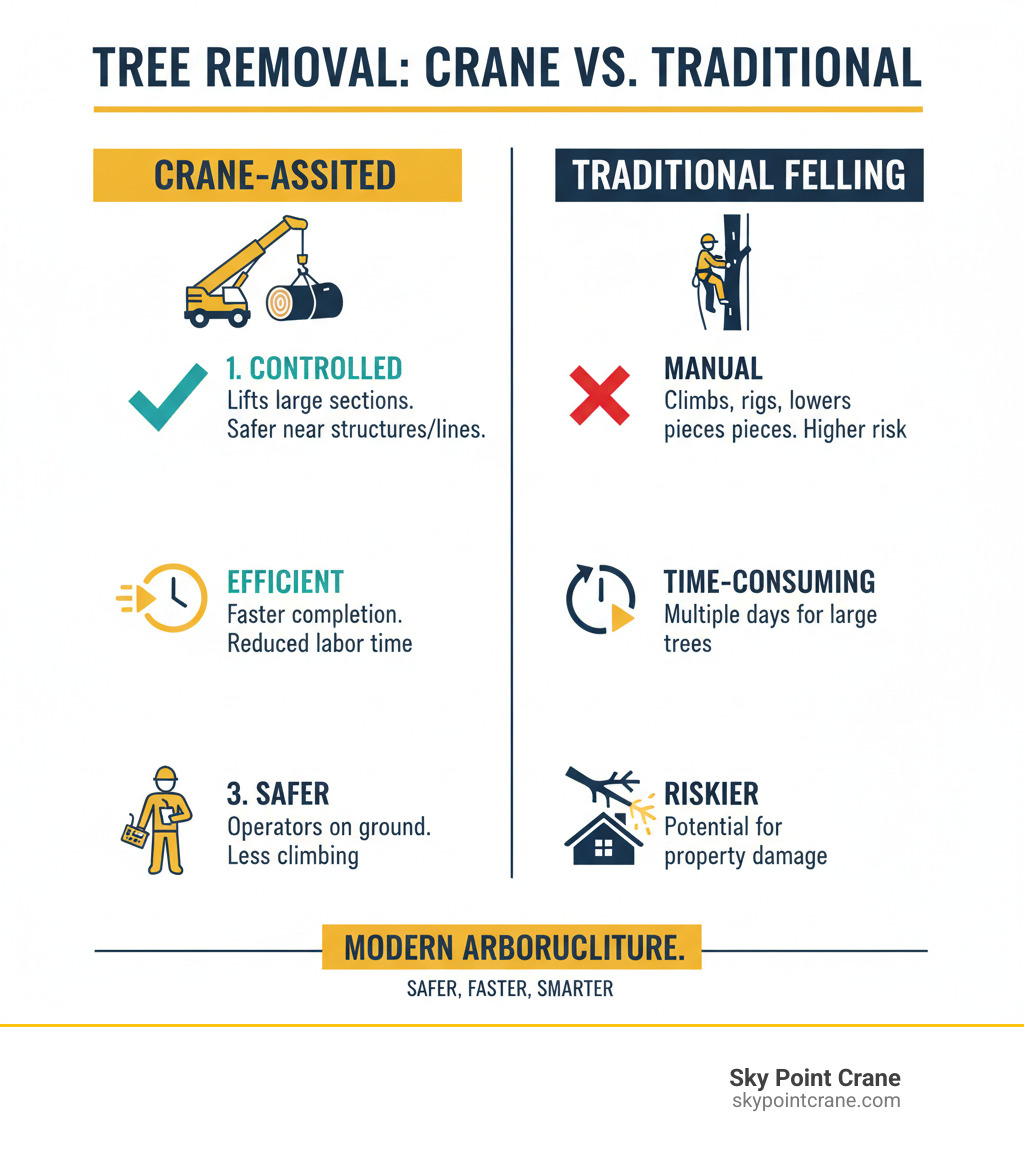
Traditional tree removal can be a multi-day ordeal, with climbers spending hours carefully rigging down sections. In stark contrast, a crane can lift entire multi-ton sections in mere moments. Jobs that would take a team of climbers three days can often be completed in a single day with crane assistance. This dramatic efficiency gain is matched by an even more critical improvement in safety. Crane operators work from a secure cab, and ground crews stay clear of the drop zone. The risk of property damage plummets when heavy sections are lifted cleanly up and away, rather than being precariously lowered through a maze of obstacles.
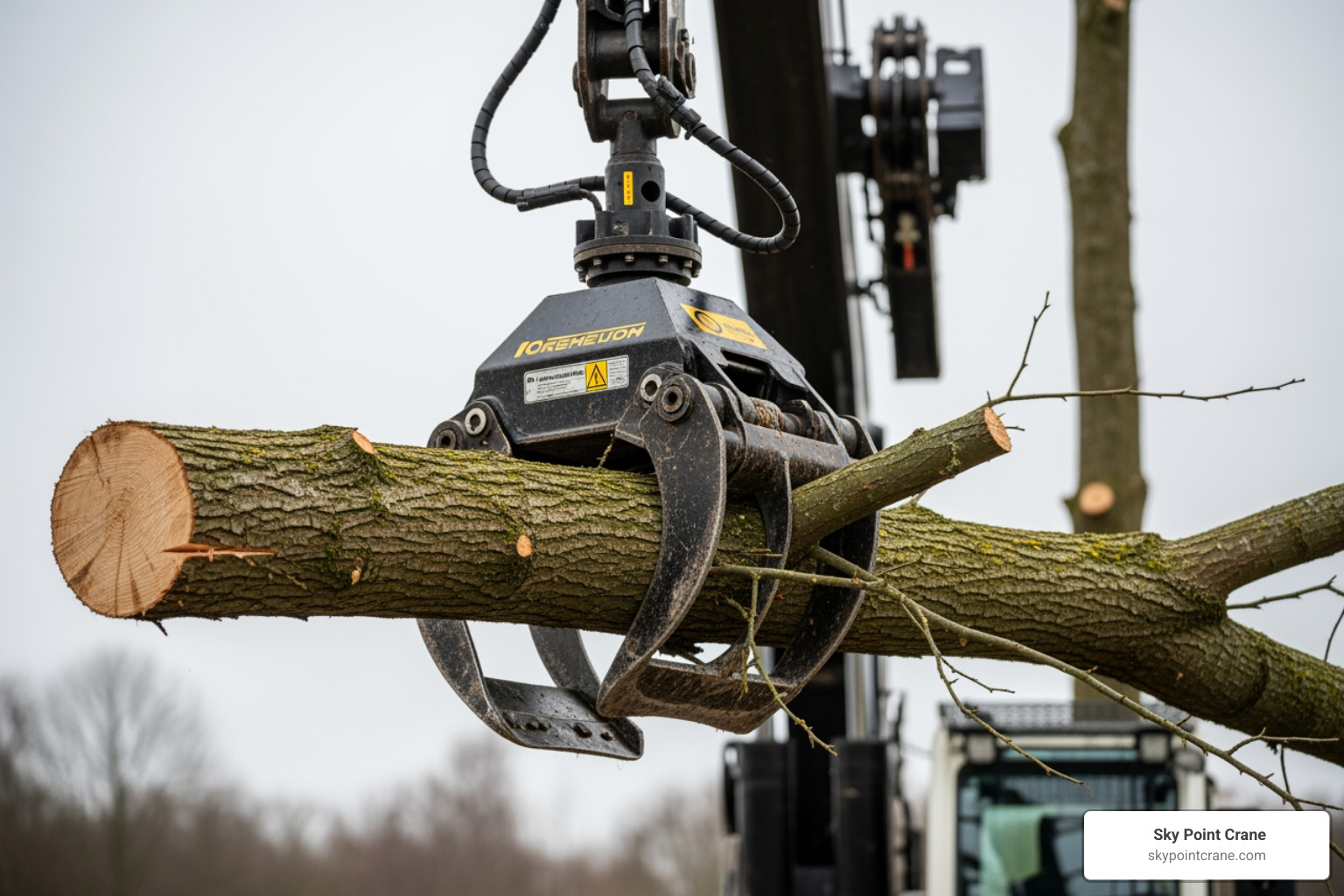
The technology itself has advanced significantly. Modern knuckle boom cranes equipped with grapple saws can remotely cut and grip tree sections simultaneously, often eliminating the need for a climber to ascend the tree at all. These articulating cranes can steer around buildings and power lines with a level of precision that was once unimaginable, turning high-risk removals into carefully choreographed operations.
I’m Dave Brocious, and through decades of crane operations and strategic leadership in lifting solutions, I’ve witnessed how tree removal crane technology has transformed what’s possible in arboriculture and construction site management. At Sky Point Crane, we’ve applied this expertise to help contractors and property managers in Pennsylvania, Ohio, West Virginia, and Maryland tackle tree removal challenges that would have been prohibitively dangerous or expensive just years ago.
Similar topics to Tree removal crane:
- Advanced rigging techniques
- Rough terrain crane
- Rigging services near me
What is Crane-Assisted Tree Removal and How Does It Work?
Imagine having a giant mechanical arm that can reach 60, 80, even 100 feet into the air, gently pluck massive tree sections weighing thousands of pounds, and place them exactly where you want them. That’s the magic of crane-assisted tree removal—and it’s fundamentally different from the way trees have been removed for generations.
Traditional felling involves making strategic cuts and hoping gravity does its job in the right direction. But with crane removal, you’re not hoping for anything. The crane becomes an extension of your control, supporting the weight of each section before it’s even cut. This means lifting instead of felling—a subtle shift that changes everything about safety and precision.
Here’s how the process unfolds. First, a specialized tree removal crane is positioned for optimal reach and stability. The operator extends the boom over the tree, and rigging lines or specialized attachments secure a section that needs removal. The real beauty happens next: an arborist makes a strategic cut, but instead of that section crashing downward, the crane is already supporting its weight. The section lifts smoothly away from the trunk, swings clear of your house, power lines, or prized rose garden, and descends gently to a designated drop zone on the ground.
This controlled dismantling process continues piece by piece, section by section, until the entire tree is safely on the ground. Throughout the operation, the crane operator maintains constant communication with certified arborists and the ground crew. The arborist determines where to cut and estimates the weight of each section. The operator handles the actual lifting and placement. Meanwhile, the ground crew processes each section as it arrives—chipping smaller branches and preparing larger logs for hauling.
In many modern operations, arborists work from the ground using remote controls or from aerial lifts, eliminating the need to climb precarious trees. This arborist collaboration ensures every cut is strategic, every lift is calculated, and every movement keeps personnel out of harm’s way.
The result? A tree that once loomed dangerously over your property is systematically dismantled with surgical precision, minimal disruption, and maximum safety.
When is a Crane Necessary?
Not every tree needs a crane—but when you encounter certain situations, a tree removal crane transforms from “nice to have” into “absolutely essential.”
Large or oversized trees are the most obvious candidates. When you’re dealing with massive specimens—especially those towering beyond 60 feet with extensive canopies and heavy trunks—the weight alone makes traditional removal dangerous and unpredictable. A crane handles these giants with confidence.
Trees that are unstable or decaying present a particularly nasty challenge. Structural compromise from disease, rot, or internal damage means climbers can’t trust the tree to support their weight. Even worse, the tree might collapse unpredictably during removal. A crane eliminates the need for anyone to climb these hazards, supporting unstable sections externally.
Trees in confined spaces are where cranes really shine. Picture a mature oak nestled between two houses, with barely six feet of clearance on either side. There’s simply no room for traditional felling—but a crane can lift sections straight up and over the obstacles. Similarly, when trees grow in tight backyards accessible only through narrow gates, cranes can reach over the house from the street.
Proximity to structures dramatically increases removal risk. A tree leaning over your home, garage, or shed can’t be dropped conventionally without risking catastrophic damage. The crane lifts sections directly away from these valuable structures, providing a safe buffer zone.
Power lines add another layer of complexity and danger. Trees tangled with or growing near active electrical lines demand extreme caution. The precision control of crane-assisted removal keeps both tree sections and equipment safely away from these potentially deadly hazards.
After severe weather, storm-damaged trees create unpredictable and dangerous conditions. Partially fallen trees, tangled limbs, and splintered trunks don’t behave normally during removal. Cranes can safely extract these damaged sections without putting workers at risk.
Finally, limited access areas make cranes invaluable. If debris removal equipment like chippers can’t reach the backyard, a crane can lift entire sections over your house or other barriers, streamlining the entire operation from start to finish.
In these challenging scenarios, choosing crane-assisted removal isn’t just about convenience—it’s about changing a high-risk operation into a controlled, efficient, and often more cost-effective solution.
Traditional Methods vs. Crane Removal
The difference between traditional tree removal and crane-assisted methods isn’t just about equipment—it’s about fundamentally different approaches to risk, efficiency, and precision.
| Feature | Traditional Tree Removal (Climbing/Rigging) | Crane-Assisted Tree Removal |
|---|---|---|
| Safety | High-risk for climbers working at height, often in unstable trees. Potential for rigging failures, unexpected limb breaks, and falling debris poses a significant threat to both crew and property. | Dramatically improved safety. Operators work from a secure cab, and climbers are often not needed in the tree. Controlled lifting eliminates unpredictable falls, creating a safer work environment that aligns with modern safety standards like those from OSHA for tree care operations. |
| Speed | A slow, methodical process. Can take multiple days for large or complex trees, as each section requires a time-intensive rigging setup. | Exceptionally fast. Jobs are often completed in hours instead of days. The crane can remove large sections rapidly with minimal setup time between cuts, significantly reducing project duration. |
| Site Impact | Often requires extensive ground rigging, which can damage lawns and landscaping. The potential for falling or swinging sections can harm structures, fences, and other property. A large work zone is needed. | Minimal ground disturbance. Sections are lifted cleanly up and away, preventing damage to the surrounding landscape and property. Cranes can operate from a single position, often the street or driveway, preserving delicate lawns and gardens. |
| Cost-Effectiveness for Complex Jobs | Can become very expensive due to being labor-intensive. Extended timelines increase labor costs, and the higher risk can lead to higher insurance premiums. | Highly cost-effective for difficult jobs. While there is a crane rental cost, it is often offset by massive reductions in labor hours and time on site. Faster completion means lower overall project costs. |
| Labor Requirements | Requires a larger crew, including multiple skilled climbers and a ground team. The work is physically demanding and requires extensive, specialized rigging expertise. | Uses a smaller, more specialized crew, typically consisting of a certified crane operator, a certified arborist, and a ground support team. This reduces physical strain and focuses expertise where it’s needed most. |
Traditional climbing and rigging methods have served arborists well for decades, and they remain the right choice for many straightforward removals where access is easy and risks are low. However, when you’re facing a complex situation—a massive tree over your home, a storm-damaged giant, or a tree in an impossibly tight space—the crane-assisted approach offers advantages that traditional methods simply can’t match.
The key difference comes down to control. Traditional methods rely on gravity, friction, and the skill of the climber to manage the descent of heavy wood. It’s a calculated battle against physics. Crane removal, on the other hand, replaces that uncertainty with absolute mechanical precision, turning a potentially chaotic process into a choreographed, predictable, and safe operation.