
Is a Used VLM Right for You? What to Know Before You Buy
Why Warehouse Space Costs More Than You Think
A used vertical lift module can transform your warehouse operations by reclaiming up to 90% of your floor space while cutting costs nearly in half compared to new equipment. Here’s what you need to know:
Quick Facts About Used Vertical Lift Modules:
- Cost Range: $35,000 to $75,000 (vs. $75,000 to $140,000 for new units)
- Space Savings: Up to 85-90% reduction in floor space requirements
- Productivity Boost: Up to 85% increase in workforce efficiency
- Picking Accuracy: Up to 99.9% with automated goods-to-person retrieval
- Common Brands: Kardex Remstar, Modula, Hänel Lean Lift
- Typical ROI: Faster payback due to lower initial investment
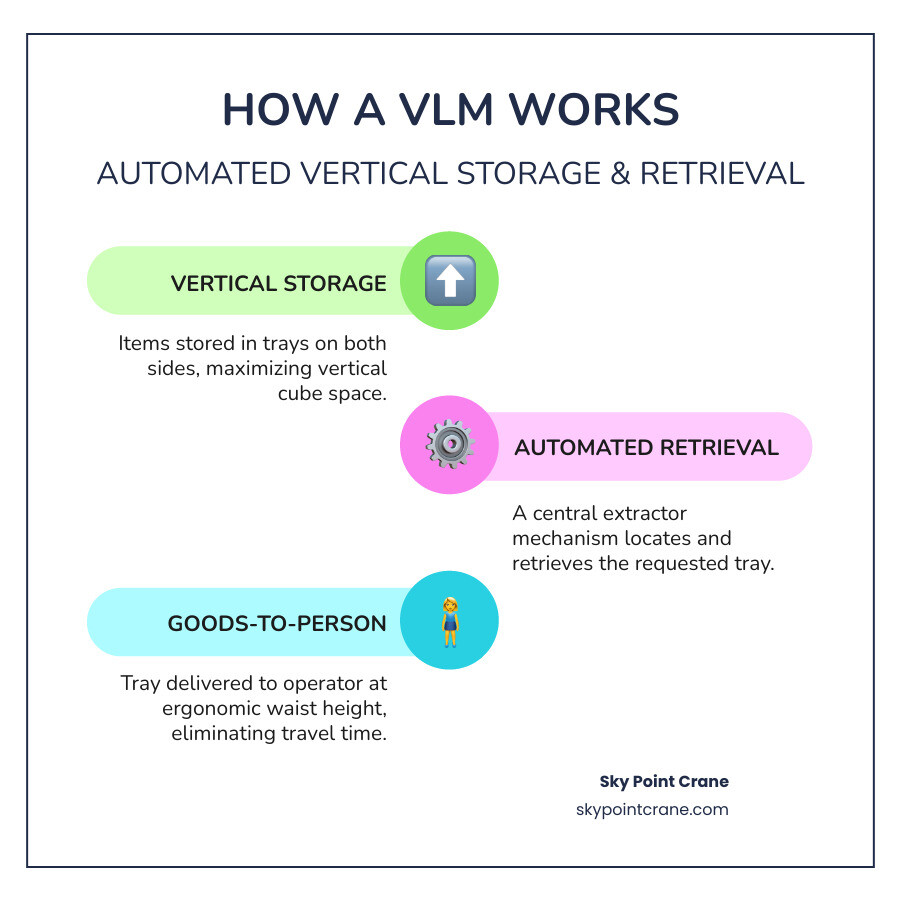
If your facility has limited floor space but adequate ceiling height (typically 16 feet or more), a used VLM could be the answer. These automated storage systems use vertical space to store trays of parts or products, then deliver them directly to an operator at an ergonomic height—eliminating the walk, search, and climb time that kills productivity in traditional warehousing.
The trade-off? You’re working with available specifications rather than custom configurations. But for many operations, the 50% cost savings and shorter lead times make used VLMs an excellent choice.
I’m Dave Brocious, and over my 30+ years in manufacturing, distribution management, and industrial equipment, I’ve helped companies solve complex operational challenges including used vertical lift module installations and rigging projects. At Sky Point Crane, we understand that choosing the right storage automation—and installing it safely—can make or break your operational efficiency.
Relevant articles related to used vertical lift module:
The Core Benefits: Why Choose a Vertical Lift Module?
In today’s competitive landscape, optimizing every inch of your warehouse and every minute of your workday is paramount. A used vertical lift module isn’t just a piece of equipment; it’s a strategic investment in efficiency, space, and productivity. Let’s explore the primary benefits that make VLMs a game-changer for many businesses.
Reclaim Up to 90% of Your Floor Space
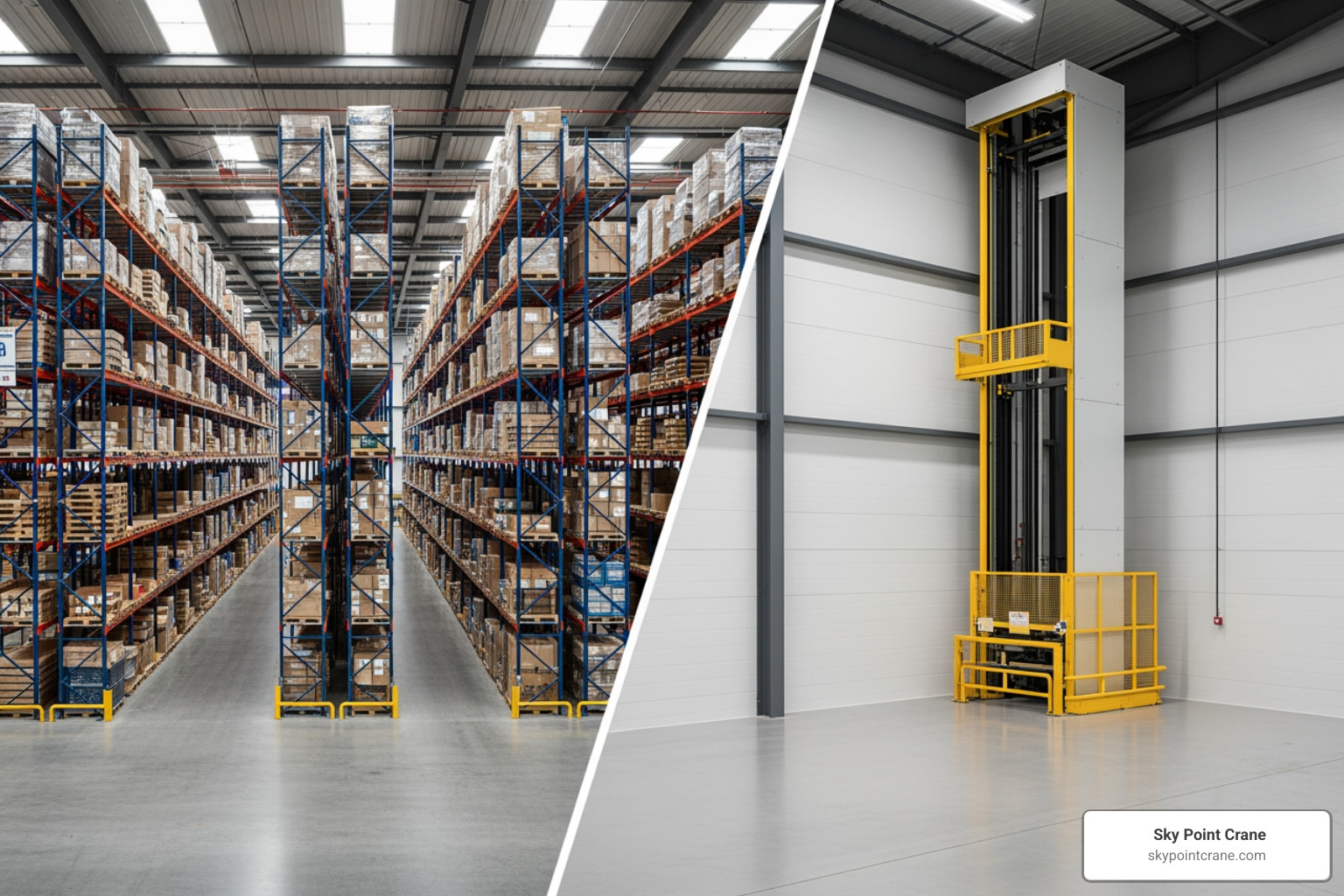
Perhaps the most compelling benefit of a VLM is its incredible ability to save space. Traditional shelving spreads inventory across valuable floor area, often leaving significant overhead space unused. VLMs, however, exploit the vertical cube, turning your warehouse into a high-rise for your inventory.
Imagine condensing 5,000 square feet of traditional shelving into a mere 150 square feet for the machine itself – that’s a staggering 90% decrease in your footprint! Our research shows that used vertical lift modules can recover up to 90% of valuable floor space, or reduce floor space requirements by up to 85% compared to traditional shelving. This high-density storage capability means you can store more items in a smaller area, freeing up vast amounts of floor space for other critical operations like additional production lines, staging areas, or even delaying costly facility expansion. It’s like finding extra square footage you didn’t even know you had!
For more ways to optimize your storage, explore our commercial storage solutions.
Boost Productivity and Accuracy
Beyond space savings, VLMs fundamentally transform how your team interacts with inventory through the “goods-to-person” principle. Instead of operators walking aisles, searching for items, and climbing ladders, the VLM brings the requested item directly to an ergonomic access point. This drastically reduces walk and search time, which can account for a significant portion of an operator’s day.
The result? A dramatic increase in efficiency. Our data indicates that vertical storage solutions can increase workforce productivity by up to 85%. Think about it: less walking means less fatigue, allowing your team to focus on the task at hand – picking. This automation, often coupled with integrated software, also leads to a remarkable improvement in picking accuracy, achieving up to 99.9%. Fewer errors mean less time spent on rework, fewer mis-shipments, and happier customers.
Furthermore, VLMs significantly improve workforce ergonomics. By delivering trays to an accessible height, they minimize bending, stretching, and climbing, reducing the risk of injuries and improving overall job satisfaction. This commitment to safety and efficiency is something we deeply value at Sky Point Crane, echoing our own commitment to safety and efficiency in all our operations.
New vs. Used VLM: A Cost and Value Analysis
When considering a major equipment investment like a Vertical Lift Module, the decision often boils down to balancing cost with capability. While new VLMs offer the latest technology and custom configurations, a used vertical lift module presents a compelling case for significant cost savings and faster return on investment (ROI).
The Price Tag: New vs. Used
Let’s talk numbers. Our research clearly illustrates the substantial difference in upfront investment:
- New VLMs typically range from $75,000 to $140,000.
- Used VLMs generally range from $35,000 to $75,000.
This means that purchasing a used vertical lift module can net you savings of 50% or even more, sometimes acquiring top-condition storage equipment at nearly half the cost of new ones. Some specific models, like certain Hanel Lean Lift units, can even be found for as little as one-third the cost of new. These significant savings allow businesses to preserve capital, redirecting funds to other growth areas or critical operational needs. The lower initial outlay also translates to a much faster ROI, making the financial benefits of automation accessible to a wider range of businesses.
Beyond the initial price, considering a used unit often means shorter lead times. While new equipment can have ship dates stretching 12 to 20 weeks or more, a used VLM that’s already available can be acquired and implemented much faster, accelerating your path to operational efficiency.
Factors Influencing the Price of a Used VLM
Just like buying a used car, the price of a used vertical lift module isn’t static. Several key factors come into play:
- Age and Usage Hours: Newer models with fewer operational hours will naturally command a higher price.
- Brand Reputation: Established brands like Kardex Remstar, Modula, and Hanel often retain their value better due to their reputation for durability and performance.
- Machine Condition: “Excellent condition” or “top-condition” units that have been well-maintained and used in clean environments (like electronics applications) will be priced higher than those showing significant wear and tear.
- Height and Width: Taller or wider units, especially those that fit specific facility requirements, can influence pricing.
- Tray Quantity and Capacity: The number of trays included and their individual weight capacity (e.g., 650 lbs, 880 lbs, 1,102 lbs per tray) directly impacts the VLM’s utility and therefore its value.
- Control System and Software Version: Modern control systems (like co-pilot color touchscreens or specific Kardex Controls versions) and up-to-date software can add significant value, as they improve functionality and integration capabilities.
- Included Warranty and Services: A limited warranty, or services like professional disassembly, crating, and re-installation by certified technicians, can justify a higher price point, offering peace of mind and reducing your overall project risk.
Understanding these factors helps us evaluate if a listed used vertical lift module truly offers the best value for your specific needs.
Key Specifications When Buying a Used Vertical Lift Module
Choosing the right used vertical lift module for your facility requires careful consideration of its technical specifications and how they align with your operational needs. It’s a bit like being a detective, gathering clues to ensure the perfect fit.
VLM vs. Vertical Carousel: Understanding the Difference
Before diving into the specifics of VLMs, it’s crucial to distinguish them from their cousin, the vertical carousel, as both are vertical storage solutions but operate differently.
| Feature | Vertical Lift Module (VLM) | Vertical Carousel |
|---|---|---|
| Mechanism | Automatic inserter/extractor mechanism | Rotating shelves (like a Ferris wheel) |
| Tray Delivery | Brings specific tray to ergonomic access point | Rotates all shelves to bring desired product |
| Height Flexibility | Dynamic height optimization; stores items of varying heights within same unit | Fixed shelf heights; best for uniform items |
| Space Utilization | Excellent, uses vertical space efficiently | Good, but less flexible with item heights |
| Item Suitability | Ideal for a wide range of small to medium parts | Best for uniform, high-volume items |
| Security | Enclosed system, often with automatic doors | Enclosed, but entire system rotates |
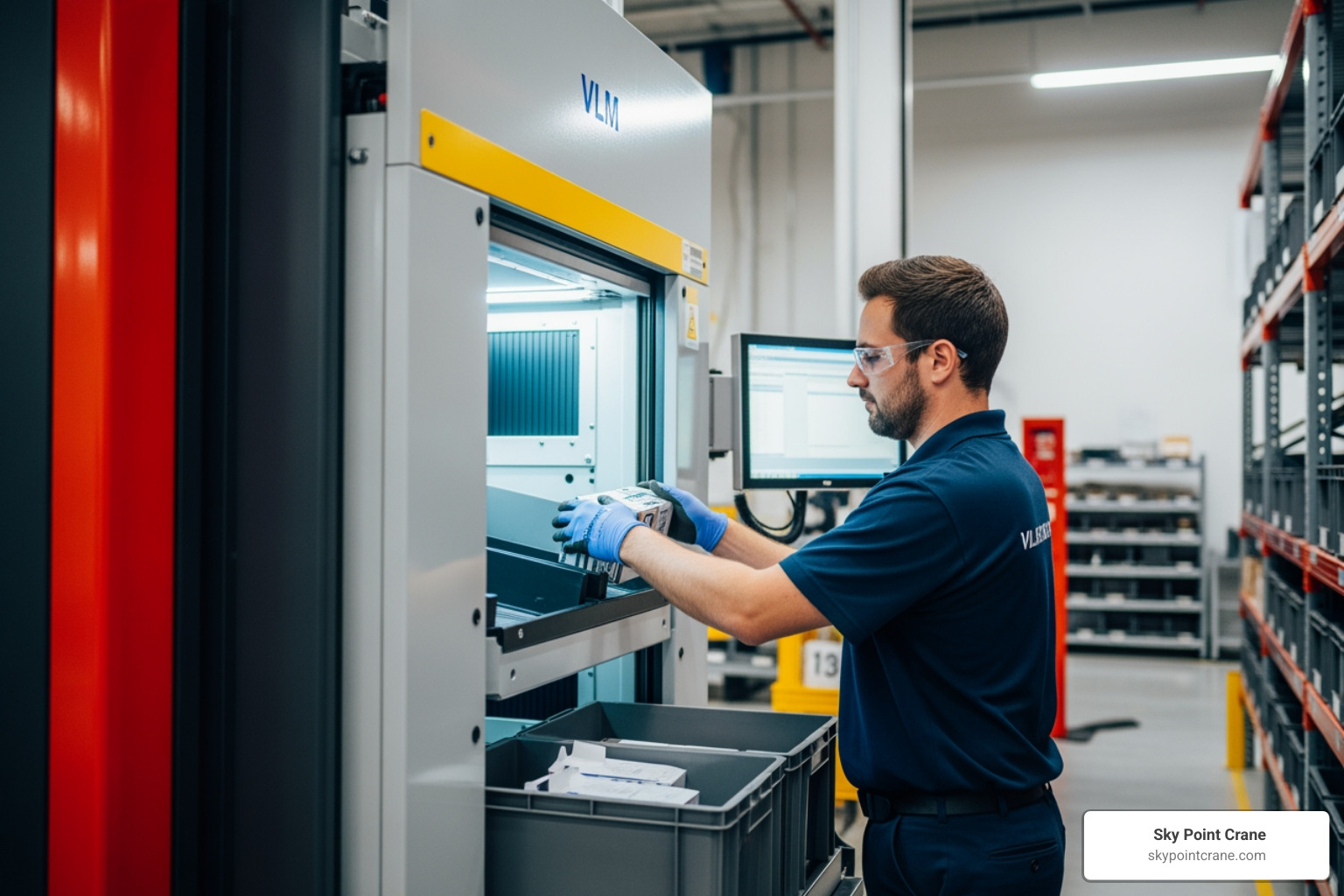
While vertical carousels are great for uniform items, the VLM’s intelligent software and automatic inserter/extractor allow it to store loads of different heights within the same unit. This dynamic flexibility means it can optimize vertical space more effectively by detecting the height of stored items and placing trays as close as possible, maximizing storage density.
Essential Specifications for Your Operation
When you’re in the market for a used vertical lift module, precision is key. Here’s a buyer’s checklist of essential specifications:
- Facility Height Measurement: This is non-negotiable. VLMs require adequate ceiling height, often 16 feet or more, to fully use their vertical storage capabilities. Units can be quite tall, with examples ranging from 16 feet to over 27 feet. Measure your available clear height carefully.
- Footprint Dimensions: While VLMs save floor space, they still occupy a specific footprint. Note the machine’s width and depth. For instance, some units might be 110″ W x 120″ D, while others could be 138.5″ W x 124.88″ D.
- Tray Size and Weight Capacity: This dictates what you can store. Common tray sizes vary (e.g., 96.5″ L x 24″ W, 122″ W × 33.75″ D, 81″ W × 32.5″ D). Equally important is the individual tray capacity, which can range from 100 lbs to over 1,100 lbs per tray. Ensure these capacities meet your product weight requirements.
- Throughput Requirements: How quickly do you need to access items? Some VLMs offer dual-tray delivery systems for up to 30% faster access, crucial for high-volume picking operations.
- Power Requirements: Verify the electrical needs (e.g., 480VAC / 15 Amp / 10.0 kVA or 208VAC / 32.7 Amp) to ensure compatibility with your facility’s power supply.
- Control System and Features: Look for modern control systems like co-pilot color touchscreens, integrated laser pointers for picking accuracy, and safety features such as photo eye barriers or automatic closing doors.
Understanding these details helps us assess if a particular used vertical lift module aligns with your operational needs. For more on how we handle various equipment, check out our equipment capabilities.
Assessing Condition and Warranty on a Used VLM
Buying used equipment always comes with questions about its longevity and reliability. When considering a used vertical lift module, a thorough assessment of its condition and understanding any warranty offered is paramount.
- Inspecting for Wear and Tear: While you might not be able to do a full internal inspection, visual checks for excessive rust, damaged panels, or obvious signs of heavy use are important. Photos should be clear and comprehensive.
- Checking Maintenance Logs: Reputable sellers should provide maintenance records. A well-documented history of routine maintenance indicates a unit that has been cared for and is likely to have a longer operational life.
- Professional Evaluation: If possible, consider having an independent, certified technician inspect the unit before purchase. This can uncover hidden issues and give you a clearer picture of its true condition.
- Understanding Limited Warranties: Many sellers of used vertical lift modules offer a “limited warranty.” This typically covers specific parts for a short period and may not include labor or travel. Clarify exactly what is covered, for how long, and what conditions apply.
- Installation Warranty vs. Parts Warranty: Some providers might offer a warranty on their installation work, while the VLM itself might only have a limited parts warranty. It’s important to differentiate these. Some companies, for example, commit to replacing wearable parts on every installation of pre-owned equipment and offering scaled product warranty support.
A serviced and well-kept VLM can function for 20, 30, or even 40 years. Your due diligence here can save you headaches and unexpected costs down the line.
Is a VLM Solution Right for Your Business?
While the benefits of a used vertical lift module are clear, it’s not a universal solution. Determining if a VLM is the right fit involves a careful analysis of your application, inventory profile, throughput needs, and existing facility constraints.
Industries That Benefit Most
VLMs shine in environments where floor space is at a premium, inventory is diverse, and accuracy is critical. We see them making a significant impact across various sectors:
- Manufacturing: Storing small parts, tools, and components, ensuring quick access for assembly lines.
- Automotive Parts: Managing vast inventories of diverse parts, from tiny screws to larger engine components, ensuring rapid retrieval for repair and assembly.
- E-commerce Fulfillment: Accelerating order picking for high SKU count operations, crucial for fast shipping demands.
- Aerospace: Handling expensive, sensitive, and critical components with high security and precise inventory control.
- Healthcare and Medical Devices: Storing delicate instruments, pharmaceuticals, and medical supplies in a controlled, secure environment.
VLMs are ideal for industries with high SKU counts and limited floor space, especially when dealing with smaller, cube-shaped, slower-moving items. They provide a secure, efficient, and ergonomic solution for managing diverse inventories. At Sky Point Crane, we understand the unique needs of the industries we serve, and often see how specialized equipment can transform operations.
Potential Drawbacks and Limitations
Like any technology, VLMs have their limitations:
- Ceiling Height Requirements: This is a major one. If your warehouse has low ceilings (less than 16 feet), a VLM simply won’t be able to provide its full space-saving potential, and might not even be feasible.
- Not Suitable for Oversized or Palletized Goods: VLMs are designed for smaller, individual items that fit onto trays. They are not ideal for storing large, bulky items, full pallets, or irregularly shaped products that don’t easily fit within tray dimensions.
- Throughput Caps: While VLMs significantly boost productivity for a certain range of items, they have a finite picking rate. For extremely high-volume, uniform item picking, other automation solutions might be more appropriate.
- Maintenance Needs: Like any complex machinery, VLMs require routine maintenance, including checking lift mechanisms, sensors, and software updates. Most systems require annual inspections and preventive maintenance to ensure optimal performance. Factor this into your operational budget.
- Software Integration Challenges: In most cases, a VLM will require warehouse management software (WMS) to truly open up its potential. This software tracks inventory, manages tray locations, and optimizes picking routes. Integrating a used vertical lift module with existing WMS can sometimes be complex, requiring careful planning and potentially additional investment in software upgrades or customization.
Understanding these limitations helps you make an informed decision and ensures that a VLM is a true solution, not just a fancy piece of equipment.
The Purchase and Installation Process
Once you’ve decided that a used vertical lift module is the right investment for your business, the journey isn’t over. Finding a reliable unit and ensuring its safe and efficient installation are critical steps.
Where to Find Reliable Used VLMs
Finding a quality used vertical lift module requires a bit of hunting, but several avenues offer promising leads:
- Industrial Equipment Resellers: These specialized dealers often have a rotating inventory of used VLMs from various brands like Kardex Remstar, Modula, and Hanel. They typically offer units that have been inspected, and sometimes refurbished, and may come with limited warranties. Look for resellers with a strong reputation and positive reviews.
- Auction Websites: Online industrial equipment auctions can be a source for used VLMs, often at competitive prices. However, these usually come “as-is” with little to no warranty or support, requiring more due diligence on your part.
- Direct from Businesses: Sometimes, companies upgrading their systems or closing facilities will sell their VLMs directly. This can be a great way to find well-maintained units, but it requires networking and often involves handling the logistics and disassembly yourself.
- Specialized Brokers: Some companies specialize in buying and selling second-hand warehouse automation, often offering comprehensive services from sourcing to installation. They might also highlight the environmental benefits, noting that buying second-hand saves money and reduces the carbon footprint associated with new metal production.
Regardless of the source, always prioritize transparency from the seller regarding the unit’s history, condition, and any available documentation.
The Critical Role of Professional Rigging and Installation
Acquiring a used vertical lift module is only half the battle; getting it safely into your facility and operational is the other. This is where professional rigging and installation become absolutely critical. VLMs are large, heavy, and complex pieces of machinery that require specialized expertise for transportation, placement, and assembly.
- Transportation Logistics: Moving a VLM from its previous location to your facility involves careful disassembly, crating, and specialized transport. Many sellers will offer professional disassembly and crating by certified technicians.
- Site Preparation: Before the VLM arrives, your facility needs to be ready. This includes ensuring adequate floor load capacity, clear access paths, and proper electrical hookups.
- The Need for 3D Lift Planning: This is where Sky Point Crane excels. For complex installations, especially when maneuvering large equipment within an existing structure, 3D Lift Planning is invaluable. It allows us to simulate the entire lifting and placement process, identifying potential obstacles, optimizing crane placement, and ensuring a safe, efficient installation before any physical work begins. This is particularly important for areas within Western and Central Pennsylvania, Ohio, West Virginia, and Maryland, where our teams operate.
- Safe and Precise Placement: Installing a VLM requires precision. Our NCCCO certified operators and experienced rigging teams use specialized equipment to carefully lift, move, and position the VLM components, ensuring they are correctly assembled and anchored according to manufacturer specifications.
- Using Certified Riggers and Crane Operators: Never underestimate the importance of certified professionals. Our teams at Sky Point Crane are experts in heavy equipment handling, ensuring that your valuable investment is installed correctly and safely, minimizing downtime and avoiding costly errors.
Whether you’re moving a VLM across the state or just across the warehouse, partnering with a rigging and crane service like Sky Point Crane ensures a smooth, safe, and efficient installation, allowing you to quickly realize the benefits of your new automation.
Conclusion
Investing in a used vertical lift module can be a remarkably smart strategic move for businesses looking to optimize their warehouse operations. We’ve seen how these systems can transform facilities, reclaiming up to 90% of valuable floor space, boosting workforce productivity by up to 85%, and achieving near-perfect picking accuracy. The significant cost savings compared to new units, often half the price, make advanced automation accessible and provide a much faster return on investment.
However, a successful VLM integration isn’t just about the purchase; it’s about making informed decisions at every step. From understanding the nuances between VLMs and vertical carousels, to carefully checking specifications like height, tray capacity, and power requirements, every detail matters. And critically, ensuring a professional installation by certified riggers is paramount to the safety and longevity of your investment.
For the right application—typically businesses with high SKU counts, limited floor space, and a need for improved accuracy in industries like manufacturing, automotive, or e-commerce—a used vertical lift module offers a powerful combination of efficiency, economy, and environmental responsibility.
When you’re ready to make this transformative leap, for a safe and successful VLM installation, partnering with expert riggers is non-negotiable. Explore our Industrial Storage and rigging services to ensure your used vertical lift module is precisely and safely integrated into your operations in Western and Central Pennsylvania, Ohio, West Virginia, and Maryland.