
Finding Your Fit: A Guide to Vertical Lift Storage Systems
Why Modern Warehouses Are Looking Up
Vertical lift storage is changing how warehouses and industrial facilities manage inventory. These automated systems use vertical space to store and retrieve items, delivering them directly to operators at an ergonomic height. Here’s what you need to know:
What is Vertical Lift Storage?
- Automated system that stores trays vertically in an enclosed tower
- Goods-to-person principle – items come to you, not the other way around
- Space savings of up to 85-90% compared to traditional shelving
- High accuracy – up to 99.9% picking accuracy with guided retrieval
- Common uses – manufacturing parts, tools, medical supplies, and high-value inventory
Key Benefits:
- Reclaim 85% of your floor space
- Boost workforce productivity by up to 85%
- Eliminate walking, searching, and bending
- Improve security for valuable components
- Integrate with existing warehouse management systems
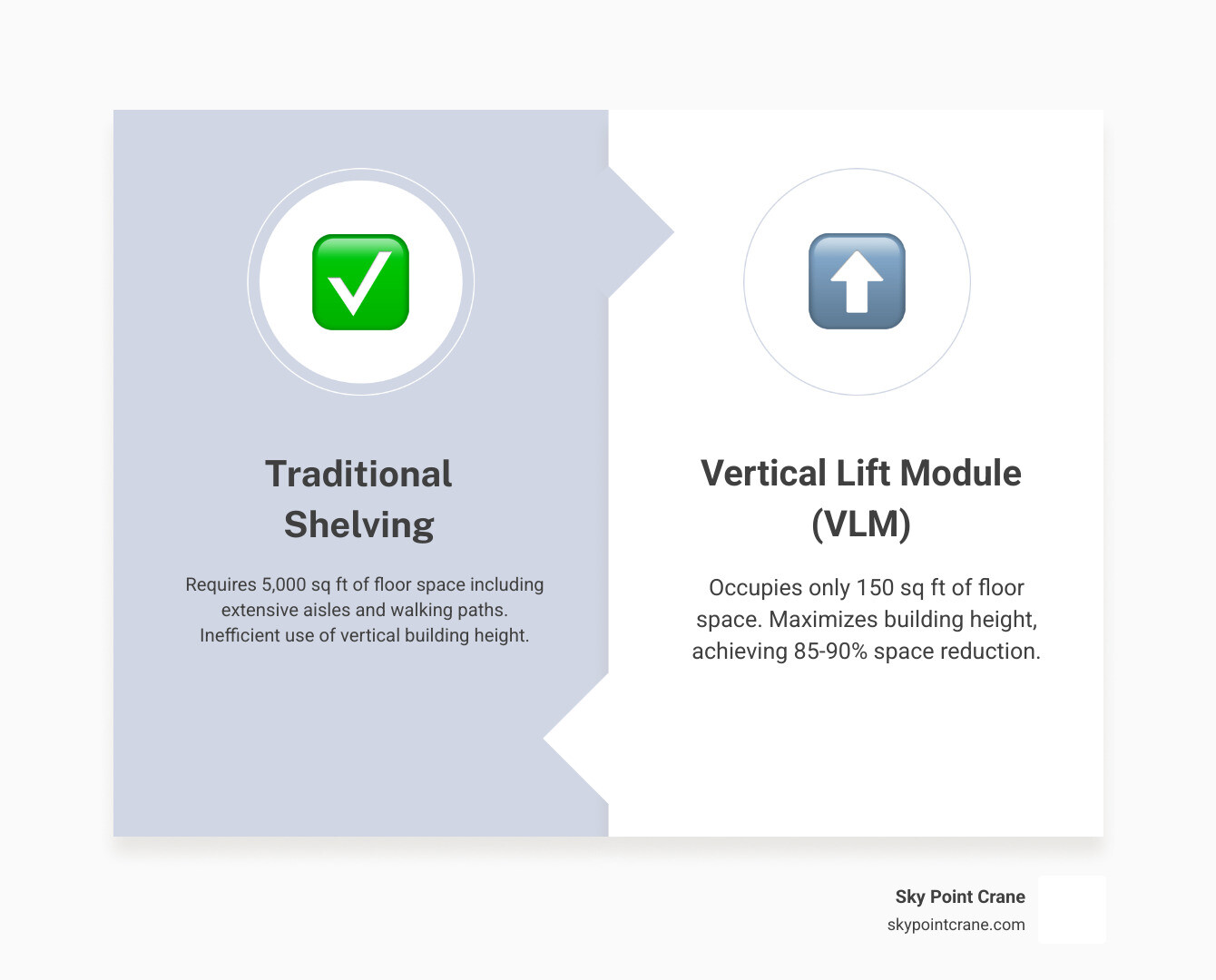
Whether you’re managing a distribution center, manufacturing facility, or aerospace parts operation, vertical lift storage can condense thousands of square feet into a compact footprint. Some operations have reduced 5,000 square feet down to just 150 square feet.
I’m Dave Brocious, and with over 30 years of experience in manufacturing, distribution management, and industrial solutions, I’ve seen how vertical lift storage systems solve critical space and efficiency challenges for facilities across Western Pennsylvania and beyond. At Sky Point Crane, we help customers evaluate and implement these systems as part of comprehensive industrial storage solutions.
Key terms for vertical lift storage:
How Vertical Lift Storage Works
At its core, a Vertical Lift Module (VLM) is an advanced automated storage and retrieval system (AS/RS) designed to maximize vertical space. Think of it as a giant, intelligent vending machine for your inventory, carefully engineered to bring items directly to your operators. This innovative approach is often referred to as the “goods-to-person” principle – a fundamental shift from operators having to walk, search, and bend to find items.
The operation of a VLM is a marvel of modern engineering. Inside a VLM, items are stored on trays within a tall, enclosed tower. When an operator needs a specific item, they interact with a control console, often a user-friendly touch-screen interface, to input their request.
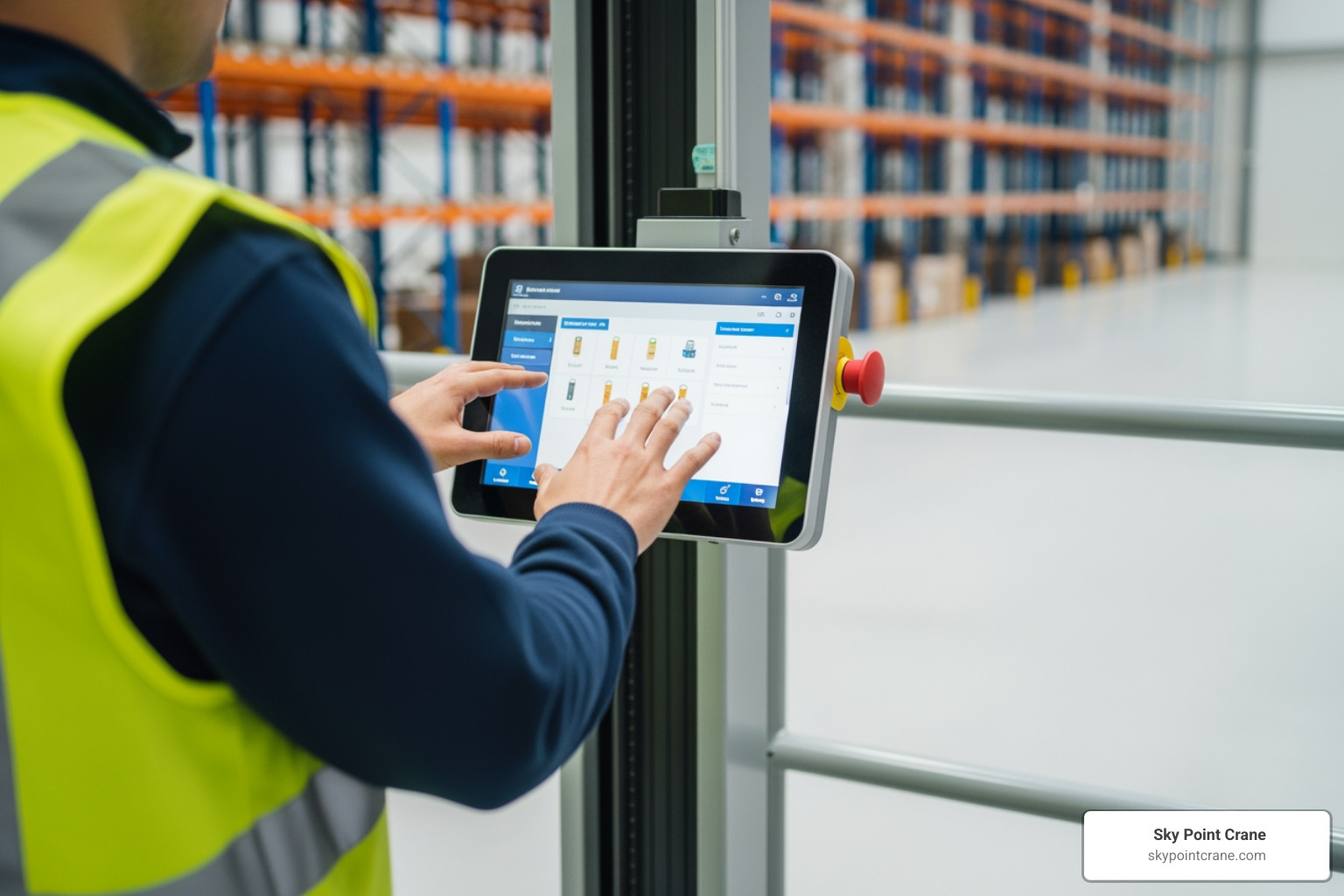
Once the request is made, an automated extractor (sometimes called an inserter/extractor or I/E device) springs into action. This robotic mechanism travels vertically within the VLM, locating the correct tray and retrieving it. The tray is then delivered to an ergonomic access point at the front of the unit, typically at waist height, making retrieval comfortable and safe for the operator. This eliminates the need for ladders, forklifts, or extensive manual handling.
Many VLMs integrate seamlessly with existing Warehouse Management Systems (WMS). This integration allows for real-time inventory updates, streamlined order processing, and better overall control of your stock. The VLM acts as an extension of your WMS, ensuring that every item’s location and quantity are accurately tracked.
Beyond efficiency, VLMs significantly improve inventory security. By storing items in an enclosed unit, access can be strictly controlled, preventing unauthorized personnel from reaching valuable or sensitive components. The integrated software provides a comprehensive audit trail, tracking who accessed what and when, which drastically reduces the risk of loss or theft. This controlled environment also protects your products from dust, dirt, and potential damage, leading to reduced product damage and waste.
One of the most impressive aspects of vertical lift storage is its contribution to picking accuracy. Human error is a common challenge in manual picking operations. VLMs combat this by automating item retrieval and using integrated software to guide the operator. Many systems incorporate visual aids like laser pointers or LED light bars that illuminate the exact location of the item on the delivered tray. This precision helps achieve an astonishing 99.9% picking accuracy rate, minimizing costly mistakes and ensuring customer satisfaction.
Key Benefits of Upgrading Your Warehouse
Upgrading your storage system to a vertical lift storage solution is more than just a change; it’s a strategic move that delivers a multitude of benefits, fundamentally changing your warehouse operations.
Space Optimization
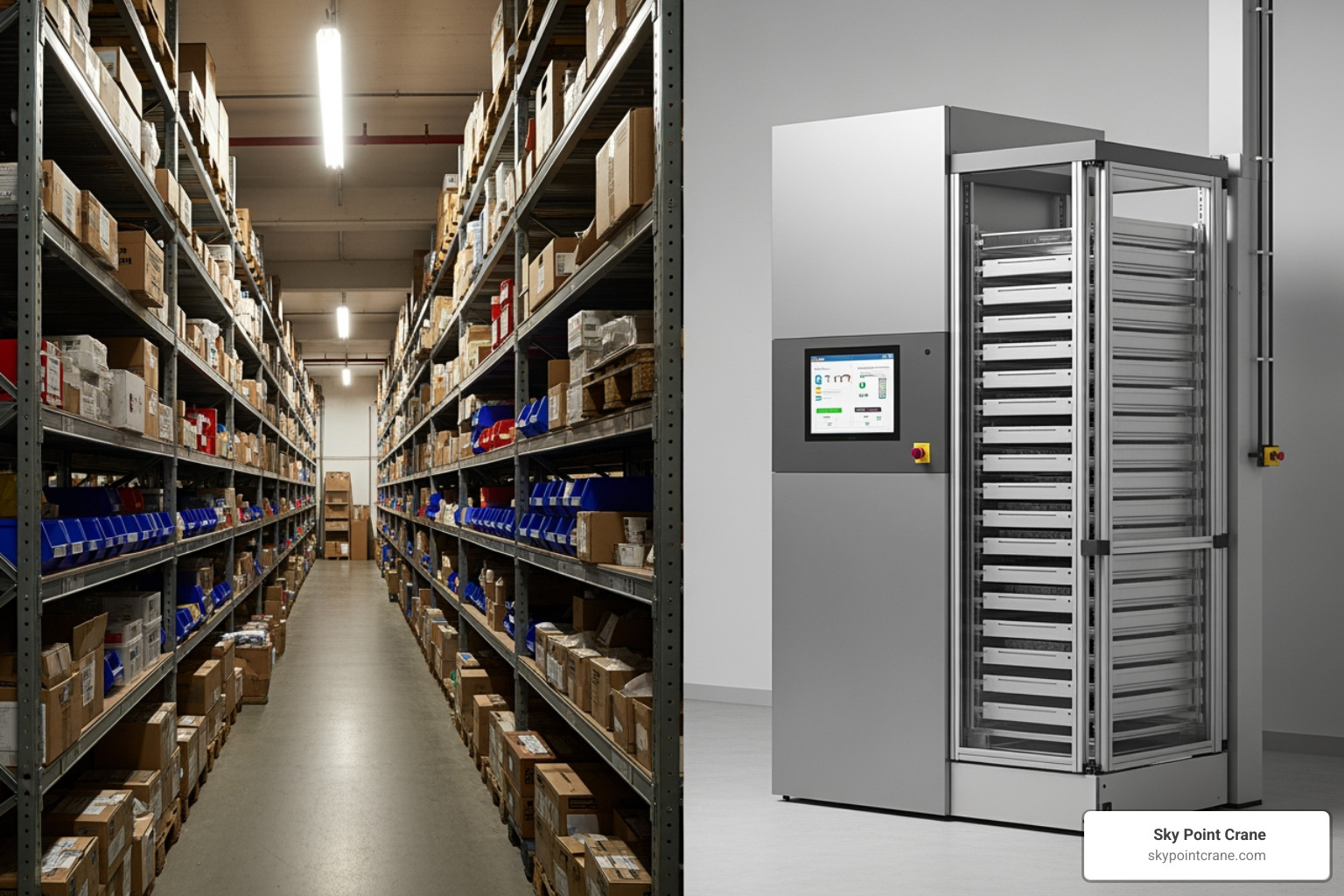
The most immediate and perhaps dramatic benefit of VLMs is their unparalleled ability to optimize space. We often find that our clients in Western and Central Pennsylvania, Ohio, West Virginia, and Maryland are struggling with growing inventory and limited floor space. Vertical lift storage offers a powerful solution by utilizing the often-overlooked vertical cube of your facility. These systems can reclaim up to 85% of your floor space, changing areas previously dedicated to wide aisles and extensive shelving into valuable production or operational space. Imagine condensing a sprawling 5,000 square feet of traditional storage to about 150 square feet for the machine itself – that’s a phenomenal 90% decrease in your footprint! This allows you to maximize your building height, making the most of every cubic foot. For more insights on maximizing your indoor space, check out our guide on Indoor Industrial Storage.
Increased Productivity
Beyond saving space, VLMs are productivity powerhouses. They can boost workforce productivity by up to 85%. How? By eliminating the time-consuming tasks that plague traditional warehouses: walking long distances, searching for specific items, and bending to reach shelves. With the “goods-to-person” principle, the items come directly to the operator. This automation allows operators to process complex orders quickly without waiting for parts retrieval, improving overall efficiency. One worker can often handle the workload of multiple operators when using vertical lift storage solutions, freeing up valuable labor for other critical tasks.
Why vertical lift storage is a game-changer for ergonomics
The physical demands of traditional warehousing can take a toll on operators. Repeated bending, stretching, and climbing to access items lead to fatigue and an increased risk of injury. This is where vertical lift storage truly shines in terms of ergonomics. VLMs deliver trays to an ergonomic, waist-high retrieval point, virtually eliminating the need for operators to bend, climb, or overextend. This significantly reduces the risk of musculoskeletal injuries, creating a safer and more comfortable work environment. A happier, healthier workforce is a more productive workforce, and the reduction in workplace injuries can lead to substantial cost savings in the long run.
How VLMs contribute to inventory management
Effective inventory management is the backbone of any successful operation. VLMs provide a robust framework for superior inventory control. With integrated software, these systems offer real-time tracking of every item stored within, from its exact location to its quantity. This level of detail drastically reduces human error that can occur during manual counting or record-keeping. Furthermore, the enclosed and secure design of vertical lift storage units makes them ideal for high-value parts, sensitive components, or regulated materials. They protect inventory from unauthorized access, environmental factors, and potential damage, ensuring your critical assets are always accounted for and in pristine condition. For more on comprehensive storage strategies, explore our resources on Commercial Storage Facilities.
Applications and Customization Options
Vertical lift storage systems are not one-size-fits-all solutions; their adaptability makes them valuable across a broad spectrum of industries and applications. We see VLMs making a significant impact in various sectors by addressing unique storage challenges.
Common Industries
These automated giants are particularly beneficial for industries that manage a high volume of diverse SKUs, require rapid access to parts, or deal with limited floor space. Common industries that extensively use VLMs include:
- Manufacturing: For storing components, tools, jigs, and fixtures.
- Automotive: Managing spare parts, service components, and specialized tools.
- Aerospace: Handling high-value, sensitive, and often small parts with strict inventory control requirements.
- Healthcare: Storing medical devices, pharmaceuticals, and surgical instruments in a secure and organized manner.
- E-commerce and Distribution Centers: Expediting order fulfillment for a vast array of products, from small electronics to apparel.
VLMs prove their worth in environments where precision, speed, and security are paramount, such as cleanrooms or healthcare facilities, where climate control and contamination prevention are critical.
To understand how VLMs stack up against other industrial storage methods, let’s look at a comparison:
| Feature | Vertical Lift Module (VLM) | Vertical Carousel | Industrial Warehouse Pallet Racking |
|---|---|---|---|
| Space Utilization | Excellent (up to 85-90% savings) | Very Good (up to 70% savings) | Good (requires wide aisles) |
| Goods-to-Person | Yes | Yes | No (person-to-goods) |
| Picking Speed | Very Fast (direct tray delivery) | Fast (rotates shelves) | Moderate to Slow (manual retrieval) |
| Picking Accuracy | High (99.9% with visual aids) | High (guided retrieval) | Moderate (prone to human error) |
| Ergonomics | Excellent (waist-high access) | Very Good (waist-high access) | Poor (bending, reaching, climbing) |
| Security | Excellent (enclosed, controlled access) | Good (enclosed, controlled access) | Moderate (open access) |
| Inventory Management | Excellent (real-time tracking, software integration) | Good (software integration) | Manual or WMS dependent |
| Item Height Flexibility | Excellent (automatic height detection) | Limited (fixed shelf heights) | Excellent (adjustable beam levels) |
| Best For | Small to medium parts, high-value items | Small parts, high-turnover items | Palletized, bulky, or heavy items |
For larger, palletized goods, traditional Industrial Warehouse Pallet Racking remains a robust solution, but for smaller, high-SKU items, VLMs offer a clear advantage.
Customizing your vertical lift storage system
One of the greatest strengths of vertical lift storage is its modularity and extensive customization options. These systems are designed to adapt to diverse facility layouts and inventory needs, ensuring they perfectly integrate into your operations.
- Modular Design: VLMs can be configured with modular heights, trays, and access bays. This means a system can be built to fit the exact height of your facility, even spanning multiple floors or operating through walls to connect different areas like a warehouse and a cleanroom.
- Adjustable Heights: Many VLMs feature automatic height detection technology. This intelligent feature scans each tray as it’s stored and allocates only the necessary vertical space, optimizing capacity and ensuring high-density storage.
- Tray Dimensions and Partitions: Trays come in various sizes and can be further customized with partitions and dividers. This allows you to create dedicated compartments for different items, maximizing organization and preventing item migration. For example, the Modula Lift offers a maximum payload of up to 990 kg for all tray models up to 4,100 mm long, demonstrating significant capacity for diverse inventory.
- Payload Capacities: From light components to heavy industrial parts, VLMs are built to handle a wide range of weights. Some heavy-duty models like the PowerColumn 3 (PC3) VLM can support up to 2,000 lbs per tray.
- Climate Control Options: For sensitive materials, VLMs can be equipped with climate control features, maintaining specific temperature and humidity levels, ideal for pharmaceuticals or electronics.
- Integration Capabilities: VLMs can integrate with a variety of systems, including your WMS, conveyors, and even robotics, creating a highly automated workflow.
Whether you need a compact unit for a small workshop or a multi-unit system for a large distribution center, vertical lift storage can be custom to your specific requirements. We’ve seen how flexible systems like the VersaLift can even be adapted for residential use, demonstrating the versatility of vertical lift technology. You can see examples of different lift types to understand the range of applications.
Evaluating Your Investment: ROI and Maintenance
Considering an investment in vertical lift storage is a significant decision for any business in Western Pennsylvania, Ohio, West Virginia, or Maryland. It’s crucial to look beyond the initial cost and evaluate the long-term benefits, including return on investment (ROI), maintenance requirements, and even environmental impact.
Calculating ROI
The ROI of a VLM is often compelling, driven by several key factors:
- Labor Savings: By automating picking and retrieval, VLMs drastically reduce the labor hours spent on traditional material handling. This means fewer personnel dedicated to picking or allowing existing staff to be redeployed to more value-added tasks.
- Space Cost Reduction: Reclaiming up to 85-90% of your floor space means you might delay or avoid costly warehouse expansions, or even reduce your existing footprint, leading to significant savings on rent, utilities, and property taxes.
- Increased Throughput: Faster picking speeds and improved accuracy translate directly to higher throughput and quicker order fulfillment, enhancing customer satisfaction and enabling business growth.
- Improved Accuracy: With picking accuracy reaching 99.9%, the costs associated with mispicks, returns, and inventory discrepancies are virtually eliminated, leading to substantial savings.
When you factor in these elements, the payback period for a VLM can be surprisingly short, often measured in just a few years.
Lifespan and Maintenance
VLMs are robust industrial machines designed for a long operational life, typically 10-20 years or more with proper care. Like any piece of sophisticated machinery, they require routine preventive maintenance to ensure optimal performance and longevity.
- Routine Maintenance: This includes regular checks of lift mechanisms, sensors, and software. Many systems are designed with front-facing maintenance access, making service easier and less disruptive to operations.
- Annual Inspections: Most manufacturers recommend annual inspections by certified technicians to identify potential wear and tear before it becomes a problem.
- Software Updates: Keeping the VLM’s control software up-to-date ensures it runs efficiently, integrates smoothly with your WMS, and benefits from the latest features and bug fixes.
By adhering to a recommended maintenance schedule, you can maximize the lifespan of your vertical lift storage system and minimize unexpected downtime.
Sustainability
In an era where environmental responsibility is increasingly important, VLMs offer notable contributions to sustainability:
- Reduced Energy Consumption: By optimizing storage density, VLMs can reduce the overall energy consumption associated with heating, cooling, and lighting a larger, less efficient warehouse space.
- Smaller Facility Footprint: A more compact storage solution means less land use, fewer construction materials, and a smaller environmental impact from your facility.
- Use of Recyclable Materials: Many manufacturers, such as Vidir, design their VLMs with sustainability in mind, promoting efficiency and using recyclable materials in their construction. This commitment helps reduce the overall environmental footprint of your operations.
Frequently Asked Questions about Vertical Lift Storage
We often get asked common questions about vertical lift storage as businesses explore these innovative solutions. Here are some of the most frequent inquiries we address:
How much floor space can I realistically save?
This is usually the first question on everyone’s mind, and for good reason! The answer is substantial. Vertical lift storage systems can reduce floor space requirements by an impressive 85% to 90% compared to traditional shelving. This is achieved by utilizing the vertical height of your facility, turning what was once sprawling aisles and floor-level storage into a single, compact unit that reaches towards the ceiling. Imagine taking 5,000 square feet of inventory and condensing it into a mere 150 square feet. This reclaimed space can then be used for additional production, assembly lines, offices, or simply to improve workflow and safety.
What types of items are best suited for a VLM?
VLMs are incredibly versatile, but they excel with specific types of inventory. They are ideal for small to medium-sized items, tools, spare parts, and high-value components. Think of items that would typically be stored in bins, drawers, or on shelves, such as:
- Electronic components
- Fasteners and hardware
- Medical instruments and supplies
- Tooling and machine parts
- Automotive components
- Maintenance, Repair, and Operations (MRO) supplies
- High-value or sensitive items requiring secure storage
Their enclosed nature and precise retrieval make them perfect for items that need protection, organization, and rapid access without occupying extensive floor space.
How does a VLM compare to a vertical carousel?
Both VLMs and vertical carousels are automated “goods-to-person” systems designed to maximize vertical space, but they operate differently and offer distinct advantages:
- Vertical Lift Module (VLM): A VLM consists of two columns of trays with an automated inserter/extractor in the middle. When an item is requested, the inserter/extractor retrieves the specific tray and delivers it to an ergonomic access opening. The key advantage here is item height flexibility. The VLM’s automatic height detection can allocate varying amounts of space for each tray, making it highly efficient for storing items of different heights. It brings only the requested tray to the operator.
- Vertical Carousel: A vertical carousel operates like a Ferris wheel. Shelves or carriers are attached to a chain-driven system that rotates vertically. When an item is requested, the entire carousel rotates to bring the correct shelf to the access opening. While efficient for space, carousels typically have fixed shelf heights, meaning space can be wasted if items don’t perfectly fill the vertical dimension of each shelf. It brings the entire shelf to the operator.
In summary, VLMs offer greater flexibility for items of varying heights and often provide better overall storage density due to their adaptive tray spacing, while carousels can be excellent for high-turnover, uniformly sized items.
Conclusion: Is a VLM the Right Solution for You?
The landscape of industrial storage is continually evolving, and vertical lift storage systems represent a significant leap forward in efficiency, safety, and space utilization. We’ve explored how these intelligent machines can revolutionize your operations, from dramatically reducing your physical footprint to supercharging your workforce productivity.
To recap, the benefits are clear and compelling:
- Best space savings: Reclaim up to 85-90% of your floor area, converting it into valuable operational space.
- Drastic productivity gains: Boost workforce efficiency by up to 85%, eliminating wasteful walking and searching.
- Improved safety and ergonomics: Deliver items to operators at an ergonomic height, reducing strain, fatigue, and the risk of injuries.
- Improved inventory control: Achieve near-perfect picking accuracy and secure your valuable assets with integrated software and controlled access.
- Contribution to sustainability: Optimize energy use and reduce your environmental footprint.
Deciding if a VLM is the right fit for your facility in Western Pennsylvania, Ohio, West Virginia, or Maryland requires careful consideration. We encourage you to:
- Analyze your inventory profile: Are you storing many small to medium-sized parts, tools, or high-value items?
- Assess your facility’s vertical height: Do you have unused overhead space that could be leveraged?
- Plan for future growth: Can a VLM accommodate your expanding inventory needs without requiring a costly physical expansion?
For complex projects, especially those involving the installation of heavy equipment like a VLM, professional rigging and lift planning are absolutely essential to ensure safety and efficiency. At Sky Point Crane, we provide expert services for challenging industrial projects, leveraging our extensive experience to manage every aspect from planning to execution. We understand the nuances of integrating advanced storage solutions into existing or new facilities. Explore our Industrial Storage solutions to see how we can help you find the perfect fit for your operational needs.