
Why Boom Truck Rental Is Essential for Modern Construction Projects
Boom truck rental provides construction teams with mobile, truck-mounted cranes that combine lifting power with job site mobility. These versatile machines solve a fundamental challenge: getting heavy loads exactly where they need to be, quickly and safely. Unlike stationary cranes, boom trucks drive to your site, set up in minutes, and maneuver through tight access points, making them ideal for placing HVAC units, setting steel beams, or handling roof trusses.
Quick Overview: Boom Truck Rental Essentials
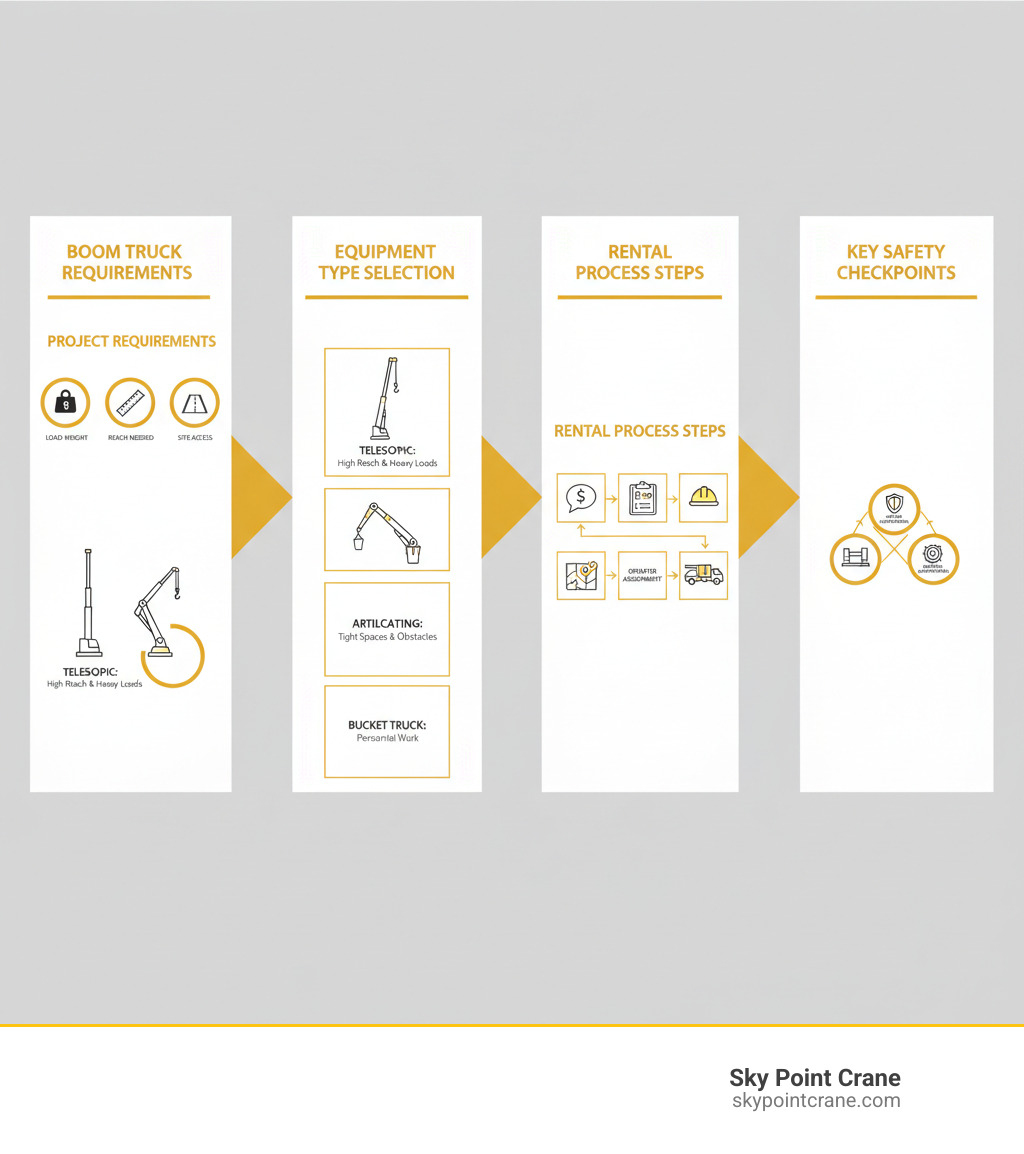
- Types: Telescopic (straight-line reach), articulating/knuckle (maneuverability), and bucket trucks (personnel lifting).
- Capacities: 20-ton to 200-ton models with boom lengths from 40 to 160+ feet.
- Process: Request a quote, provide project details, review costs, and schedule delivery with a certified operator.
- Key Factors: Lifting capacity, reach, site access, ground conditions, and power source.
- Safety: Requires NCCCO certified operators, proper outrigger setup, and OSHA compliance.
The rental model offers access to specialized equipment without the high costs of ownership, maintenance, and storage. When project demands change, you can easily switch to a different model.
As Dave Brocious, I’ve spent 30 years helping construction teams solve lifting challenges across Pennsylvania, Ohio, West Virginia, and Maryland. Sky Point Crane specializes in boom truck rental solutions that include certified operators, lift planning, and 24/7 availability to keep your projects on track.
Quick look at Boom truck rental:
- Advanced rigging techniques
- Crane rental costs
- Rough terrain crane
What is a Boom Truck? Key Differences and Capabilities
A boom truck rental unit is one of the most practical pieces of lifting equipment in construction. It’s a powerful hydraulic lifting arm mounted on a commercial truck chassis, combining mobility and muscle. This design allows it to drive on highways, steer city streets, and set up for lifts in a fraction of the time required by traditional cranes. The hydraulic boom extends and retracts with precision, providing control over both vertical height and horizontal reach for tasks like placing HVAC units or setting steel beams.

Boom Truck vs. Crane: Understanding the Nuance
While a boom truck is technically a type of crane, the terms are often used to distinguish between equipment classes. Traditional mobile cranes, like all-terrain models, are built for the heaviest lifts. They often require separate transport for counterweights and extensive setup time, making them suitable for major infrastructure projects.
Boom trucks fill a different role. By integrating the crane onto a standard truck chassis, they remain agile and highway-legal, allowing them to move between job sites in a single day without logistical problems. Setup takes minutes, not hours. This mobility makes them ideal for moving materials around an active site, with the trade-off being lower lifting capacities than their larger cousins.
Boom Truck vs. Aerial Lifts: Reaching New Heights, Differently
Boom trucks are often confused with aerial lifts (cherry pickers), but they serve different purposes under OSHA regulations.
Aerial lifts are designed to lift people safely. Their primary job is to get workers and their tools to liftd work areas for tasks like painting, electrical work, or window cleaning. They typically handle only 500 to 1,000 pounds.
Boom trucks are built to move heavy loads measured in tons. Their main function is material handling, with capacities ranging from 18-ton models to specialized 200-ton units. While some have personnel baskets, their design focuses on lifting serious weight. OSHA strictly prohibits using boom lifts as cranes or vice versa. For personnel lifting, see our Man Lift Truck Rental guide.
Key Components: Boom, Jib, Outriggers, Truck Chassis
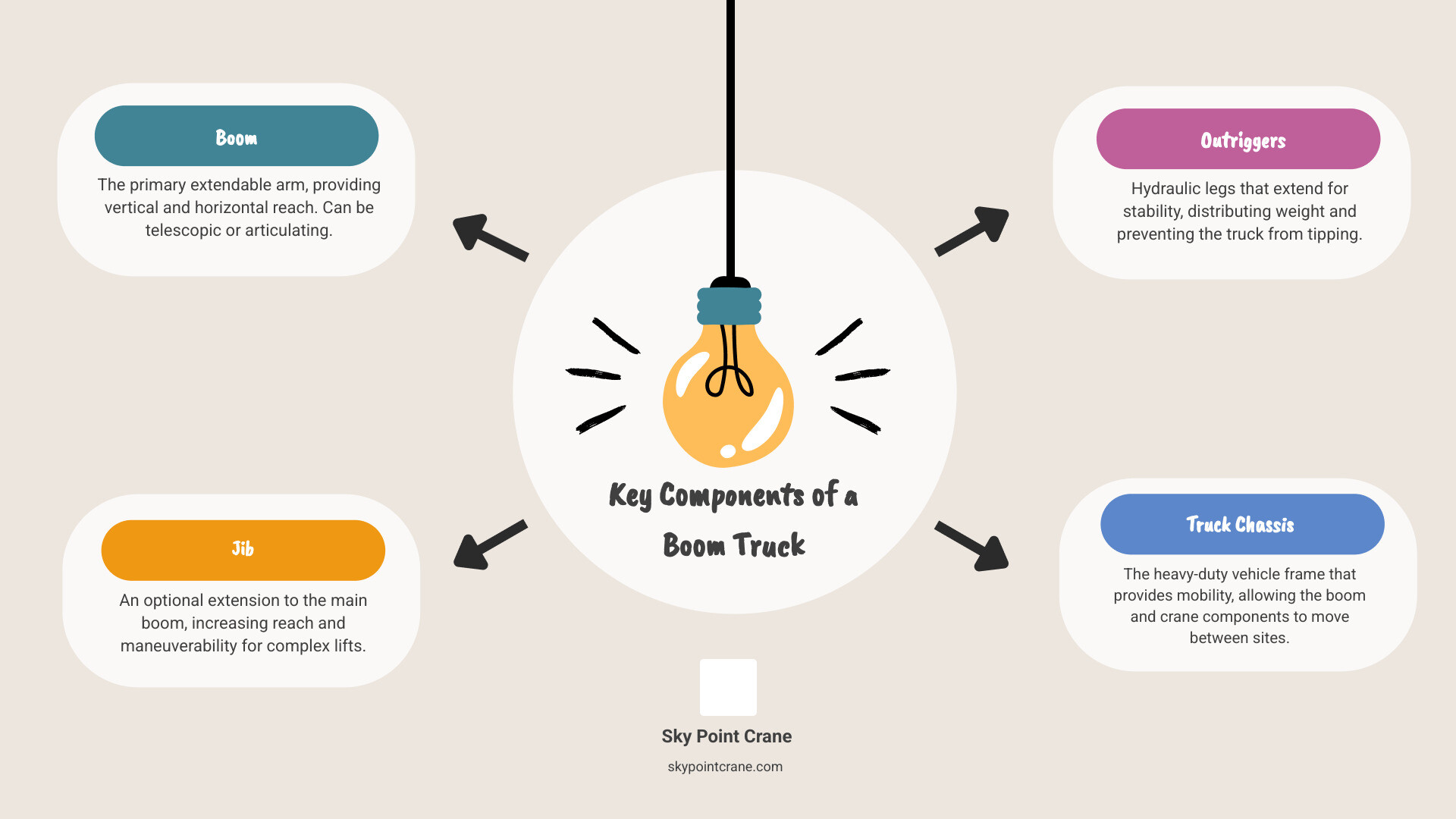
Four essential components work together for safe lifting:
- The boom is the hydraulic arm that provides vertical lift and horizontal reach. It can be telescopic (straight sections) or articulating (jointed sections).
- A jib is an extension attached to the boom’s end, adding extra reach and allowing operators to maneuver loads around obstacles.
- Outriggers are hydraulic legs that extend from the chassis to stabilize the truck. They distribute the load’s weight over a wider footprint to prevent tipping and are essential for every safe lift.
- The truck chassis is the heavy-duty vehicle frame that makes the entire system mobile and street-legal, allowing it to be driven directly to the job site.
Types of Boom Trucks and Their Primary Applications
When exploring boom truck rental options, it’s crucial to know that each type is a specialized tool for specific lifting challenges. Sky Point Crane’s fleet includes a variety of boom trucks to match diverse project needs across Pennsylvania, Ohio, West Virginia, and Maryland.
Telescopic Boom Trucks
Often called “stiff boom” cranes, telescopic boom trucks feature a boom that extends straight out, providing a direct path for the load. These machines are built for straight-line reach and heavy lifting, with horizontal reaches up to 130 feet and lifting capacities from 18-ton to 28-ton.
Their strength makes them ideal for applications like steel erection, HVAC placement, and general rooftop work such as setting trusses or solar panels. When you have a clear path and a heavy load, a telescopic boom truck is your most efficient choice. For more details, see our Telescopic Boom Truck Crane guide. We also offer specialized Crane Rental for Steel Erection services.

Articulating (Knuckle) Boom Trucks
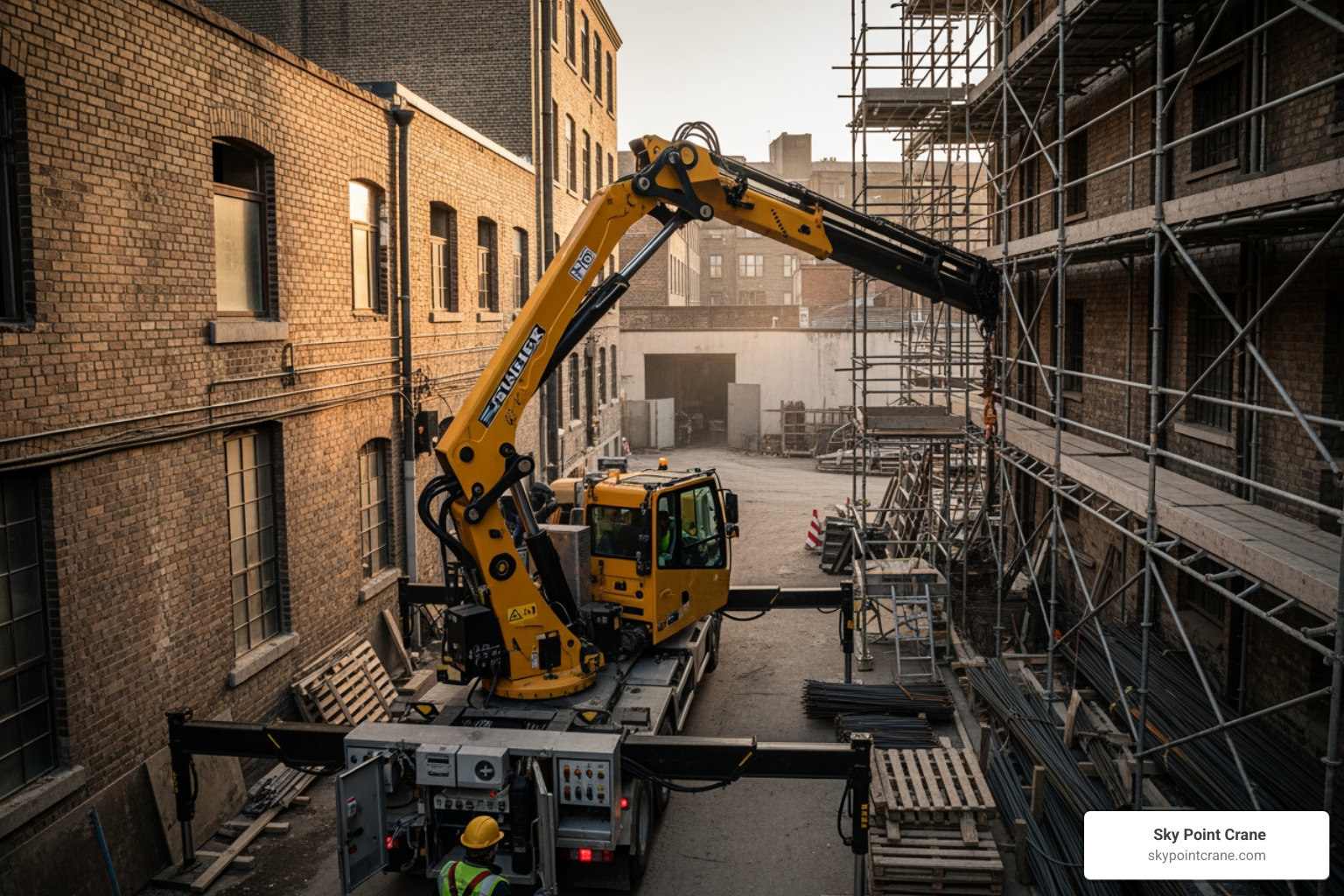
Known as knuckle boom cranes, these trucks have a folding boom that bends at multiple joints, like knuckles. This design provides exceptional maneuverability, allowing the boom to move up, over, and around obstacles. They are perfect for tight spaces and urban construction because they require less setup room.
Their superpower is up-and-over access, making them invaluable for placing materials behind existing structures or in congested areas. Despite their flexibility, they are powerful, with some models handling loads up to 78,000 pounds. They excel at material delivery through narrow openings and navigating complex rigging scenarios. Learn more in our Knuckle Boom Truck Crane Guide 2025.
Bucket Trucks (Personnel Lifts)
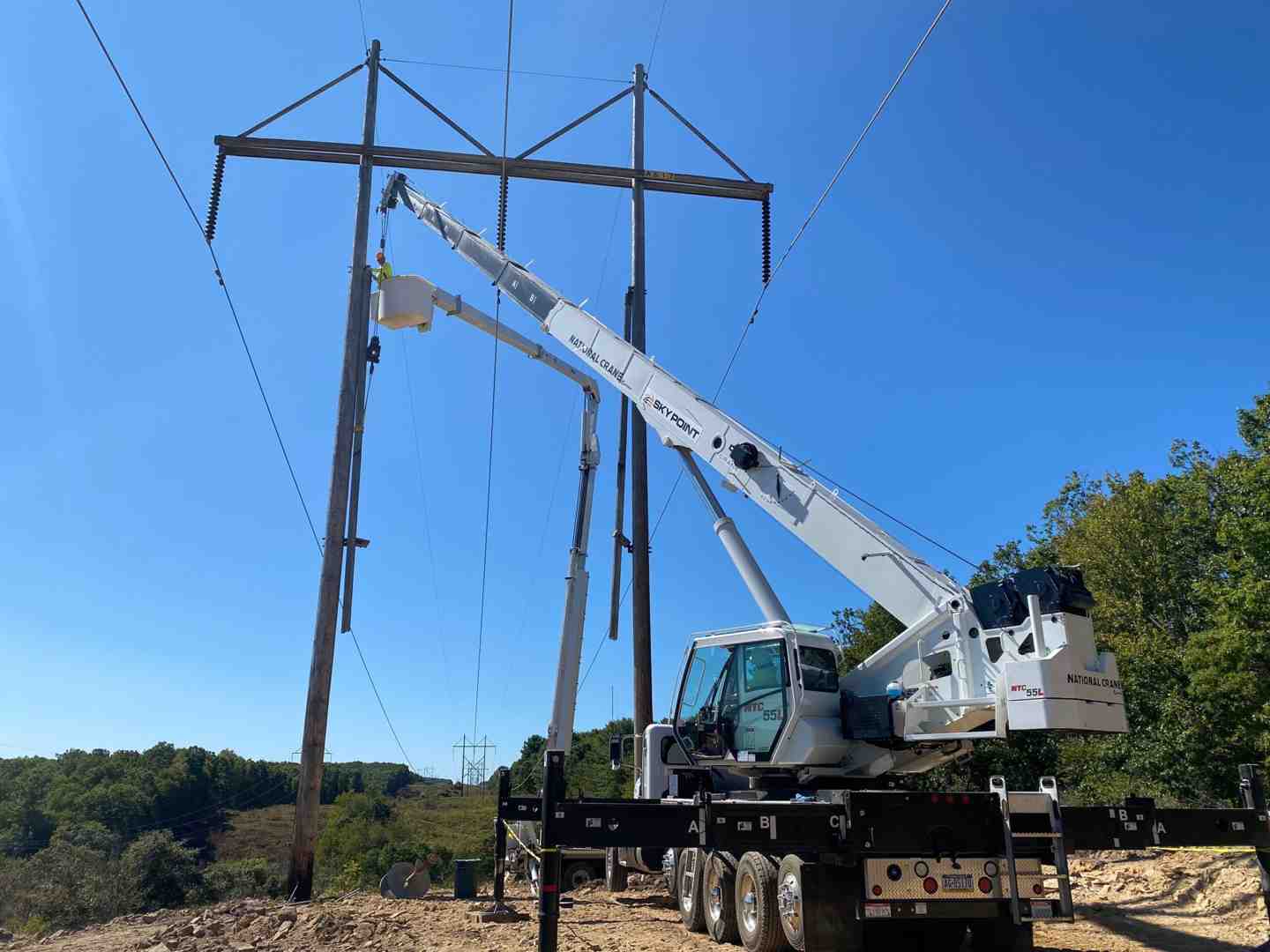
Bucket trucks, or “man lifts,” specialize in lifting people safely. Their key feature is the personnel basket at the end of the boom, providing a secure platform for workers and their tools. Many models offer insulated options to protect operators from electrical hazards, making them essential for utility work.
These trucks are the standard for electrical line maintenance, telecom work, tree trimming, and sign installation. Their design prioritizes operator safety for tasks requiring human precision at height. Find more in our Boom Truck with Bucket guide. We also provide Crane Rental for Tree Removal services.
How to Choose the Right Boom Truck for Your Project
Picking the right boom truck is about matching the equipment to your project’s specific demands. At Sky Point Crane, we guide contractors across Pennsylvania, Ohio, West Virginia, and Maryland through this process to ensure a perfect fit.
Assessing Your Project’s Lifting Requirements
Before requesting a boom truck rental, you must know your load.
- Lifting capacity is the starting point. Know the exact weight of your load. Our boom trucks range from 18-ton to 28-ton capacity, with specialized knuckle booms handling up to 200 tons. Never underestimate weight; exceeding capacity is a primary cause of accidents.
- Load charts are the crane’s instruction manual, specifying how much it can lift at different angles and extensions. Our operators study these before every lift.
- Reach and height are critical. How far out (horizontal reach) and how high up (vertical height) does the load need to go? Our equipment offers horizontal reaches up to 160 feet and vertical heights up to 185 feet.
For complex jobs, our Heavy Lift Crane Planning Solutions help ensure every detail is accounted for.
Evaluating Job Site Conditions
The operating environment is as important as the load itself.
- Ground conditions must be firm and level to support the truck and its load. We assess the surface and use mats if needed to ensure stability.
- Access space determines the best truck type. Articulating knuckle booms excel in tight spaces like alleyways or congested sites.
- Overhead obstructions like power lines, trees, and buildings must be identified early to prevent dangerous situations.
We use advanced 3D Lift Planning to create a virtual model of your job site, simulating the lift to identify potential issues before we arrive.
Considering Power Source and Environmental Impact
The power source affects performance and compliance.
- Diesel and gas-powered trucks are the standard for outdoor projects, offering robust power and all-day operation.
- Electric-powered options are ideal for indoor work or sensitive areas. They produce zero emissions and are quiet, making them suitable for hospitals, schools, or residential zones.
Choosing an electric model can also reduce your project’s carbon footprint and meet local low-emission regulations. We can help you decide which option is best for your situation.
| Feature | Telescopic Boom Trucks | Articulating (Knuckle) Boom Trucks |
|---|---|---|
| Reach Type | Straight-line, outward extension | Multi-jointed, up-and-over, around obstacles |
| Max. Reach | Often greater horizontal and vertical height | Excellent for navigating complex spaces, less raw horizontal reach |
| Capacity | Generally higher lifting capacities for heavy, direct lifts | Good lifting capacity, but emphasis on maneuverability |
| Best Use Cases | Steel erection, HVAC placement, rooftop work, clear path lifts | Tight spaces, urban construction, material delivery over/around obstacles |
| Footprint | May require more setup room due to turntable and outriggers | Can operate in smaller work zones, more compact setup |
The Smart Way to Lift: Your Guide to Boom Truck Rental
For professionals in Pennsylvania, Ohio, West Virginia, and Maryland, boom truck rental is often the smartest financial decision for a project. It provides access to powerful equipment without the heavy burden of ownership.
Why Renting is Often Smarter Than Buying
Buying a new boom truck costs hundreds of thousands of dollars, and that’s just the start. Ownership comes with significant hidden costs: insurance, taxes, storage, and unpredictable maintenance and repairs. A single hydraulic failure can set you back thousands.
Boom truck rental eliminates this financial uncertainty. A single rental rate covers a well-maintained, certified machine without surprise bills or depreciation. Renting also provides crucial flexibility. One project may need a telescopic boom, while the next requires a knuckle boom for a tight space. Renting gives you access to the right tool for every job, allowing you to scale your equipment needs up or down based on demand. This keeps your overhead lean and your budgets accurate.
For a detailed comparison, see our analysis: Truck Crane Rental vs Purchase: Which is the Best Option for Your Business?.
The Boom truck rental Process: From Quote to Job Site
We’ve streamlined our rental process for maximum efficiency.
- Request a Quote: Request a Quote online or call us. Provide key project details: load weight, required reach and height, job location, and any site obstacles.
- Understand the Costs: Our estimates clearly break down rates based on truck type, capacity, and rental duration (from a 4-hour minimum to weekly or longer). Most rentals include a certified operator for safety and efficiency. Our Crane Rental Costs: Complete Guide explains all pricing factors.
- Finalize and Schedule: We’ll handle the rental contract and verify insurance coverage. Our guide on Crane Rental Insurance can help. Once complete, we schedule delivery and execute your lift safely and on time.
Questions to Ask Your Boom truck rental Provider
Before committing, ask these critical questions to ensure you’re partnering with a professional operation:
- Are your operators NCCCO certified? (All of ours are—it’s non-negotiable).
- How is your equipment maintained and certified? (We perform multipoint inspections and annual re-certifications).
- What is your safety record and what are your protocols? (We have a full-time safety staff and a 30-year track record).
- Can you serve my location and timeline? (We offer 24/7 availability across PA, OH, WV, and MD).
- What support services do you offer? (We provide comprehensive solutions, including 3D Lift Planning).
- Who handles delivery, setup, and pickup?
These questions help you find a partner committed to your project’s success. With Sky Point Crane, you’re not just renting equipment; you’re gaining a dedicated team.
Mastering Safety: Best Practices for Boom Truck Operation
When you’re working with equipment as powerful as a boom truck, safety isn’t just important—it’s everything. At Sky Point Crane, our commitment to safety has been the foundation of our business for over three decades, shaping every boom truck rental and operation we undertake.

Operator Certification and Training
The person at the controls is as important as the machine. That’s why we insist on NCCCO certification for every operator. This rigorous certification proves an operator’s competency in load charts, stability, rigging, and safety procedures.
We primarily offer fully operated rentals, meaning our certified operator comes with the equipment. This reduces your liability and ensures maximum efficiency, as our operators know their machines inside and out. While bare rentals (equipment only) may seem cheaper, they shift the enormous responsibility of sourcing and supervising a qualified operator onto you. For most projects, an operated rental is the smarter, safer choice. Learn more about our NCCCO Certified Crane Operators.
Job Site Safety Protocols
Safe operation is a team effort. We follow strict protocols on every job site.
- Pre-operation inspections are conducted daily to check hydraulic systems, controls, and safety features.
- Clear work zones are established and maintained to keep unnecessary personnel away from the lift area.
- Proper outrigger setup is non-negotiable. We ensure they are fully extended on stable ground before any lift begins, as improper setup is a leading cause of accidents.
- Power line awareness is critical. We identify all overhead obstructions and maintain strict safe working distances.
- Certified signal persons are used whenever the operator’s view is obstructed, ensuring clear communication and precise movements. Our team includes certified Rigging Signal Persons.
For a complete overview, visit our Crane Safety Protocols page.
Understanding OSHA Regulations
We strictly adhere to all Occupational Safety and Health Administration (OSHA) regulations. A key rule concerns intended use. Equipment must only be used for the purpose it was designed for.
OSHA explicitly prohibits using boom lifts as cranes and vice versa. A boom lift is for personnel, and a boom truck is for materials. The engineering and safety systems are fundamentally different. Using equipment outside its design parameters is illegal, voids insurance, and puts lives at risk. You can review the rule here: OSHA regulation prohibits boom lifts from being used outside their intended purpose. With Sky Point Crane, you can trust that every operation is fully compliant.
Conclusion: Power Your Project with a Reliable Partner
This guide has covered the essentials of boom truck rental, from the different types of machines to choosing the right one and operating it safely. The key takeaway is that renting delivers versatility, efficiency, and cost-effectiveness for modern construction projects. Whether you’re in Pittsburgh, Columbus, Charleston, or Baltimore, renting provides access to the right tool for the job without the heavy costs of ownership.
At Sky Point Crane, we are more than an equipment provider; we are your project partner. We offer:
- NCCCO certified operators with decades of experience.
- 3D lift planning to optimize complex lifts and ensure safety.
- 24/7 crane services across Pennsylvania, Ohio, West Virginia, and Maryland for planned projects and emergencies.
After 30 years in this business, I know that a successful lift comes down to partnership. It’s about having a team that understands your challenges and has the expertise to solve them efficiently.
Ready to get started? Let’s discuss your next project. Our team is here to provide a detailed quote and help you plan and execute your lift safely and successfully.
Explore our full range of crane rental services and find how Sky Point Crane can lift your next project.