
Everything You Need to Know About Boom Truck Leasing
What You Need to Know Before Renting a Bucket Crane
Bucket crane rental gives you mobile, height-access lifting power without the cost of owning the equipment. Here’s a quick overview of what to expect:
| Key Factor | What to Know |
|---|---|
| Typical lift heights | 34 ft to 185 ft depending on model |
| Platform capacity | 350 lbs (single person) up to 800+ lbs (material handling) |
| Daily rental cost | $200–$300/day for most standard bucket trucks |
| Common uses | Utility work, sign installation, telecom, construction |
| Insulated vs. non-insulated | Insulated required for electrical/utility work |
| Operator requirements | OSHA training required; CDL may be needed |
Renting bucket crane equipment sounds straightforward — until you’re on-site and realize you ordered the wrong lift height, the wrong boom type, or a non-insulated truck for electrical work. Getting those details wrong costs time, money, and can put workers at risk.
This guide walks you through everything: equipment types, specs, costs, safety rules, and how to choose the right truck for your job.
I’m Dave Brocious, and with over 30 years of experience in equipment solutions and business operations — including leading Sky Point Crane’s bucket crane rental services across Western Pennsylvania, Ohio, West Virginia, and Maryland — I’ve seen what separates a smooth rental experience from a costly one. Let’s make sure your next project goes smoothly.
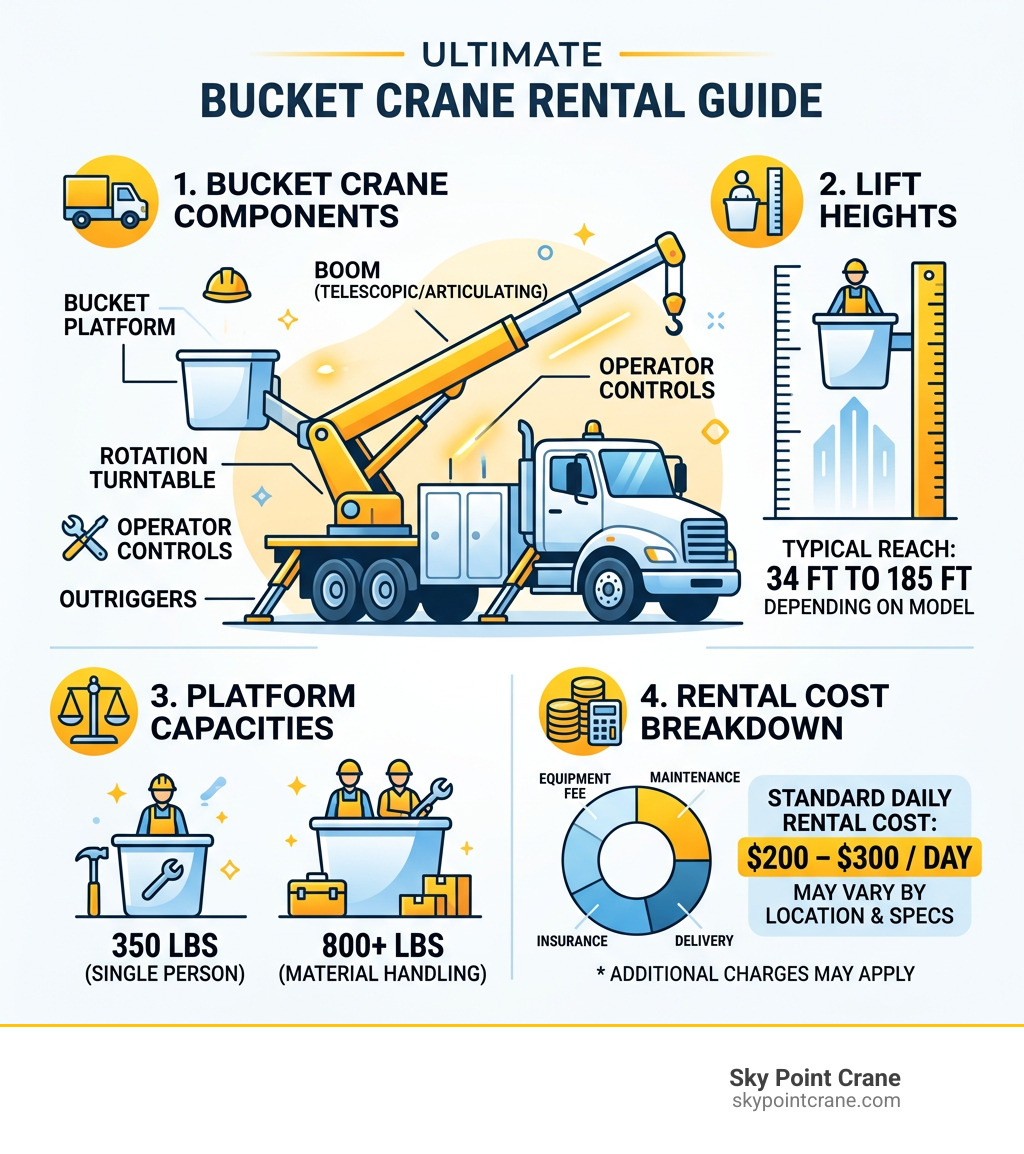
Simple bucket crane rental glossary:
Understanding the Bucket Crane Rental and Equipment Types
When we talk about a bucket crane rental, we are often describing a specialized hybrid of a truck, a crane, and an aerial work platform. While the industry uses terms like “cherry picker,” “bucket truck,” or “boom truck” interchangeably, there are technical differences that matter for your project.
A boom truck is essentially a truck frame with a telescoping boom mounted on a rotating turret. This turret allows for 360-degree maneuverability, which is vital when you are working in tight spots in downtown Pittsburgh or a crowded construction site in Maryland. According to OSHA regulations, it is critical to use this equipment only for its intended purpose. For instance, you cannot use a standard boom lift as a crane to lift heavy structural steel unless it is specifically designed and rated for that task.
At Sky Point Crane, we provide a variety of configurations to ensure you have the right tool for the job. If you are curious about the mechanics, you can find more info about boom truck with bucket options that bridge the gap between simple personnel lifts and material handling cranes.
Articulating vs. Telescopic Bucket Crane Rental Options
Choosing between an articulating boom and a telescopic boom is one of the first decisions we help our clients make.
- Telescopic Booms: These extend straight out like a telescope. They are fantastic for high-reach tasks where you have a clear line of sight to the work area. If you need to reach 150 feet straight up to repair a stadium light in West Virginia, this is your go-to.
- Articulating Booms: These feature “knuckles” that allow the boom to bend. This “up-and-over” reach is essential for working over obstacles like power lines, roof edges, or trees. In tight urban spaces in Ohio, an articulating bucket van is often the only way to get a technician to the exact spot they need to be.
For a deeper dive into which might suit your project, check out our bucket truck rentals complete guide.
Insulated vs. Non-Insulated Bucket Crane Rental Models
Safety is our primary concern, especially when electricity is involved. This is where the distinction between insulated and non-insulated models becomes a matter of life and death.
- Insulated Bucket Trucks: These are designed for utility work. The boom is constructed with non-conductive materials like fiberglass, and the unit undergoes regular dielectric testing. This prevents electricity from traveling through the boom to the truck or the ground, protecting the operator.
- Non-Insulated Bucket Trucks: These are typically used for signage, painting, or tree trimming where there is no risk of electrical contact. They are often lighter and may offer different reach capacities.
If your job involves power lines, you must opt for a boom lift bucket truck rental that is specifically rated as insulated.

Key Specifications: Lift Heights and Platform Capacities
Understanding the numbers is the only way to ensure your bucket crane rental is actually useful once it arrives on-site. We’ve seen many “rookies” make the mistake of ordering a truck based on the height of the structure, forgetting that the platform sits a few feet lower than the “working height.”
| Equipment Type | Working Height | Platform Capacity | Best Use Case |
|---|---|---|---|
| Articulating Bucket Van | 34–40 ft | 350 lbs | Telecom, light maintenance |
| Standard Bucket Truck | 41–60 ft | 350–500 lbs | Signage, tree trimming |
| Material Handling Truck | 45–55 ft | Up to 1,000 lbs | Utility poles, heavy transformers |
| Telescopic Boom Lift | 60–185 ft | 500–750 lbs | High-rise construction, bridges |
Most standard bucket vans have a platform capacity of around 350 pounds. This is perfect for a single person and their tool belt. However, if you need two people in the bucket or heavy equipment, you’ll need a model rated for 700 to 1,000 pounds.
Material Handling and Jib Attachments
Sometimes, you need to lift more than just a person. This is where material handling bucket trucks come into play. These units feature a winch and a jib—a horizontal beam attached to the boom with a pulley system.
A typical 41-45 ft material handling truck can lift up to 800 lbs via the jib while the operator is in the bucket. This allows for precise positioning of beams, pipes, or transformers. If your project requires this dual capability, look into a truck with lift bucket rental that includes a winch system.
Common Applications for Boom Truck and Bucket Equipment
The versatility of a bucket crane rental makes it a staple across several industries in our service regions of Pennsylvania and beyond.
- Utility and Electrical Work: Using insulated trucks to repair power lines or install new transformers.
- Telecommunications: Hanging 5G nodes or repairing fiber optic cables. Often, a boom lift bucket van rental is preferred here for its ability to navigate tight neighborhood streets.
- Signage and Lighting: Installing LED billboards or replacing parking lot lights.
- Tree Care: Safely reaching high branches for trimming without the need for climbing.
- Construction: Lifting workers and light materials to upper floors or rooflines.
- Bridge Inspection: Using articulating booms to reach under and around bridge structures.
Cost Factors and Rental Duration Options
We know that budget is a major factor in any project. The cost of a bucket crane rental typically starts between $200 and $300 per day for standard models, but several factors can influence the final invoice.
- Duration: Daily rates are the highest. If you know the job will take a while, we always recommend weekly or monthly leasing. Weekly rates often provide a significant discount over the daily price, and monthly rates are even more cost-effective.
- Equipment Size: A 35-foot towable lift will cost much less than a 180-foot telescopic boom truck.
- Delivery and Fuel: Depending on your location in Central Pennsylvania or Maryland, delivery fees can range from $150 to over $500. Fuel surcharges are also common, especially for diesel-powered units.
- Damage Waivers: These usually cost 10-15% of the rental price. While optional, they can save you from a $50,000 bill if a boom is damaged on-site.
For a more detailed breakdown of what to expect on your quote, see our page on bucket truck rental cost.
Safety Standards and Operator Requirements
Safety isn’t just a checklist at Sky Point Crane; it’s our culture. When you rent from us, we ensure the equipment meets all ANSI A92.2 standards and has undergone its annual inspection. But the machine is only half the equation—the operator is the other half.
- NCCCO Certification: For larger boom trucks that function as cranes, an NCCCO-certified operator is often required. We provide these experts to ensure your lift is executed perfectly.
- Fall Protection: OSHA mandates that anyone in a bucket must wear a full-body harness with a lanyard attached to a designated anchor point.
- Daily Inspections: Operators must perform a “pre-start” check every day. This includes checking hydraulic fluid levels, looking for leaks, testing emergency overrides, and ensuring outriggers are stable.
- Stability: Never operate a bucket crane on soft ground or a slope without proper outrigger pads and leveling.
Frequently Asked Questions about Bucket Equipment
Can a boom lift be used as a crane?
Generally, no. OSHA specifically prohibits using boom lifts outside their intended design. A boom lift is designed to lift people, not to act as a structural crane for heavy material. Using one as a crane can lead to structural failure or tipping. If you need to lift heavy materials, you should rent a dedicated boom truck or mobile crane.
What is the difference between working height and platform height?
This is the most common point of confusion. Platform height is the maximum height the floor of the bucket can reach. Working height is calculated by adding approximately 6 feet to the platform height (accounting for the reach of a person standing in the bucket). If you need to reach a 40-foot wire, you might only need a 34-foot platform height.
Do I need a special license to rent a bucket truck?
It depends on the truck’s Gross Vehicle Weight Rating (GVWR). Many smaller bucket vans can be driven with a standard driver’s license. However, larger boom trucks often require a Commercial Driver’s License (CDL). Regardless of the license, OSHA requires that the operator be trained and evaluated on the specific type of equipment being used.
Conclusion
Whether you are hanging signs in Pittsburgh, maintaining utility lines in West Virginia, or managing a massive construction project in Maryland, a bucket crane rental provides the reach and safety you need to get the job done right.
At Sky Point Crane, we pride ourselves on being more than just an equipment provider. We are your partners in project management. From 24/7 emergency service to complex 3D lift planning, our NCCCO-certified team is ready to support your lifting needs across Western and Central Pennsylvania, Ohio, West Virginia, and Maryland.
Don’t leave your safety or your budget to chance. Explore our boom truck crane rental services today and let us help you reach new heights.