
The Heavyweight Champion’s Guide to Construction Equipment Moving
What You Need to Know About Construction Equipment Moving
Construction equipment moving is the process of safely relocating heavy machinery — excavators, bulldozers, cranes, loaders — from one job site to another. Here’s a quick overview of how it works:
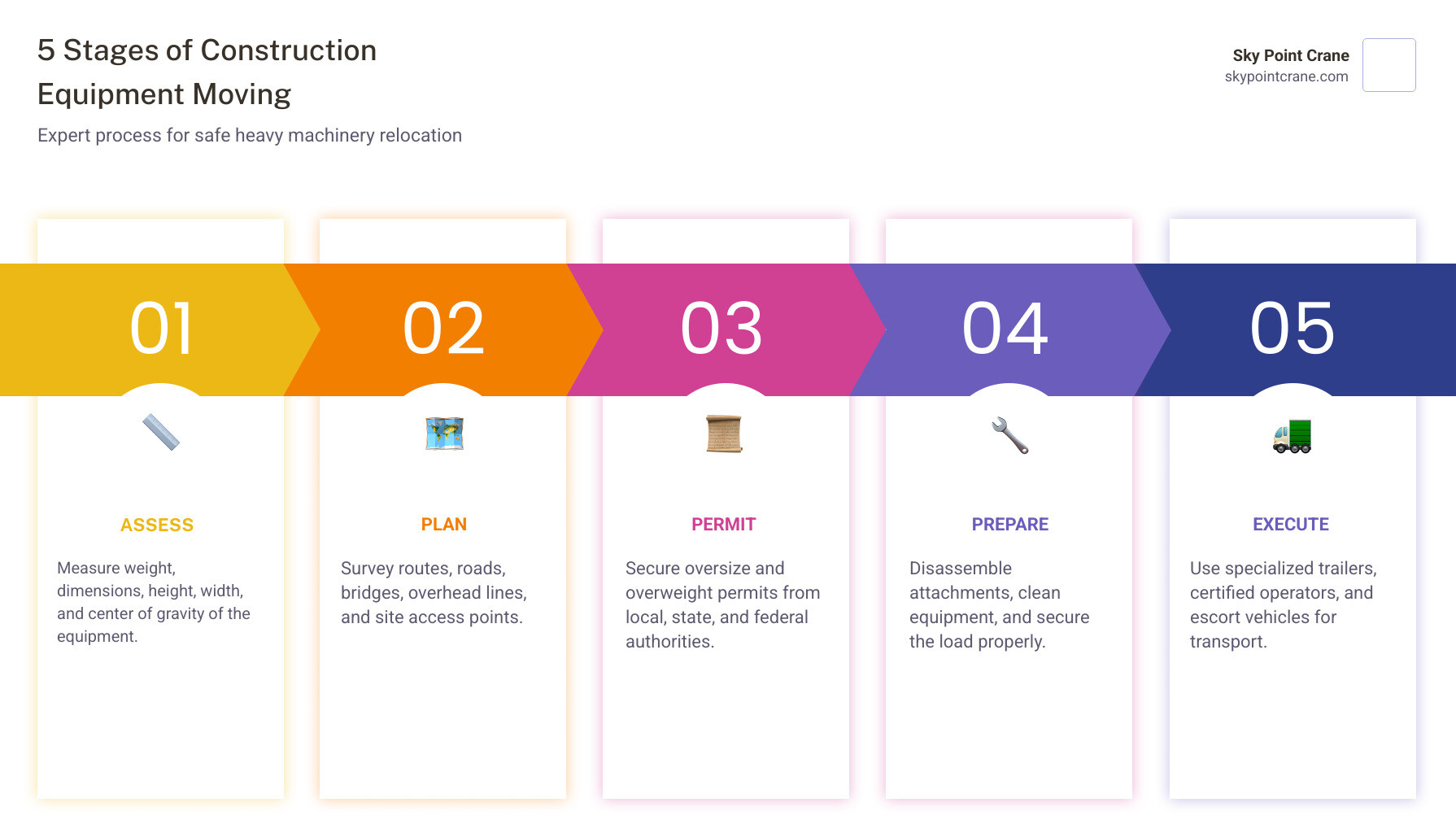
- Assess the equipment – Measure weight, height, width, and center of gravity
- Plan the route – Survey roads, bridges, overhead lines, and site access points
- Get permits – Secure oversize/overweight permits from local, state, and federal authorities
- Prepare the machine – Disassemble attachments, clean, and properly secure the load
- Execute the move – Use specialized trailers, certified operators, and escort vehicles
- Reassemble and test – Inspect, reassemble, and verify full function on-site
Moving heavy construction equipment is one of the most complex logistics challenges in the industry. A single mistake — a missed permit, an unsecured load, or a poorly planned route — can mean costly delays, regulatory violations, or worse, serious injury.
Consider this: moving a 90,000-pound bulldozer across rural terrain requires an entirely different strategy than relocating a large crane to an urban high-rise project. The variables are enormous. Weight distribution, ground bearing pressure, low-clearance bridges, overhead utility lines, and tight site access all add layers of difficulty that demand careful, expert planning.
This guide is designed to walk you through every stage of the process — from initial assessment to final delivery — so you can make confident, informed decisions on your next equipment relocation.
I’m Dave Brocious, and with over 30 years of experience in strategy, operations, and heavy equipment services at Sky Point Crane, I’ve seen how the right approach to construction equipment moving can make or break a project timeline. My goal here is to give you a practical, no-fluff resource you can actually use.
Relevant articles related to Construction equipment moving:
Understanding the Challenges of Construction Equipment Moving
When we talk about Construction equipment moving, we aren’t just talking about driving a truck from point A to point B. We are talking about navigating a high-stakes logistical puzzle. Whether we are operating in the bustling streets of Pittsburgh or the rugged terrains of West Virginia, the challenges remain formidable.

One of the primary hurdles is weight distribution. Heavy machinery isn’t just heavy; it’s often “unbalanced” heavy. If the weight isn’t distributed correctly across the trailer axles, you risk structural failure of the transport vehicle or, worse, a catastrophic tip-over. This ties directly into the center of gravity. Riggers must calculate exactly where that balance point lies to prevent the load from swinging during a lift or shifting during transit.
Then there’s the matter of oversized dimensions. Many machines exceed the standard width of 8 feet 6 inches or the standard height of 13 feet 6 inches. This means we have to worry about infrastructure obstructions like low-hanging power lines, narrow bridge trusses, and even the turning radii of city intersections.
Site accessibility and terrain analysis are equally critical. We’ve all seen sites where the ground looks solid but is actually soft clay or loose fill. We have to calculate the ground bearing pressure to ensure the surface can support both the machinery and the transport vehicle without sinking. In our service areas across PA, OH, WV, and MD, we often deal with steep inclines and winding roads that require specialized braking and traction strategies.
Assessing Weight and Dimensions
A successful move starts with a tape measure and a scale. We cannot guess when it comes to load assessment. Knowing the exact operating weight—for instance, a Cat 988 wheel loader clocks in at approximately 112,574 lbs—is the difference between choosing a standard lowboy and needing a multi-axle heavy-haul configuration.
We also have to look at axle weight. State DOTs in Maryland or Ohio have strict limits on how much weight each individual axle can apply to the pavement. If we exceed these, we face heavy fines and potential damage to the road.
| Equipment Type | Avg. Weight (lbs) | Transport Challenge | Key Requirement |
|---|---|---|---|
| Excavator | 50,000 – 100,000+ | High center of gravity | Boom/Bucket removal |
| Bulldozer | 40,000 – 90,000+ | Extreme width (blade) | Blade disassembly |
| Wheel Loader | 30,000 – 110,000+ | Articulated steering | Locking frame pins |
Strategic Planning and 3D Lift Modeling
In Construction equipment moving, “winging it” is not an option. We utilize a comprehensive Crane Project Management approach to ensure every detail is covered before the first chain is tightened. This begins with a route survey to identify physical hazards like narrow rural roads or weight-restricted bridges.
To take the guesswork out of the equation, we employ advanced technology. Our 3D Lift Planning Ultimate Guide explains how we simulate the entire move in a digital environment. This allows us to visualize clearances, calculate capacities, and identify potential risks before we even arrive on-site. It’s about risk identification—knowing that a specific utility line needs to be raised or that a project timeline needs to shift due to forecasted high winds.
Utility coordination is often the most time-consuming part of the planning phase. If a machine is too tall, we may need to coordinate with local power companies in Central Pennsylvania to temporarily lift lines. This requires seamless communication and strict adherence to schedules to minimize service disruptions for the community.
Specialized Tools for Construction Equipment Moving
When a machine is too massive for a standard trailer or needs to be moved within a confined indoor space, we break out the “big guns.”
- Hydraulic Gantries: These are lifesavers for indoor machinery moving where overhead space is limited. An Enerpac Hydraulic Gantry provides a stable, high-capacity lifting solution that can move heavy components with surgical precision.
- Self-Propelled Modular Transporters (SPMTs): For truly gargantuan loads—like bridge sections or massive industrial boilers—a Self-propelled modular transporter is the gold standard. These computer-controlled platforms have dozens of wheels that can rotate 360 degrees, allowing us to maneuver building-sized objects through tight spaces at speeds under 1 mph.
- Rigging Hardware: We use a variety of specialized slings, shackles, and spreaders. Every piece of hardware must be inspected and rated for the specific load.
- Jacks and Rollers: For horizontal movement across a factory floor, heavy-duty machinery rollers and hydraulic jacks allow us to glide multi-ton machines into position with minimal friction.
Navigating Permits and Regulatory Compliance
Permits are often the most overlooked aspect of Construction equipment moving, yet they are the most likely to cause legal and financial headaches. If your load is wider than 8’6″, taller than 13’6″, or heavier than 80,000 lbs (combined vehicle and load), you are in “permit territory.”
Each state we serve—Pennsylvania, Ohio, West Virginia, and Maryland—has its own unique DOT regulations and state-specific mandates. For example, some states may allow travel only during daylight hours, while others might restrict oversized loads during rush hour or on holiday weekends.
Pilot cars and police escorts are often required for “superloads.” These escort vehicles serve as our eyes and ears on the road, alerting the driver to upcoming hazards and helping to manage traffic flow around the oversized machinery.
Required Permit Documentation Includes:
- Exact dimensions (length, width, height)
- Total gross weight and individual axle weights
- Proposed route from origin to destination
- Proof of specialized insurance coverage
- Vehicle registration and VINs for the tractor and trailer
Equipment Preparation and Securement
Before a machine hits the road, it needs to be “shipped-prepped.” This often involves disassembly. Removing buckets, booms, counterweights, or blades can reduce the load’s dimensions enough to avoid “superload” status, saving time and money on permits.
We also perform thorough overhauls of the securement points. This isn’t just about throwing a few chains over the tracks. We follow strict tie-down protocols using high-test chains and chain binders. To protect the machine’s finish and the integrity of the straps, we use edge protectors to prevent metal-on-metal friction.
Cleaning and decontamination is another critical step, especially when moving equipment across state lines. In many regions, it is a legal requirement to remove soil and debris to prevent the spread of invasive species or pests. It’s a small step that prevents massive environmental (and legal) headaches down the road.
Safety Protocols and Professional Execution
Safety isn’t a “priority”—it’s the foundation of everything we do. In Construction equipment moving, there is zero margin for error. We utilize standardized communication systems, including high-quality radios and universal hand signals, to ensure the operator and riggers are always in sync.
A key part of our safety strategy is NCCCO certification. Every one of our operators is highly trained and certified to handle the specific complexities of heavy lifting. Furthermore, we emphasize The Importance of Certified Riggers in Today’s Construction Industry. A certified rigger understands the physics of the load, the limitations of the hardware, and the necessity of exclusion zones to keep non-essential personnel away from the “danger circle.”
PPE Requirements for the Move Team:
- Hard hats and high-visibility safety vests
- Steel-toed boots with metatarsal guards
- Gloves and eye protection
- Fall protection harnesses when working on top of large machinery
Future Trends in Construction Equipment Moving
The industry is changing rapidly, and we are staying ahead of the curve. One of the most exciting shifts is the rise of electric excavators. These machines, like the 26-ton models being unveiled by major manufacturers, present new challenges for transport—specifically regarding battery logistics and the weight of the massive battery packs.
We are also watching Volvo electric testing in California closely. As more electric and autonomous machinery enters the fleet, our transport methods will evolve. Remote-controlled transport units and advanced sensors will allow for even more precise movement of “smart” equipment. While the “muscle” of the move remains the same, the “brain” behind it is becoming more digital every day.
Frequently Asked Questions about Heavy Equipment Relocation
What permits are required for oversized construction loads?
Generally, any load exceeding 8’6″ in width, 13’6″ in height, or a total gross weight of 80,000 lbs requires an oversized/overweight permit. Requirements vary by state (PA, OH, WV, MD), and “superloads” may require additional engineering studies and police escorts.
When is it necessary to disassemble machinery for transport?
Disassembly is necessary if the machine’s dimensions exceed the physical limits of the route (like a bridge height) or if breaking the machine down into smaller loads is more cost-effective than paying for superload permits and escorts. Common items removed include excavator buckets, booms, and dozer blades.
How do you calculate the center of gravity for a complex lift?
We use the manufacturer’s specifications as a baseline, but we also account for added attachments or fuel levels. For complex moves, we utilize 3D Lift Planning software to pinpoint the center of gravity, ensuring the load remains perfectly balanced during lifting and transport.
Conclusion
At the end of the day, Construction equipment moving is about more than just heavy metal—it’s about trust and precision. Every move involves a complex dance of engineering, legal compliance, and physical labor. By treating every relocation as a critical project in itself, we mitigate risk and ensure your equipment arrives ready to work.
From our 24/7 service availability to our NCCCO-certified operators and advanced 3D planning, Sky Point Crane is dedicated to providing the highest level of safety and efficiency in Western and Central Pennsylvania, Ohio, West Virginia, and Maryland. When you need expert Machinery Moving Services or professional rigging, we are here to handle the heavy lifting.
Don’t leave your high-value assets to chance. Partner with a team that understands the “Heavyweight Champion” approach to equipment relocation. Give us a call today to discuss your next move.