
Everything You Need to Know About Utility Bucket Truck Rentals
What to Know Before Renting a Utility Bucket Truck
A utility bucket truck rental gives crews safe, reliable access to overhead work — whether that’s power lines, telecom equipment, or tree trimming — without the cost of owning the equipment outright.
Here’s a quick overview of what you need to know:
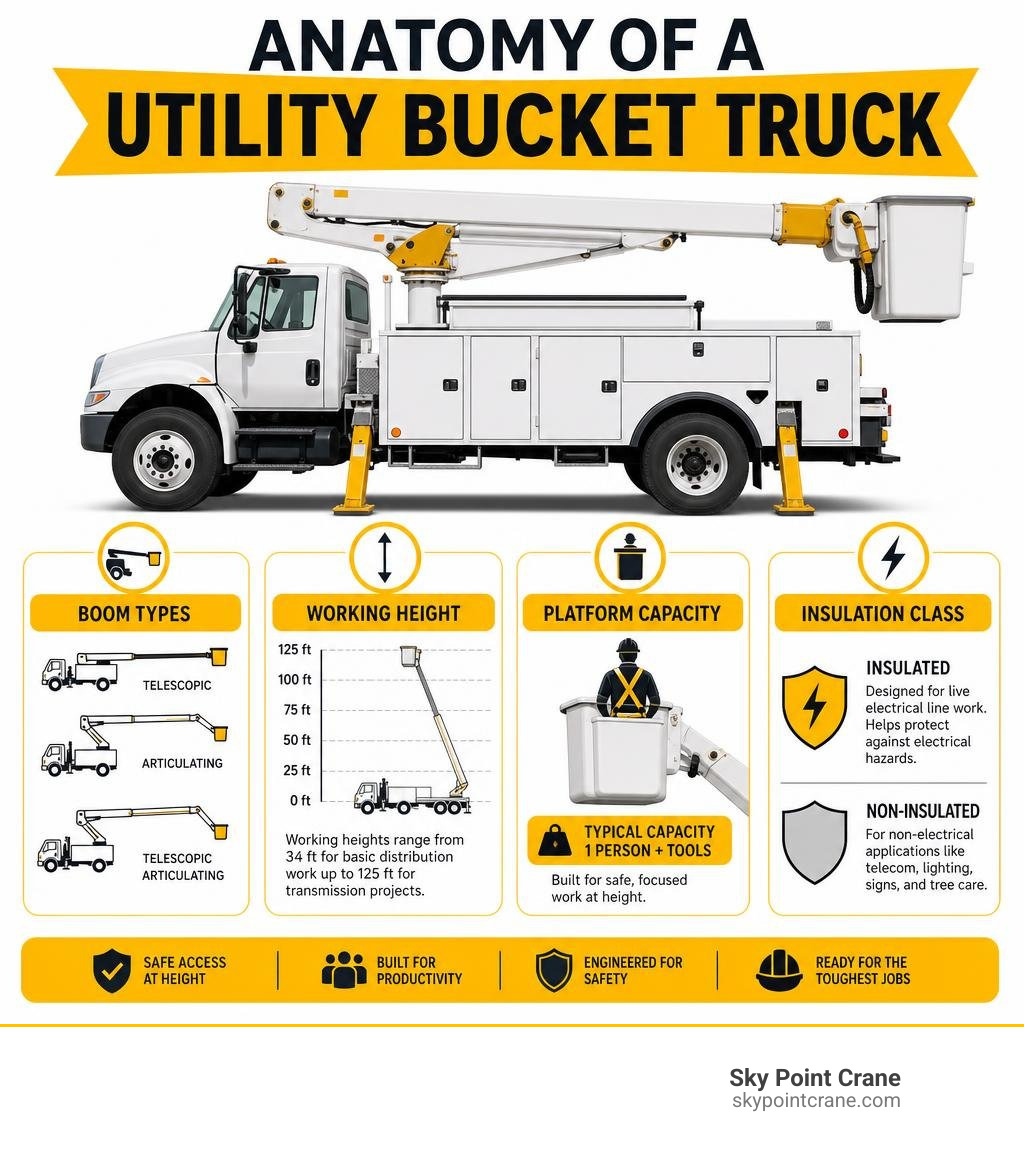
- Working heights range from 34 feet for basic distribution work up to 125 feet for transmission projects
- Rental terms are typically daily, weekly, or monthly — with rates like $340–$380/day for mid-range units
- Insulated trucks are required for live electrical line work; non-insulated units work for telecom, signs, and municipal tasks
- CDL requirements depend on the truck’s GVWR — heavier units often require a Class A or B CDL
- Insurance is required before most rental companies will release a truck — usually $1,000,000+ in commercial liability coverage
- Support from reputable rental providers includes 24/7 technical assistance and field service dispatch if something breaks down
Bucket trucks go by several names — cherry pickers, aerial lifts, boom trucks, and line trucks — but they all do the same core job: get a worker safely off the ground and into position.
I’m Dave Brocious, and with over 30 years of experience in energy, equipment, and business operations, I’ve worked closely with the teams and industries that depend on utility bucket truck rental to keep critical infrastructure running. In the sections below, I’ll walk you through everything — from choosing the right truck type to understanding costs, licensing, and safety requirements — so you can make a confident rental decision.
Utility bucket truck rental terms you need:
Key Types and Specifications of Utility Bucket Trucks

When looking for a utility bucket truck rental, the first step is matching the boom type and insulation level to your specific job site requirements. Navigating these specifications ensures you don’t end up with a truck that is either unsafe for the work or unable to maneuver around obstacles.
Insulated vs. Non-Insulated Booms
The distinction between insulated and non-insulated booms is the single most critical safety factor.
- Insulated Booms: These units feature a fiberglass boom section that prevents electricity from traveling down the boom to the truck chassis, protecting both the operator in the bucket and ground personnel. They are mandatory for power line maintenance and any work near energized lines. Many modern insulated rentals feature advanced safety setups like the TruGuard dielectric isolating system.
- Non-Insulated Booms: Built entirely of steel or aluminum, these booms offer zero electrical protection. They are lighter and highly efficient, making them perfect for telecom, sign painting, and municipal tasks where live electrical lines are not a concern.
Boom Configurations: Telescopic, Articulating, and Overcenter
How the boom moves determines how easily your crew can access difficult work areas:
- Telescopic Booms: These extend straight out like a telescope. They are excellent for projects requiring straightforward vertical or horizontal reach with minimal obstructions.
- Articulating Booms: Featuring multiple hinged sections, articulating booms let operators bend “up and over” obstacles like tree branches, building overhangs, or tightly spaced utility poles.
- Overcenter Booms: These specialized articulating booms can travel past the vertical centerline of the truck. This design provides exceptional horizontal side reach close to the ground, which is highly valued in forestry and distribution work.
Choosing the right combination of these features will directly impact your crew’s efficiency. For instance, a 42′ Bucket Truck Rental Options package utilizing an articulating-telescopic design provides the ultimate balance of maneuverability and horizontal reach.
| Feature / Type | Insulated Booms | Non-Insulated Booms | Articulating Booms | Telescopic Booms |
|---|---|---|---|---|
| Primary Material | Fiberglass sections | Steel / Aluminum | Steel & Fiberglass | Steel |
| Electrical Protection | Yes (Dielectric rated) | No | Varies (Insulated options available) | Varies (Insulated options available) |
| Maneuverability | Standard | High | High (Up-and-over access) | Straight-line extension |
| Best Used For | Live-line utility, transformers | Signs, telecom, municipal | Tree trimming, congested areas | Long-reach, open-space tasks |
Understanding Working Heights in Utility Bucket Truck Rental
“Working height” is generally calculated by taking the platform height (the floor of the bucket) and adding 6 feet to account for the operator’s reach.
For standard neighborhood distribution lines, telecom routing, and light municipal tasks, rentals ranging from 34 to 45 feet are the industry standard. Units like those found in 40′ Bucket Truck Rental Options are incredibly popular because they fit on Class 5 or 6 chassis (such as the Ford F-550 or Ram 5500), which are easy to park on residential streets.
When you transition to heavy-duty distribution or forestry work, working heights typically jump to 50 to 75 feet. For high-voltage electrical transmission line work, specialized utility fleets utilize massive bucket trucks reaching up to 125 feet to safely access towers and high-tension wires.
Platform Capacities and Material Handling Features
The bucket itself is more than just a standing platform; it is a mobile workstation. Standard platform capacities generally range from 350 lbs (perfect for a single worker and basic hand tools) to 600 lbs (designed for two workers or heavy equipment).
If your project involves lifting heavy hardware like transformers, crossarms, or heavy telecom spools, you should look for Insulated & Material Handling Bucket Truck Rentals. These trucks feature a built-in material-handling jib and a hydraulic winch at the top of the boom. This allows the operator to lift up to 1,000 to 2,000 lbs of equipment directly from the bucket, eliminating the need for a separate crane on site. Additionally, integrated hydraulic tool circuits at the bucket allow workers to plug in hydraulic impact wrenches, saws, or pruners directly to the truck’s central power system.
Core Industries and Applications for Utility Bucket Truck Rental

Whether performing scheduled upgrades or responding to storm damage, a wide range of industries rely on bucket trucks to keep our modern world connected, powered, and cleared.
Electrical Utility and Telecom Infrastructure Work
Power companies and electrical contractors are the primary users of insulated bucket trucks. Linemen rely on these vehicles to perform transformer services, swap out pole hardware, and maintain distribution lines.
The telecommunications sector is another massive user. Telecom crews utilize bucket trucks to run fiber-optic cables, service telephone lines, and install 5G small-cell receivers. Because telecom lines sit lower on the poles than high-voltage power lines, non-insulated units or specialized cable-placing bucket trucks are frequently rented for these tasks. If your project involves pulling overhead lines, choosing a Truck with Lift Bucket Rental that is configured specifically for line stringing can save countless hours of labor.
For crews looking to supplement their existing fleet during peak seasons, renting a Boom Lift Bucket Truck Rental or a highly mobile Boom Lift Bucket Van Rental ensures that overhead telecom lines can be serviced quickly without blocking entire traffic lanes.
Forestry, Signage, and Municipal Applications
Beyond utilities, aerial trucks are essential tools for maintaining public spaces:
- Forestry and Tree Care: Tree trimming around power lines is a constant necessity. Forestry crews use heavy-duty bucket trucks equipped with robust dump bodies (chip trucks) to trim limbs and collect wood chips in a single, streamlined operation.
- Sign and Lighting Maintenance: Billboard installations, commercial sign repairs, and parking lot light replacements require stable, non-insulated aerial platforms that can quickly move from one location to the next.
- Municipal Work: Local governments use bucket trucks for maintaining streetlights, servicing traffic signals, putting up holiday decorations, and conducting bridge or building inspections.
For massive municipal or commercial projects, choosing Heavy Duty Bucket Truck Options for Massive Projects ensures your crew has the stability, height, and platform capacity to handle large-scale installations safely.
Rental Costs, Terms, and Safety Requirements
Understanding the financial and regulatory aspects of a utility bucket truck rental is just as important as selecting the right physical truck.
Rental Rates and Duration
Rental pricing is highly dependent on the size of the truck, its insulation class, and the rental duration. Generally, renting for a longer term reduces your average daily rate.
Mid-range bucket trucks (40 to 55 feet working height) typically follow a structured pricing model:
- Daily Rate: ~$340 to $380 per day
- Weekly Rate: ~$1,360 to $1,520 per week
- Monthly Rate: ~$4,080 to $4,560 per month
For specialized units, such as 4×4 digger derricks or massive 125-foot transmission trucks, expect rates to adjust upward. It is also important to factor in mobilization costs. Delivery fees can average around $5.00 per mile outside of the rental company’s immediate local area, so finding a provider with regional hubs nearby is key to keeping costs down. For a complete breakdown of what goes into these rates, check out our guide on The Price of Reaching the Sky in a Rental Bucket.
How to Choose the Right Utility Bucket Truck Rental
To ensure you get the best value, ask yourself these structural questions before signing a rental agreement:
- What is the maximum height and side reach required? Don’t just look at vertical reach; horizontal side reach is crucial if you cannot park directly beneath the work area.
- Is there a risk of electrical contact? If yes, always rent an insulated unit.
- What are the terrain conditions? If you are working on roadside rights-of-way or muddy construction sites, a 4WD chassis is highly recommended.
- Are there fuel surcharges or environmental fees? Always review the fine print of your rental contract to avoid unexpected charges.
For a comprehensive step-by-step walkthrough, refer to our Bucket Truck Rentals Complete Guide.
Licensing, CDL, and Insurance Requirements
A common point of confusion is whether an operator needs a Commercial Driver’s License (CDL) to drive a rented bucket truck. This is determined entirely by the truck’s Gross Vehicle Weight Rating (GVWR):
- Under 26,000 lbs GVWR (Non-CDL): Many 34 to 40-foot bucket trucks built on Class 5 chassis (like the Ford F-550) have a GVWR under 26,000 lbs. Anyone with a standard driver’s license can legally drive these units.
- Over 26,000 lbs GVWR (CDL Required): Larger bucket trucks (50+ feet) and material handlers are built on medium-duty or heavy-duty chassis that exceed 26,000 lbs. Driving these units requires a Class A or Class B CDL.
Regardless of CDL status, operators must be trained and certified to operate the aerial lift itself under OSHA and ANSI standards.
Additionally, rental companies require proof of comprehensive insurance before the truck leaves the yard. Standard minimums typically include:
- General Liability: $2,000,000
- Commercial Auto Liability: $1,000,000
- Physical Damage Coverage: To cover the replacement value of the truck. If your current policy doesn’t meet these limits, an umbrella policy can often be purchased to satisfy the requirements.
Frequently Asked Questions About Utility Bucket Truck Rentals
What is the difference between insulated and non-insulated bucket trucks?
Insulated bucket trucks feature a boom made of non-conductive materials (fiberglass) and specialized dielectric isolating systems to prevent electrical currents from traveling down the boom. These are required by OSHA for any work near energized power lines. Non-insulated trucks have all-metal booms and offer zero electrical protection, making them suitable only for non-energized environments like telecom, signage, and tree trimming away from power lines.
How are maintenance and breakdowns handled during a rental?
When renting from a professional provider, the rental company is responsible for major mechanical maintenance and structural inspections. If you encounter a technical problem on site, reputable companies offer 24/7 phone support with experienced technicians. If the issue cannot be resolved over the phone, they will dispatch a field service technician to your site or provide a replacement unit to minimize your project’s downtime.
Do I need a CDL to operate a rented bucket truck?
Only if the vehicle’s Gross Vehicle Weight Rating (GVWR) is 26,001 pounds or more. Many compact and mid-sized bucket trucks (up to 40-foot working heights) are built on non-CDL chassis. However, larger utility trucks and material handlers will require a Class B or Class Class A CDL. Additionally, all operators must be at least 18 (often 21 for commercial rentals) and be certified in aerial lift safety.
Conclusion
Renting a utility bucket truck is a highly cost-effective way to scale your fleet, tackle specialized projects, and ensure your crew can work safely at heights. By understanding your height requirements, insulation needs, weight limits, and insurance obligations, you can select the perfect truck for your next job.
At Sky Point Crane, we specialize in providing comprehensive lifting and aerial solutions across Western and Central Pennsylvania, Ohio, West Virginia, and Maryland. While we are known for our premier crane services, NCCCO-certified operators, and detailed 3D Lift Planning, we understand what it takes to execute complex overhead work safely and efficiently.
If you are planning your next project and need expert rigging, specialized lifting, or project management support, contact our team today to keep your job site moving upward safely.