
What’s Your Type? A Deep Dive into Mobile Crane Varieties
What Are the Different Mobile Cranes Types?
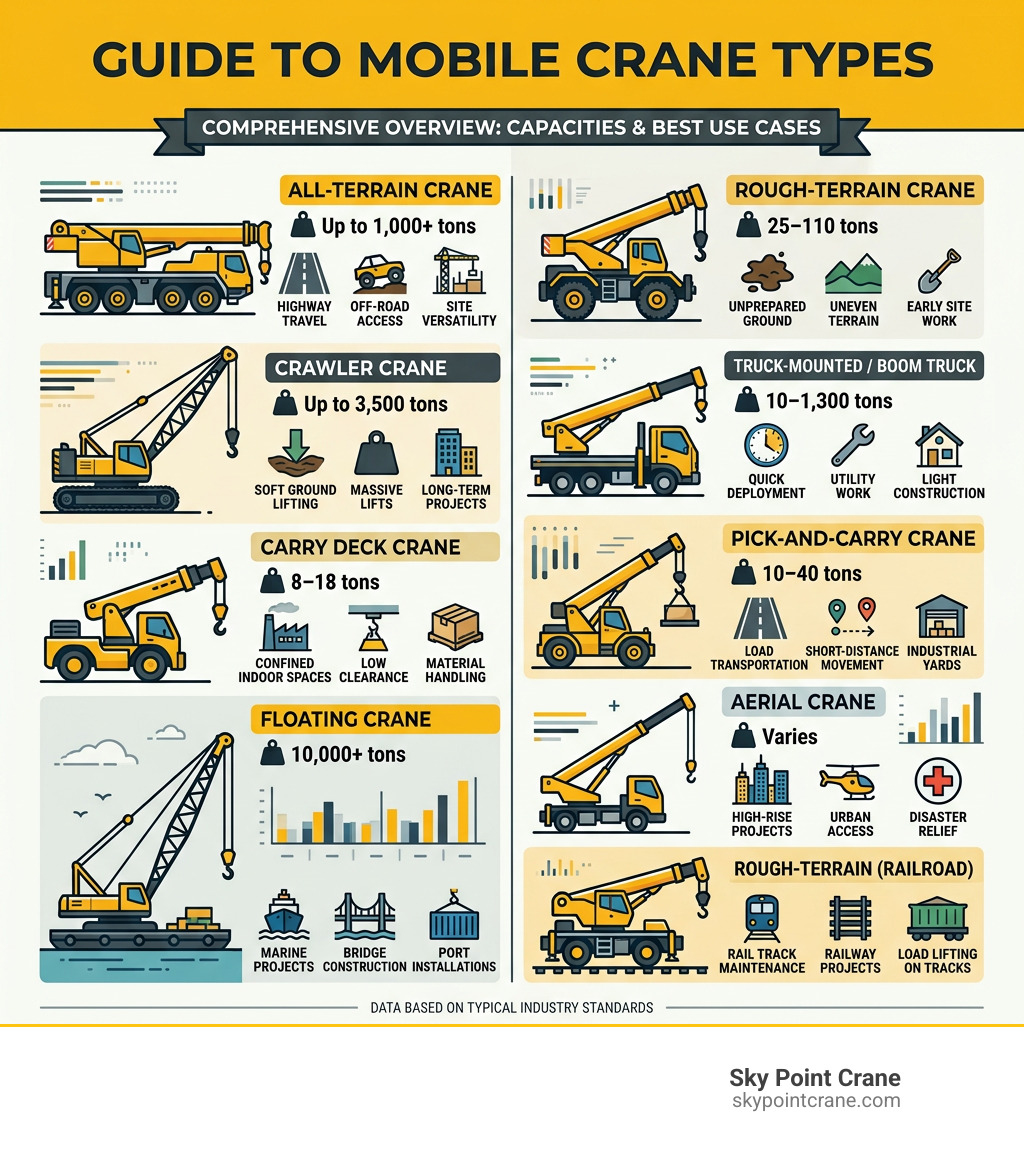
Mobile cranes types include a wide range of lifting machines designed to move between job sites with minimal setup. Here is a quick overview of the main types:
| Mobile Crane Type | Typical Capacity | Best For |
|---|---|---|
| All-Terrain Crane | Up to 1,000+ tons | Road travel + off-road sites |
| Rough-Terrain Crane | 25–110 tons | Unprepared, uneven ground |
| Crawler Crane | Up to 3,500 tons | Soft ground, heavy lifts |
| Truck-Mounted / Boom Truck | 10–1,300 tons | Quick deployment, utility work |
| Carry Deck Crane | 8–18 tons | Confined indoor spaces |
| Pick-and-Carry Crane | 10–40 tons | Short-distance load transport |
| Floating Crane | 10,000+ tons | Marine, bridge, port projects |
| Aerial Crane | Varies | High-rises, disaster relief |
| Rough-Terrain (Railroad) | Varies | Rail track maintenance |
Unlike tower cranes or fixed overhead cranes, mobile cranes are mounted on wheeled or tracked carriers. They drive — or are driven — directly to the job site. Most are ready to lift within hours, not days.
That flexibility is what makes them indispensable on construction sites across every industry, from bridge building to nuclear power plant installations. In fact, in December 2023, a Liebherr crawler crane lifted a 281-tonne dome 62 meters into the air for a nuclear power plant — a feat only possible with the right type of mobile crane.
But with so many varieties available, picking the wrong one is a costly mistake. This guide breaks down every major type so you can make a confident decision.
I’m Dave Brocious, and with over 30 years of experience in strategy, business development, and heavy equipment solutions, I’ve worked closely with the equipment and teams that make complex lifts happen across all mobile cranes types. As the voice behind Sky Point Crane, I’ll walk you through everything you need to know to match the right crane to your project.
Defining the Mobile Crane: Mobility vs. Static Power
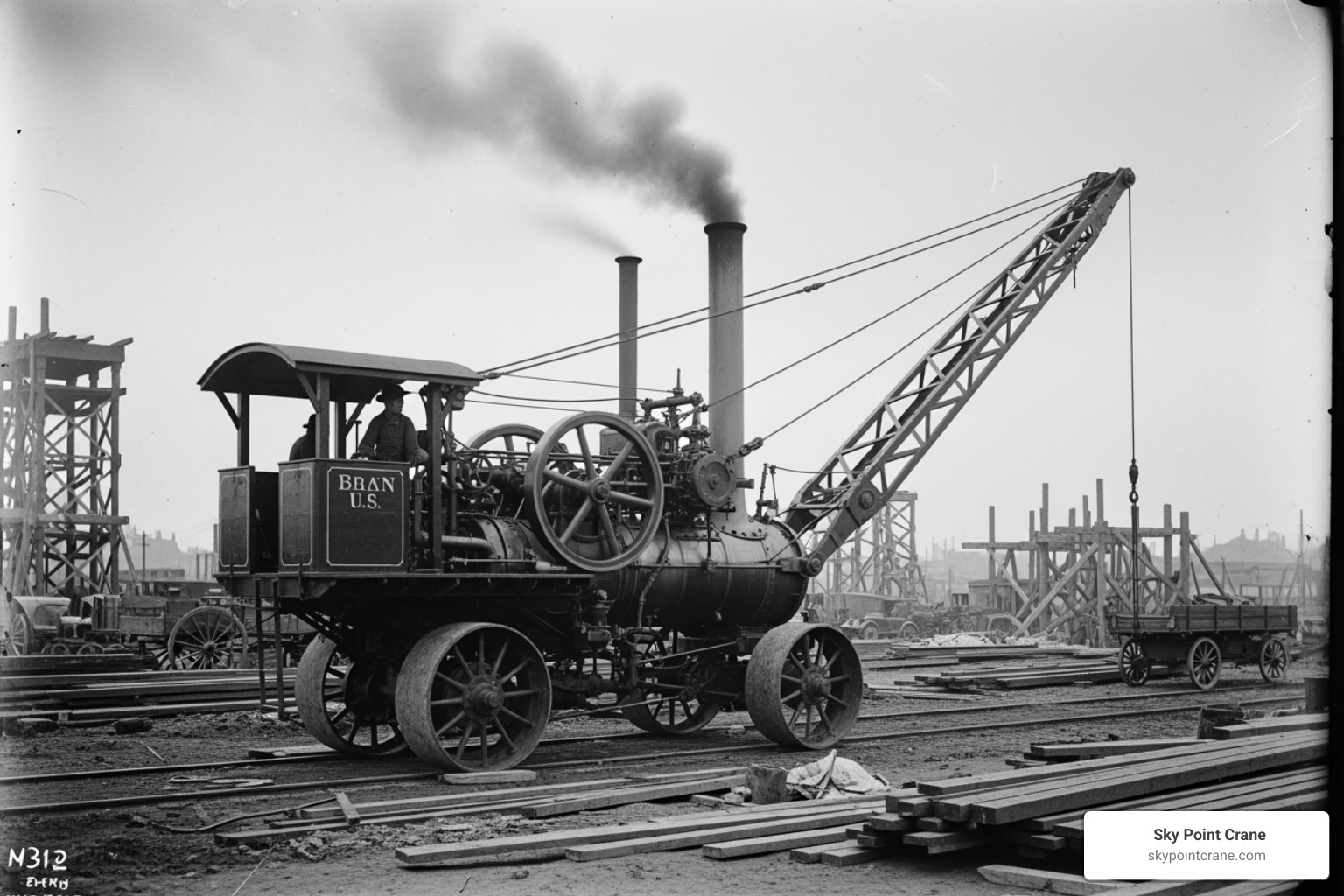
To understand why we use mobile cranes types today, we have to look at where they came from. Before the late 1800s, cranes were largely fixed structures. If you wanted to lift something, you brought the object to the crane. Between 1867 and 1873, early steam-powered demos by the Appleby Brothers began to change the narrative, showing that lifting power could actually be brought to the work.
The real “aha!” moment for the industry happened in 1947 when a ski manufacturer named Eric Sundin founded Hydrauliska Industri AB (Hiab). He used truck hydraulics to create the world’s first hydraulic truck-mounted crane. This revolutionized the prime movers of the industry. We moved away from cumbersome steam engines and toward internal combustion engines and sophisticated hydraulic systems.
Before 1960, if you needed more height, you had to manually add boom sections—a process that was both expensive and time-consuming. The introduction of the telescopic boom changed everything. Modern mobile crane mechanics now rely on these hydraulic telescoping arms or high-strength lattice structures, controlled by intricate pulley and cable systems.
The core difference between a mobile crane and a static crane (like a tower crane) is the “ready-to-go” factor. A static crane is a long-term commitment; it’s bolted to a concrete pad. A mobile crane is a “temporary superstar”—it arrives, stabilizes itself using outriggers, completes the lift, and moves on to the next job.
The Core Mobile Cranes Types and Their Applications
When we talk about the heavy hitters in our fleet at Sky Point Crane, we usually categorize them by how they move and what they can carry. Choosing between mobile cranes types requires looking at three things: capacity, terrain, and how you’re going to get it to the site.
All-Terrain Cranes
The all-terrain crane is the “Swiss Army Knife” of the lifting world. These machines feature a multi-axle chassis designed to travel at highway speeds (up to 50+ mph) while maintaining incredible off-road maneuverability. They utilize all-wheel steering, which allows them to navigate tight turns on narrow job sites in places like Pittsburgh or the mountainous regions of West Virginia.
With capacities reaching over 1,000 tons—such as the massive Demag AC1000—these cranes are the go-to for bridge construction and large-scale industrial installs. If you need a machine that can drive itself from our yard to your site and then immediately handle a 500-ton lift, this is your best bet. Learn more about our all-terrain mobile crane services to see how they fit your project.
Rough-Terrain Cranes
If your job site looks more like a muddy field than a paved parking lot, you need a rough-terrain crane. These are mounted on a two-axle chassis with four oversized rubber tires. They feature four-wheel drive and four-wheel steering, allowing them to “crab steer” through tight, unprepared sites.
The trade-off? They aren’t road-legal. You’ll need to haul them to the site on a trailer. Once there, however, they are unmatched in stability. They use H-pattern outriggers to level themselves on uneven ground. Some models even offer “pick-and-carry” capabilities, meaning they can travel short distances while holding a load. Check out our rough-terrain crane specifications for more details on these off-road beasts.
Crawler Cranes
When the weight gets truly astronomical, we call in the crawlers. Instead of tires, these cranes move on caterpillar tracks. This design distributes the machine’s weight over a massive surface area, preventing it from sinking into soft or marshy soil.
Crawler cranes typically use a lattice boom—a steel framework that is incredibly strong but lightweight. These machines can lift up to 3,500 tons and are frequently used for massive infrastructure projects, like installing reactor building domes at nuclear plants. Because they are so large, they arrive in sections on multiple trucks and are assembled on-site. For a deeper look at these heavy lifters, see our lattice boom truck crane guide.
Truck-Mounted and Boom Trucks
For utility work, HVAC installs, and quick day-jobs, truck-mounted cranes and boom trucks are the most efficient mobile cranes types. These are essentially hydraulic cranes mounted on a standard commercial truck chassis.
They can travel at normal highway speeds without special permits in many cases, making them the fastest to deploy. We offer various configurations, including the National boom truck crane models known for their reliability. Whether you need a telescopic boom truck crane for reach or a standard boom truck crane for hauling materials, these units offer the ultimate in “grab and go” convenience.
Specialized Mobile Cranes Types for Unique Environments
Sometimes the “standard” options are just too big. When you’re working inside a factory or under a bridge, you need specialized mobile cranes types.
Carry Deck and Pick-and-Carry Cranes
The carry deck crane is a small, four-wheeled marvel with a 360-degree rotating boom. Its standout feature is the flat deck around the operator’s cab, allowing it to pick up a load, set it on itself, and drive it through a tight warehouse or alleyway.
Capacities generally range from 8 to 18 tons, though some pick-and-carry models can handle up to 40 tons. They are the workhorses of industrial maintenance. If you’re moving heavy machinery through a narrow access hall, the carry deck crane applications are exactly what you should be looking at.
Marine and Aerial Varieties
For projects where the ground is actually water, we look to floating cranes. These are mounted on pontoons or specialized barges and are essential for bridge construction and salvaging sunken vessels. Some of these giants can lift entire bridge sections weighing over 10,000 tons.
On the flip side, when the site is completely inaccessible by road or water—think high-rise rooftops or remote disaster relief areas—aerial cranes (or “sky cranes”) take over. These are heavy-lift helicopters outfitted with longline cables. While rare, they are the only solution for placing equipment on skyscrapers where no ground-based crane can reach. You can find more mobile crane news and research regarding these specialized lifts through our industry resources.
Selecting the Right Mobile Crane for Your Project
Choosing from the various mobile cranes types isn’t just about picking the biggest one. It’s a science. At Sky Point Crane, we use 3D Lift Planning to ensure the machine matches the mission.
Here are the factors we help you evaluate:
- Load Capacity: How heavy is the heaviest item? You never want to operate at 100% of the crane’s rated capacity.
- Lift Height and Radius: How high does it need to go, and how far away from the crane’s center will the load be?
- Site Accessibility: Can the crane physically fit through the gates? Is there room for the outriggers to fully extend?
- Ground Conditions: Is the soil compacted? Will we need timber mats to distribute the weight?
- Transportation: Do we need “Wide Load” permits? How many support trucks are required for the counterweights?
For projects requiring specialized movement, we might suggest a knuckle boom truck crane for its ability to “fold” like a finger, or a stand-up boom truck for better visibility during utility work.
Safety Standards and Future Trends in Lifting
Safety isn’t just a checkbox; it’s our culture. Every operator at Sky Point Crane is NCCCO certified, and we strictly follow safety and health environment protocols. This includes rigorous rigging and signal person requirements to ensure every lift is coordinated and controlled.
Looking ahead, mobile cranes types is going green. Electrification is the biggest trend for 2025. Manufacturers like Liebherr are already rolling out “Zero Emission” cranes that run on battery power or plug-in electricity, which is a game-changer for indoor industrial work or noise-sensitive urban sites.
Automation and remote operation are also on the horizon. Imagine an operator controlling a crane from a safe distance using a VR headset—it’s not science fiction; it’s the next step in making an already dangerous job significantly safer.
Frequently Asked Questions about Mobile Cranes Types
What is the most versatile of the mobile cranes types for urban use?
The All-Terrain Crane is generally considered the most versatile for urban environments. Its ability to travel at highway speeds means it can move between city sites quickly, while its multi-axle steering allows it to navigate tight city streets and alleyways that would stop a standard truck crane.
Which mobile cranes types are best for soft or marshy ground?
Crawler Cranes are the undisputed kings of soft ground. Because they use tracks instead of wheels, they spread their massive weight over a larger area, resulting in lower ground bearing pressure. This prevents the crane from sinking in mud or loose soil where a wheeled crane would get stuck.
How do I determine the capacity needed for different mobile cranes types?
Capacity is determined by a “Load Chart.” You must factor in the weight of the load, the weight of the rigging (hooks, slings, etc.), the boom length, and the radius (distance from the crane’s center). At Sky Point Crane, we handle these calculations for you using 3D Lift Planning to ensure a safe “safety margin” is maintained at all times.
Conclusion
Whether you are building a bridge in West Virginia, installing HVAC units in Pittsburgh, or managing a massive industrial project in Maryland, the success of your lift depends on choosing the right mobile cranes types.
At Sky Point Crane, we don’t just rent equipment; we provide comprehensive lifting solutions. From our 24/7 emergency services to our NCCCO certified operators and expert project management, we ensure your project stays on schedule and under budget. We proudly serve Western and Central Pennsylvania, Ohio, West Virginia, and Maryland with a fleet that can handle anything from a 3-ton mini-crane lift to a massive 500-ton all-terrain project.
Ready to get started? Contact us for comprehensive mobile crane solutions and let’s get your project off the ground—safely.